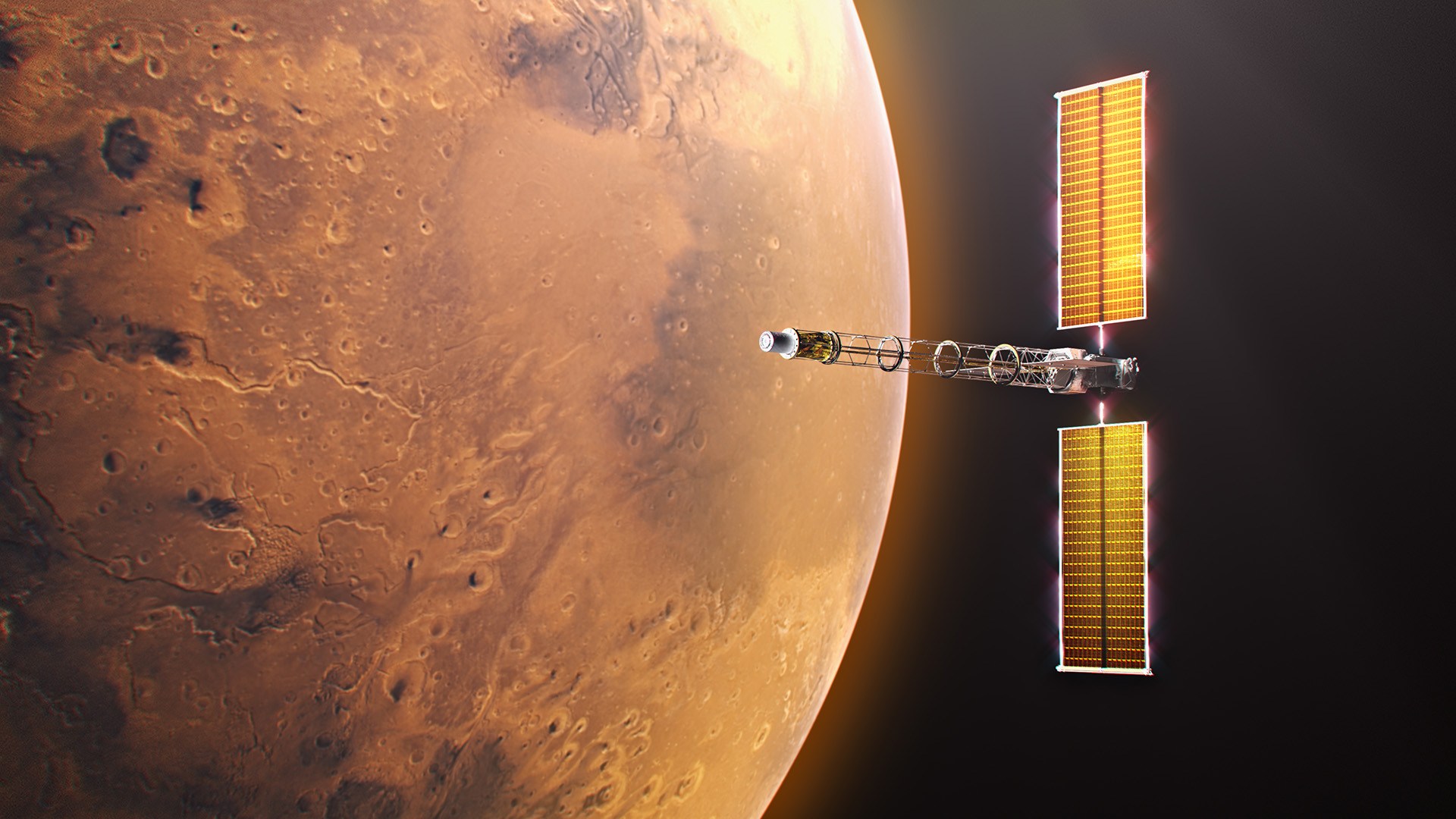
NASA’s SR-1 Freedom mission is advancing nuclear electric propulsion with new contract actions to speed work on its fission power module while adding safety oversight.
NASA is moving closer to flying what it describes as the first spacecraft powered by a fission reactor to operate beyond Earth orbit: Space Reactor-1 (SR-1) Freedom. Unveiled during the agency’s “Ignition” event, the mission is intended to prove nuclear electric propulsion in deep space—an approach that uses electricity generated onboard to drive highly efficient thrusters for long-duration travel.
Key progress is now focused on the spacecraft’s nuclear power module, the heart of the system that will generate electricity for the propulsion demonstration. NASA said it has reached mutual agreements with its industry and government partners on a set of contract actions designed to accelerate development and reduce technical risk as the project targets a late-2028 launch.
“These contract actions not only reduce technical risk and help us maintain momentum toward our 2028 launch, but they also strengthen collaboration across our partners,” SR-1 Freedom program director Steve Sinacore said in a statement. He added that the steps are meant to keep the mission on schedule while establishing a strong technical base for future nuclear-powered spaceflight.
Under the updated plan, Sierra Lobo Inc. will deliver the closed Brayton cycle power conversion system for the nuclear power module. In this design, heat produced by the fission reactor is transformed into electrical power through a closed-loop system—electricity that will then supply the spacecraft’s nuclear electric propulsion experiment.
The work will be performed through NASA’s Space Flight Systems Development and Operations Contract III, awarded in 2024. That contract supports the design, development, testing, and operational work for spaceflight hardware at NASA’s Glenn Research Center in Cleveland.
The conversion system is intended to be integrated with the fission reactor itself, which is being designed and developed by the U.S. Department of Energy’s Idaho National Laboratory. Together, these components form the nuclear power module that enables SR-1 Freedom’s propulsion demonstration.
Because the mission involves a space-based fission reactor, NASA emphasized safety measures built into the program. The agency said it is applying comprehensive safety requirements throughout the spacecraft’s development, including interagency safety reviews, ongoing oversight by a NASA chief safety officer, compliance with relevant regulations, and a structured safety design process that addresses hazards, failure tolerance, and nuclear-specific risks. NASA also noted that the reactor will not be activated until SR-1 Freedom has departed Earth orbit.
Beyond the propulsion technology test, SR-1 Freedom is slated to carry the SkyFall science mission to Mars. SkyFall consists of three Mars helicopters derived from the Ingenuity design. The rotorcraft are expected to gather scientific measurements, help assess potential exploration zones, and search for likely water sources.
NASA frames SR-1 Freedom as a stepping-stone toward broader deep-space ambitions, including next-generation fission systems that could supply dependable power for a future Moon Base during long lunar nights or in locations where sunlight is limited and solar arrays alone may fall short.
Why it matters
Nuclear electric propulsion and compact fission power could change what is practical for long-duration missions to Mars and beyond by providing steady electrical power where solar energy is constrained. The project also signals a growing NASA-DOE partnership around space nuclear technology, alongside heightened scrutiny of safety and oversight. The late-2028 launch target—and successful integration of the reactor and Brayton conversion hardware—will be key milestones to watch.