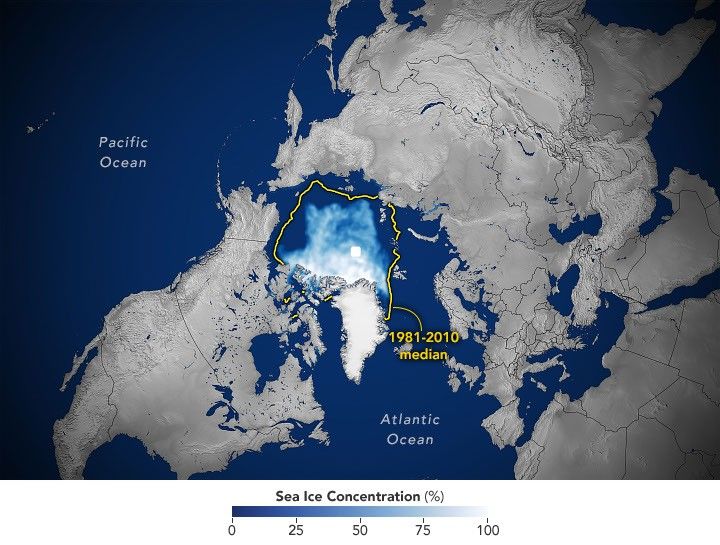
Satellite data show Arctic sea ice remains far below past norms, with shrinking winter peaks and summer lows and a shift toward thinner, younger ice.
A cap of frozen seawater forms across the Arctic Ocean each year, expanding through the long, dark winter and typically reaching its greatest area in March. As sunlight returns, the ice retreats through summer, usually bottoming out in September. That annual rise and fall is a normal rhythm that has played out for thousands of years. What has changed in the modern era is the baseline: satellite observations show that both the winter peak and the summer low now cover markedly less ocean than they did a few decades ago.
In 2026, Arctic sea ice reached its annual minimum on September 12, when it spanned about 4.6 million square kilometers (1.78 million square miles), according to NASA and the National Snow and Ice Data Center (NSIDC). That extent tied the minima recorded in 2008, 2010, and 2025 for the 10th-lowest September minimum in the satellite record.
Continuous satellite monitoring of Arctic sea ice began in late 1978, allowing scientists to track the seasonal advance and retreat year after year. Over that record, the overall trend is downward, with the decline accelerating in the 2000s and producing a sequence of record and near-record summer lows. Every summer minimum from 2007 through 2026 ranks among the 20 smallest observed since satellites began measuring sea ice. The lowest minimum occurred in September 2012.
More recently, September extents have not fallen as sharply from year to year. Scientists note that weather can strongly influence summer melt. NASA researchers have pointed to increased cloudiness over the past decade as a factor that can limit melting by reducing incoming sunlight. Even with this apparent near-term leveling, the typical summer minimum remains far below the long-term average.
The changes are not only about area. Across the Arctic, the ice that persists is increasingly young and thin. Observations show a continued reduction in multiyear ice—ice that survives at least one summer melt season—leaving a system increasingly dominated by first-year ice that is more vulnerable to warm, windy conditions.
Winter ice is also contracting. The March 2026 maximum statistically tied the March 2025 maximum as the smallest winter peak in the satellite era, highlighting that the long-term shift affects both ends of the seasonal cycle.
Researchers have long recognized that natural swings, including patterns such as the Arctic Oscillation, can push sea ice higher or lower in any given year. But scientists say the sustained decline across the full satellite record cannot be accounted for by natural variability alone. Instead, natural variability has operated alongside rising global temperatures to drive greater ice loss. Projections indicate the Arctic could become essentially ice-free at least once before the middle of the 21st century.
To calculate sea ice extent, scientists use satellites equipped with passive microwave sensors, which detect the microwave energy naturally emitted by Earth. Sea ice emits a stronger microwave signal than open water, allowing analysts to map ice cover reliably. Because microwave measurements penetrate clouds, the method provides consistent monitoring regardless of weather. The record began with NASA’s Nimbus-7 mission in 1978, continued with Defense Meteorological Satellite Program (DMSP) satellites from 1987 onward, and incorporated observations from NASA’s Aqua satellite between 2002 and 2011. Starting in 2025, researchers also began using data from Japan’s GCOM-W satellite. Satellite maps include a central “pole hole,” a region beyond the reach of some sensors; standard analyses assume that area is ice covered.
Why it matters
Arctic sea ice helps regulate climate by reflecting sunlight and shaping weather patterns, and its decline affects ecosystems and human activities across the Arctic and beyond. The shift toward thinner, first-year ice makes future summers more sensitive to short-term weather, raising the odds of abrupt low-ice years. Scientists will be watching whether the recent steadiness in September persists—or gives way to new record lows as global temperatures continue to rise.