NASA’s earliest journeys beyond Earth depended on a revolution in computing.
NASA’s earliest journeys beyond Earth depended on a revolution in computing. In the 1960s, the Apollo Guidance Computer provided the calculations that made guidance, navigation, and control possible during the agency’s first Moon missions. Since then, specialized radiation-hardened processors—built to survive intense radiation and extreme temperatures—have become a quiet workhorse of space exploration, operating for years on distant worlds and powering everything from Mars rovers to orbiters, crew capsules, and space telescopes.
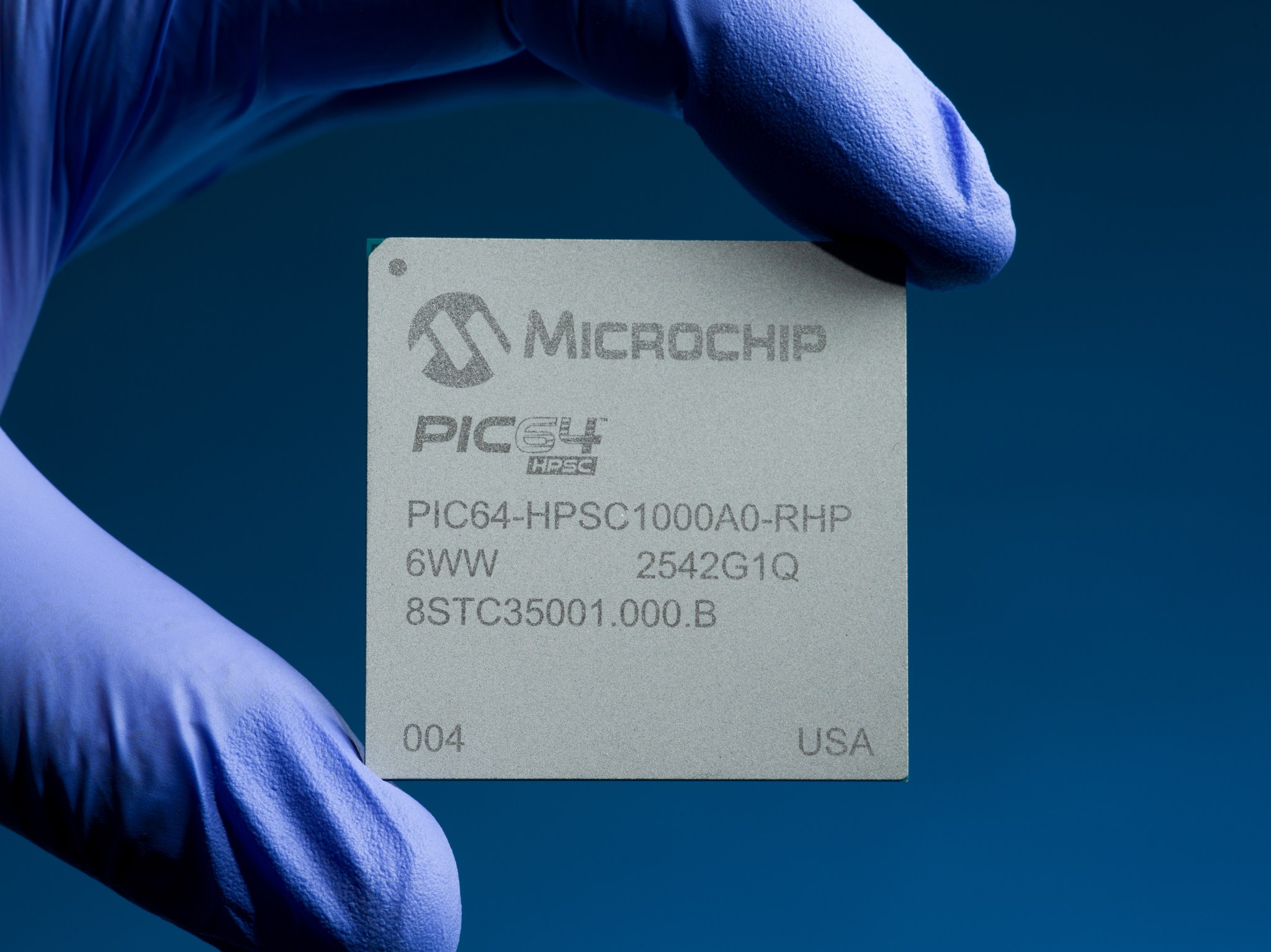
That legacy, however, is colliding with a new reality. Future missions are expected to last longer, travel farther, and carry more capable instruments, all while demanding more autonomy and reliability. Spacecraft will need to process larger streams of data in real time and make fast, informed decisions without waiting for instructions from Earth. Meeting those needs, NASA has partnered with Microchip Technology Inc. in a public-private effort that blends government and commercial investment to create a new class of onboard computing known as High-Performance Spaceflight Computing.
At the center of the project is a next-generation system-on-chip designed to deliver more than 100 times the computing performance of today’s space-qualified processors. The approach combines processing and networking in a single device, a shift intended to lower system cost and cut power use—two constraints that can determine whether a mission’s design is feasible. The architecture is also designed to scale: portions of the chip that aren’t needed for a specific task can be powered down, conserving energy while preserving performance for critical functions.
Rather than a one-size-fits-all processor, the High-Performance Spaceflight Computing family includes multiple compatible technologies that can be matched to different mission classes. A radiation-hardened version is aimed at the harshest environments, including geosynchronous orbit and deep space, as well as long-duration expeditions to the Moon, Mars, and beyond. It is intended to support real-time autonomous operations while remaining resilient against the radiation exposure that can disrupt or damage electronics. A radiation-tolerant variant, tailored to the commercial space market, targets low Earth orbit satellites with features focused on fault tolerance and cybersecurity.
The technical ambition extends beyond raw speed. By using advanced Ethernet as a high-throughput backbone, the system is designed to connect many sensors or link several chips together, enabling spacecraft to handle massive onboard data loads. That capability could allow faster rover driving through real-time perception and decision-making, or enable spacecraft to sift and prioritize scientific imagery before transmitting it—an advantage when downlink bandwidth is limited. To keep such complexity dependable, the design also incorporates continuous health monitoring and an integrated security controller intended to protect both operations and data.
NASA describes the initiative as a nationwide development effort that includes Microchip along with a broad network of academic and industry partners. Beyond the immediate hardware, the agency argues the collaboration supports U.S. leadership in spaceflight computing, improves supply-chain resilience and security, and helps build a high-tech workforce while stimulating regional economies.
Notably, the technology is being developed as a platform with potential uses beyond space. By applying the same mix of high-performance computing, network switching, high reliability, and cybersecurity, related processors could support mission-critical edge computing in terrestrial sectors including automotive, aviation, consumer electronics, industrial systems, and aerospace—ranging from drones and power grids to medical equipment, communications infrastructure, artificial intelligence, and high-volume data transmission. NASA and Microchip say that sharing a common technology foundation across space and Earth markets could lower risk and cost for both government and commercial users while strengthening domestic industrial capability.