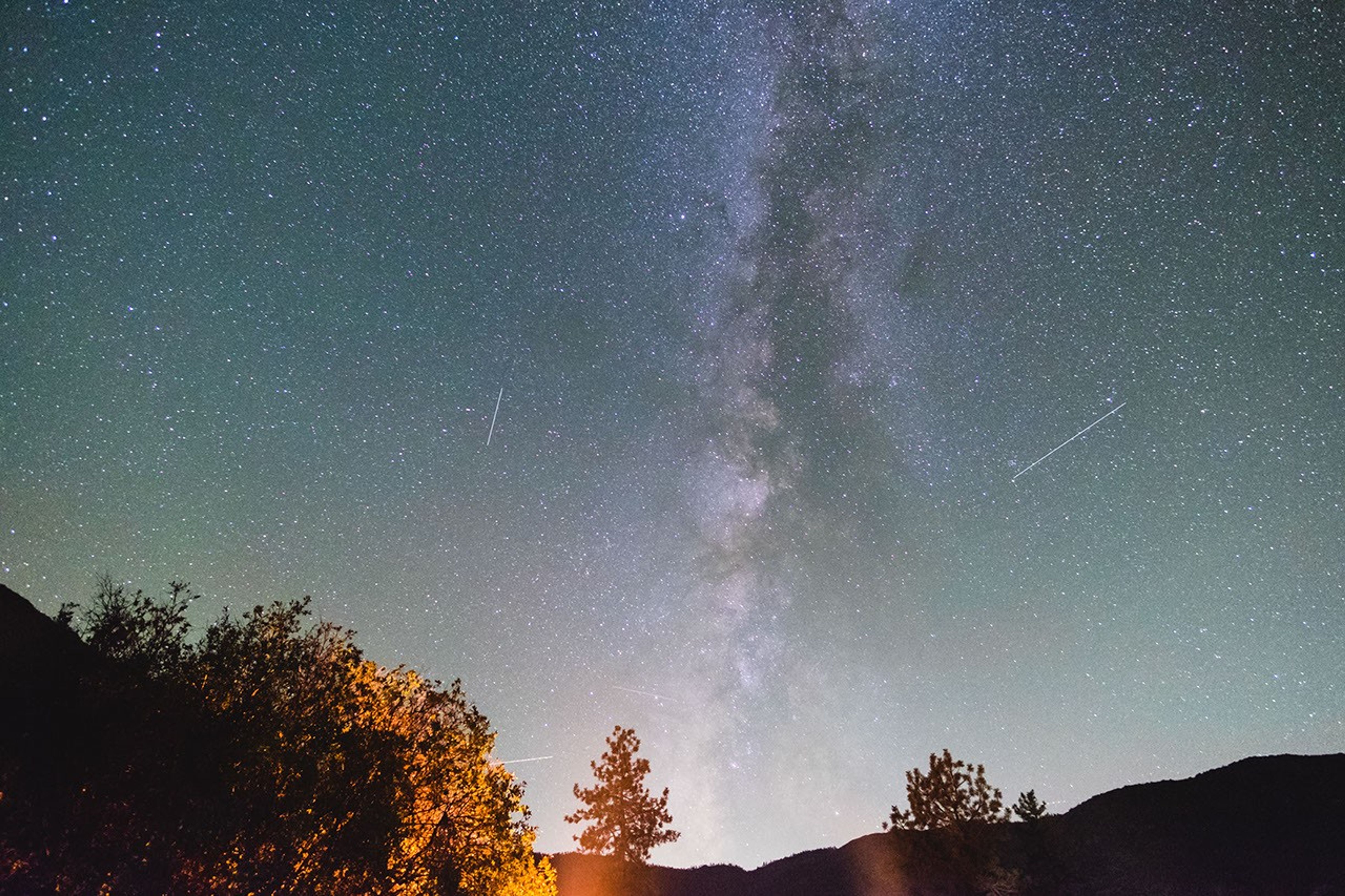
October offers skywatchers a trio of standout events: Saturn putting on its best show of the year, the Orionid meteors flashing through the pre-dawn hours, and a…
October offers skywatchers a trio of standout events: Saturn putting on its best show of the year, the Orionid meteors flashing through the pre-dawn hours, and a late-month rendezvous between the Moon and the Pleiades star cluster.
The month’s marquee target is Saturn. On October 4, the ringed planet reaches opposition—an alignment that occurs when Earth lies directly between the Sun and Saturn. From our viewpoint, Saturn sits opposite the Sun in the sky, which means it rises around sunset and remains visible for much of the night. For observers with clear skies, opposition typically delivers Saturn at its brightest and most conveniently placed for evening viewing, making this one of the year’s prime opportunities to spend time at the eyepiece.
While Saturn’s rings draw most of the attention, the planet’s atmosphere is also in the spotlight. Researchers have long tracked a striking hexagon-shaped jet stream near Saturn’s north pole, a massive feature spanning nearly 20,000 miles. More recently, new observations from NASA’s Hubble Space Telescope have revealed a different kind of pattern in the opposite hemisphere: a ten-sided atmospheric wave circling Saturn’s south pole. The newly detected structure appears to be intensifying, giving scientists an uncommon chance to watch a large-scale atmospheric phenomenon as it develops over time.
Later in the month, meteor watchers can look forward to the Orionid meteor shower, which peaks overnight on October 21 into the morning of October 22. Orionids are produced when Earth plows through streams of dust and small debris shed by Halley’s Comet. The shower is named for the constellation Orion because the meteors seem to radiate from that direction, though streaks can appear anywhere across the sky.
This year, observing conditions are complicated by moonlight: a bright waxing gibbous Moon will overwhelm some of the dimmer meteors. The best viewing window may come in the hours just before dawn, after the Moon has set. NASA recommends heading to a dark site away from city lights, allowing your eyes time to adapt, and then simply watching the sky—no telescope required.
The final highlight arrives on the night of October 27 into October 28, when the Moon passes close to the Pleiades, a compact and celebrated star cluster also known as the Seven Sisters. The Pleiades have inspired stories in many cultures, in part because the cluster can be seen from nearly everywhere on Earth. To find the pairing, look toward the east in the evening as both the Moon and the cluster climb higher through the night. With the naked eye, the Pleiades show up as a small, slightly hazy grouping of six or seven stars; binoculars or a telescope reveal many more stars and a richer sense of the cluster’s delicate structure.
For ongoing updates about NASA missions exploring the solar system and the wider universe, the agency directs the public to NASA Science resources. NASA also notes that the Night Sky Network—a nationwide partnership of amateur astronomy clubs—helps bring NASA science and inspiration to communities across the country.