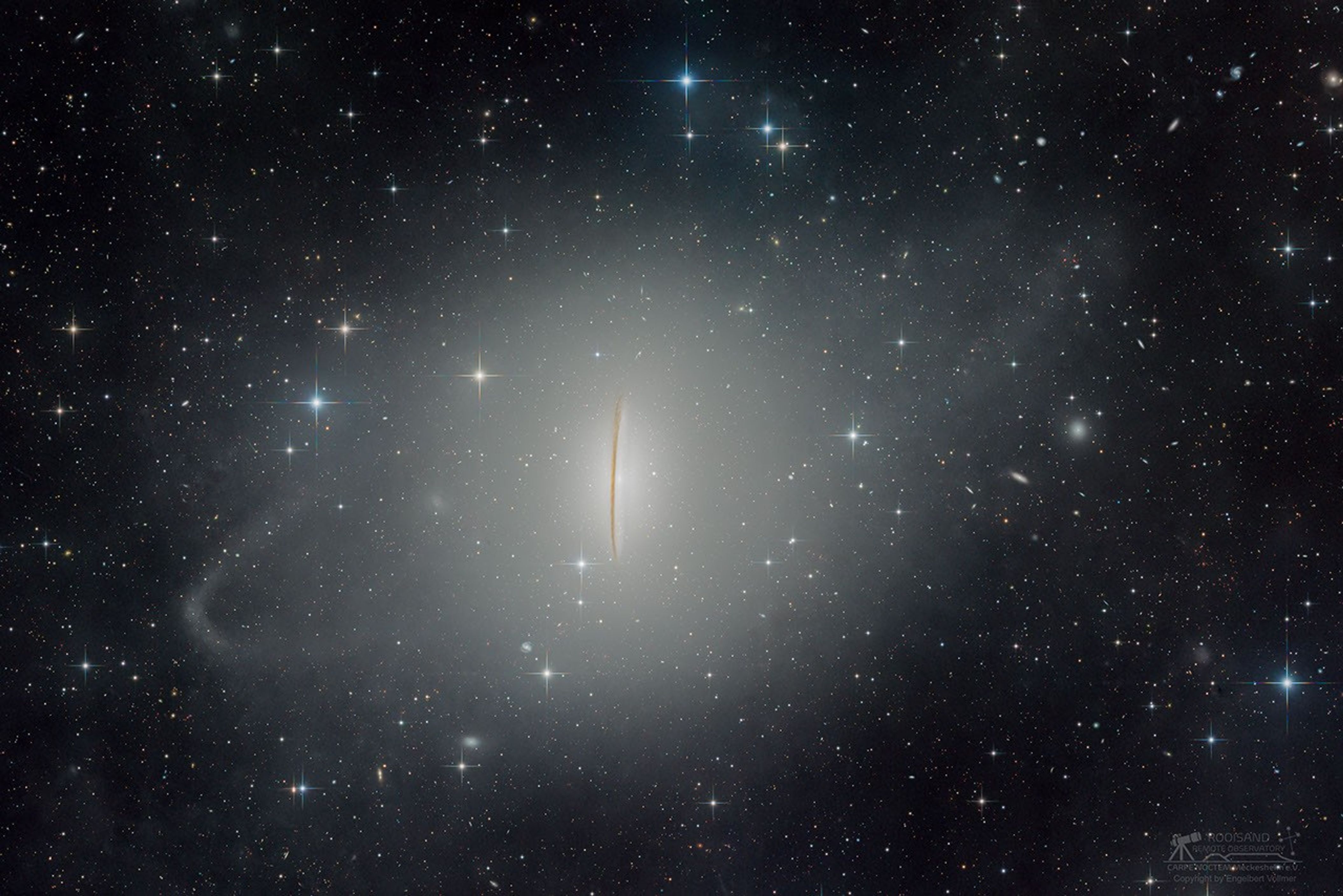
An ultra-deep image of the Sombrero Galaxy reveals a vast halo with rings and tidal streams. The delicate structures suggest a history of mergers that built up its mass.
A new ultra-deep view of the Sombrero Galaxy is showing astronomers far more than the familiar “hat” shape that gives M104 its nickname. In typical, shorter exposures, the galaxy presents a bright central bulge capped by a striking dark lane of dust—an effect that resembles a sombrero’s brim wrapped around the system’s disk.
But when observers extend the exposure time dramatically, the Sombrero’s understated outer regions come into focus. The latest image reveals a luminous, diffuse halo reaching well beyond the main disk, filled with the combined light of many stars that remain too faint and crowded to be individually resolved. Rather than appearing smooth and featureless, this faint stellar envelope contains distinct substructures.
Among the most eye-catching features is a ring-like pattern that cuts across the halo at a diagonal angle. Alongside it are additional arcs and stream-like shapes—signatures that astronomers interpret as tidal debris. Such “tidal streams” are produced when a large galaxy gravitationally disrupts smaller companions, pulling their stars into elongated trails that can persist for billions of years.
These delicate patterns provide new evidence that M104’s calm, iconic appearance hides a tumultuous history. The halo’s structure supports the conclusion that the Sombrero Galaxy has undergone collisions and mergers, assembling at least part of its present-day mass through the capture and shredding of smaller galaxies.
The Sombrero lies roughly 30 million light-years from Earth, meaning its light began its journey to us long before humans developed modern astronomy. The galaxy itself spans about 150,000 light-years—comparable to, and possibly larger than, the Milky Way. Capturing the faint halo and its subtle ripples required persistence: the featured image was collected over seven nights in mid-2026 from Namibia, where dark skies and steady conditions help make such deep observations possible.
Why it matters
Galaxies are not static islands of stars—they grow and change through repeated interactions, and M104’s newly emphasized halo features offer a visible record of that process. For researchers studying how large galaxies form, tidal streams act like forensic evidence, preserving clues about past mergers that might otherwise be erased over time. Future deep imaging and follow-up studies could help identify which kinds of smaller galaxies were absorbed and when those encounters occurred.