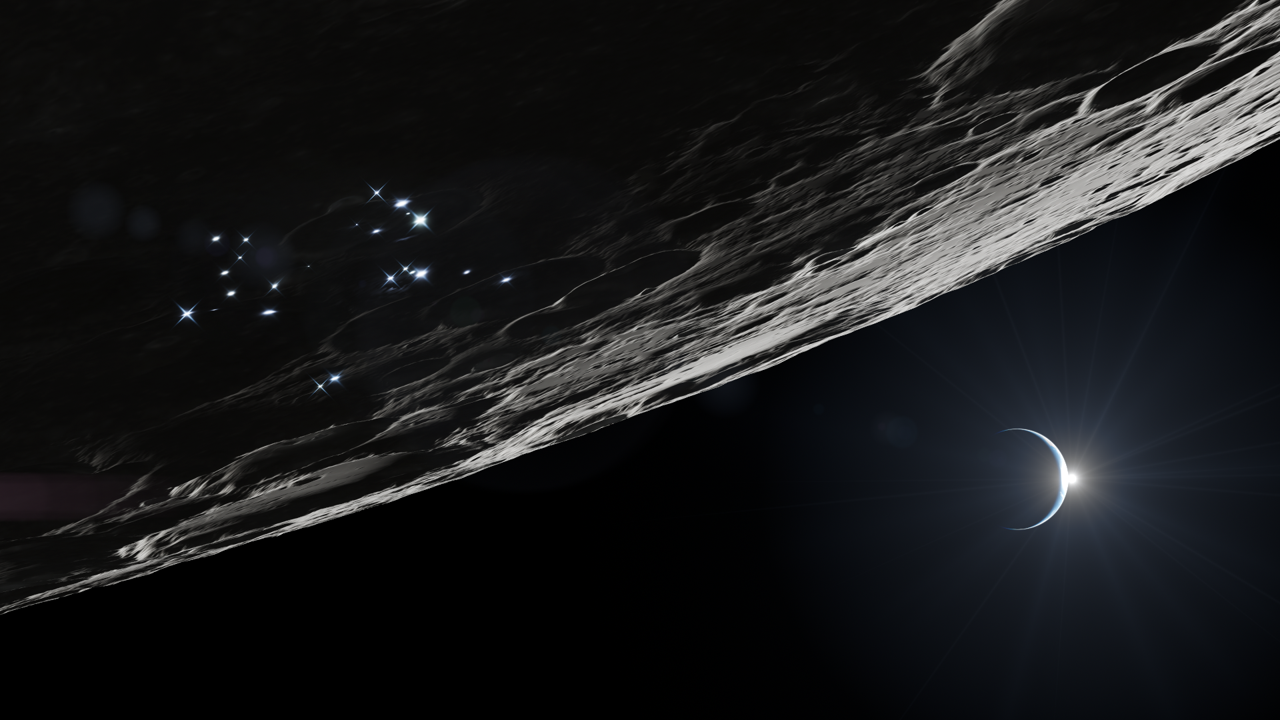
NASA is seeking ways to safely neutralize spacesuit static charge during lunar EVAs, especially in shadowed polar regions, to prevent damaging sparks near landers.
As astronauts prepare for extended exploration near the Moon’s दक्षिण ध्रुव (South Pole), NASA engineers are focusing on a hazard that is both invisible and potentially mission-threatening: static electricity on a spacesuit.
During a lunar spacewalk, simply moving across the dusty surface can cause a spacesuit to accumulate electrical charge through triboelectric effects—similar in principle to the static that builds up when materials rub together. At the same time, the suit interacts with the Moon’s surrounding plasma environment, which can also drive charging. Over the course of an EVA, these processes can turn the astronaut into a mobile reservoir of electrical potential.
The challenge becomes far more severe when a crew member enters shadowed terrain—especially the Permanently Shadowed Regions (PSRs) near the lunar South Pole. In sunlit areas, photoelectron emission helps counteract charging: sunlight knocks electrons off surfaces, providing a natural balancing mechanism. In deep shadow, that stabilizing effect disappears. The local plasma conditions also change, with reduced ambient ion flux available to neutralize electrons collected by the suit. As a result, the spacesuit can build up a substantial negative voltage relative to its surroundings.
That charge does not readily dissipate on the Moon. Unlike on Earth, where humidity and a conductive environment can help bleed off static, the lunar surface offers no comparable natural pathway to drain accumulated charge away from the suit. This creates a high-stakes scenario when an astronaut returns from shadow into sunlight and approaches a spacecraft or lander.
NASA warns that a stationary lander in sunlight tends to sit at a slightly positive electrical potential. If a heavily negatively charged astronaut comes close and makes contact, the large voltage difference can prompt an electrostatic discharge—an abrupt arc or spark as the charge equalizes. Such a rapid discharge could degrade critical layers of the spacesuit, harm sensitive electronics in the suit, and pose additional danger in the oxygen-rich environment maintained inside the suit. It also raises the risk of painful or dangerous electrical shock to the crew.
To address this threat, NASA has launched the Lunar Grounding Challenge, calling for new designs and operational approaches that can bring a spacesuit back toward electrical equilibrium safely and quickly. The goal is a practical Electrostatic Discharge (ESD) mitigation concept that neutralizes the astronaut under extreme charge differentials before the crew interacts directly with the lander—reducing the odds of a damaging spark at exactly the wrong moment in a mission.
More information about the challenge and how to participate is available at: https://work.crowdplat.com/challenge/lunar-grounding-challenge
Why it matters
As Artemis-era missions target the Moon’s South Pole—including shadowed regions of high scientific interest—static charging becomes a new kind of operational risk. A reliable way to discharge a suited astronaut could protect lifesupport systems, onboard electronics, and crew safety during repeated EVAs. The solutions proposed through this challenge may shape future suit design and the procedures astronauts follow when returning to a lander.