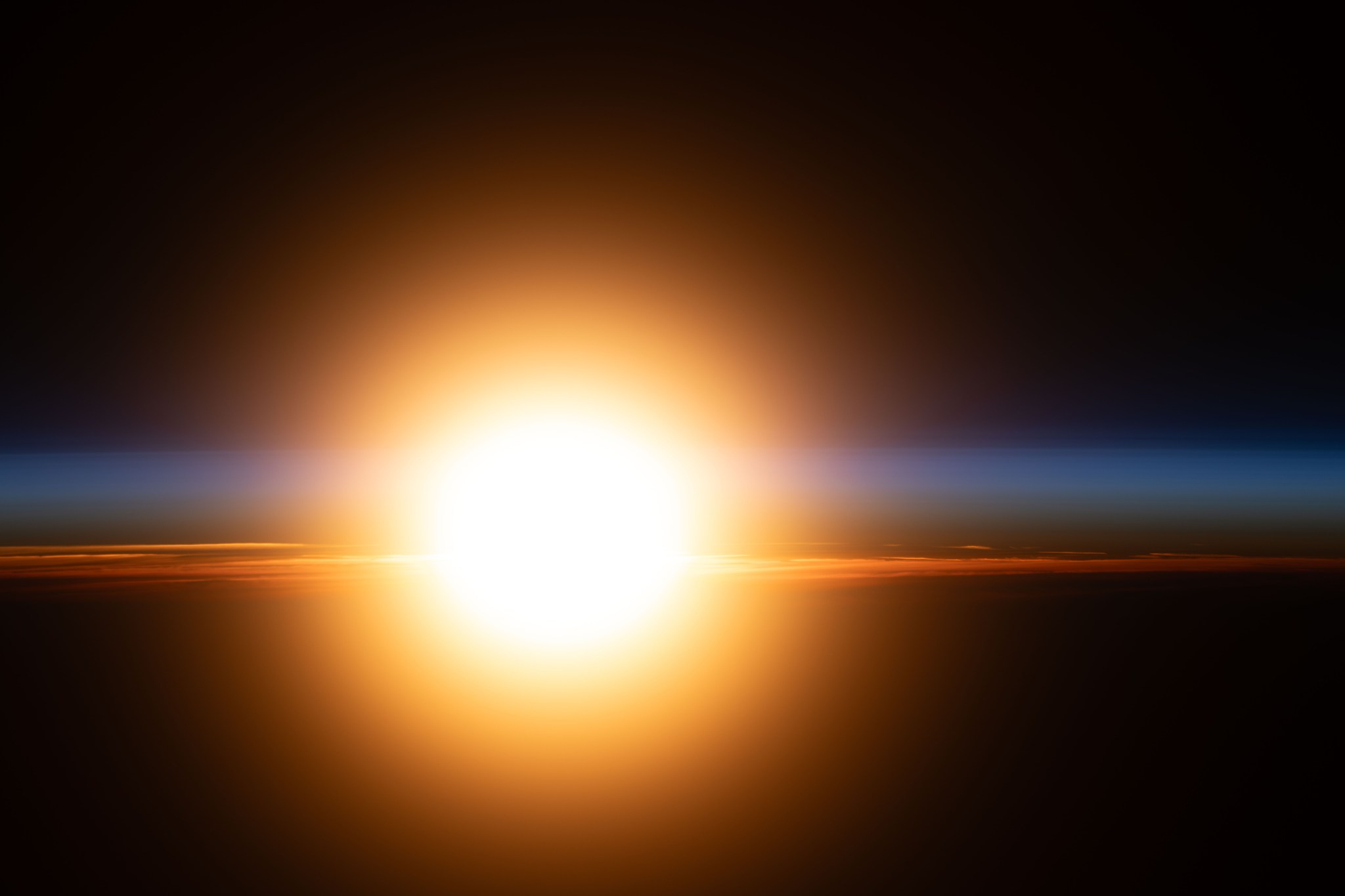
Good Morning, Earth!
Good Morning, Earth! An ISS sunrise photo spotlights the science of living in perpetual dawn
An image captured high above the planet this week has offered a vivid reminder that “morning” in orbit is less a moment than a repeating rhythm. NASA astronaut Chris Williams photographed an orbital sunrise from the International Space Station (ISS) on June 26, 2026—one of the roughly 16 sunrises the station experiences every day as it circles Earth at high speed.
For viewers on the ground, sunrise arrives once. For crews aboard the ISS, it comes in a rapid cadence dictated by physics: the station completes about 16 orbits in 24 hours, meaning astronauts see daylight and darkness alternate about every 90 minutes. That frequent cycling is not only visually striking; it also shapes daily operations, influences human biology, and underpins the station’s role as a permanent research outpost.
A laboratory that never stops moving
The ISS is often described as an orbiting laboratory, but the phrase can obscure what makes the platform unique. Unlike terrestrial labs, the station is continuously in motion, tracing a path that repeatedly crosses oceans, deserts and cloud systems. Its speed and altitude keep it in a state of freefall—microgravity—allowing scientists to observe how fluids flow, how materials solidify, and how living tissues adapt when gravity no longer dominates.
Research summarized across a broad range of scientific reporting has shown that microgravity can change the behavior of cells and proteins, alter immune responses, and affect how plants grow and use water. Those findings matter not only for future exploration—missions to the Moon and Mars—but also for Earth-based medicine and biotechnology, where insights into fundamental biological processes can inform new approaches to treatment and manufacturing.
The ISS also serves as a testbed for technologies that must work reliably in harsh, remote environments: advanced life-support systems, water recycling, air revitalization, and autonomous monitoring. Each sunrise and sunset Williams’ camera implicitly marks another interval of continuous systems engineering—power generation, thermal control, communications and navigation—required to keep the orbiting complex functioning.
Sunrises, schedules and the human body clock
Sixteen dawns a day might sound exhilarating, but it poses a practical problem: human circadian rhythms evolved around a 24-hour light–dark cycle. In orbit, astronauts follow a planned schedule tied to Earth time, not to the rapid orbital day. Even so, research has repeatedly found that sleep and circadian disruption are persistent challenges in spaceflight, affecting alertness, mood and cognitive performance.
To counter that, crews use carefully managed lighting, structured routines and operational discipline. Modern station lighting systems can shift color and intensity to support wakefulness or encourage rest, reflecting a growing body of research on how light influences hormones and sleep timing. The goal is not to replicate a natural sunrise—impossible when dawn arrives every 90 minutes—but to provide consistent signals that help the body maintain a stable daily rhythm.
The photo also underscores the psychological dimension of spaceflight. Astronauts frequently report that viewing Earth helps sustain perspective and wellbeing during long missions. Studies of crew behavior and mental health in isolated and confined environments suggest that access to meaningful views and personal “off-duty” moments can be protective, especially over months in orbit.
Why an orbital sunrise matters on the ground
Beyond its aesthetic appeal, an orbital sunrise hints at the ISS’s broader contribution to observing Earth. Instruments on and around the station track atmospheric composition, cloud properties, lightning, auroras, ocean color and other indicators that help scientists refine climate and weather models. Those measurements complement data from dedicated satellites, adding flexibility for testing new sensors and methods.
The station’s rapid orbit is an advantage: it revisits regions frequently, offering repeated looks at changing conditions. While not designed as a primary climate-monitoring platform, the ISS has become a useful vantage point for targeted Earth science campaigns and technology demonstrations.
A daily reminder of a global experiment
Williams’ image—credited to NASA and the astronaut-photographer—captures a fleeting boundary between night and day. But the bigger story is continuity: a facility that turns constant motion into constant experimentation.
Each of those 16 sunrises is another pass through an environment that cannot be duplicated on Earth, and another opportunity to learn—from human physiology to materials science to Earth observation. In that sense, “Good Morning, Earth!” is less a greeting than a summary of the ISS mission itself: returning, again and again, to the same planet with new data each time.