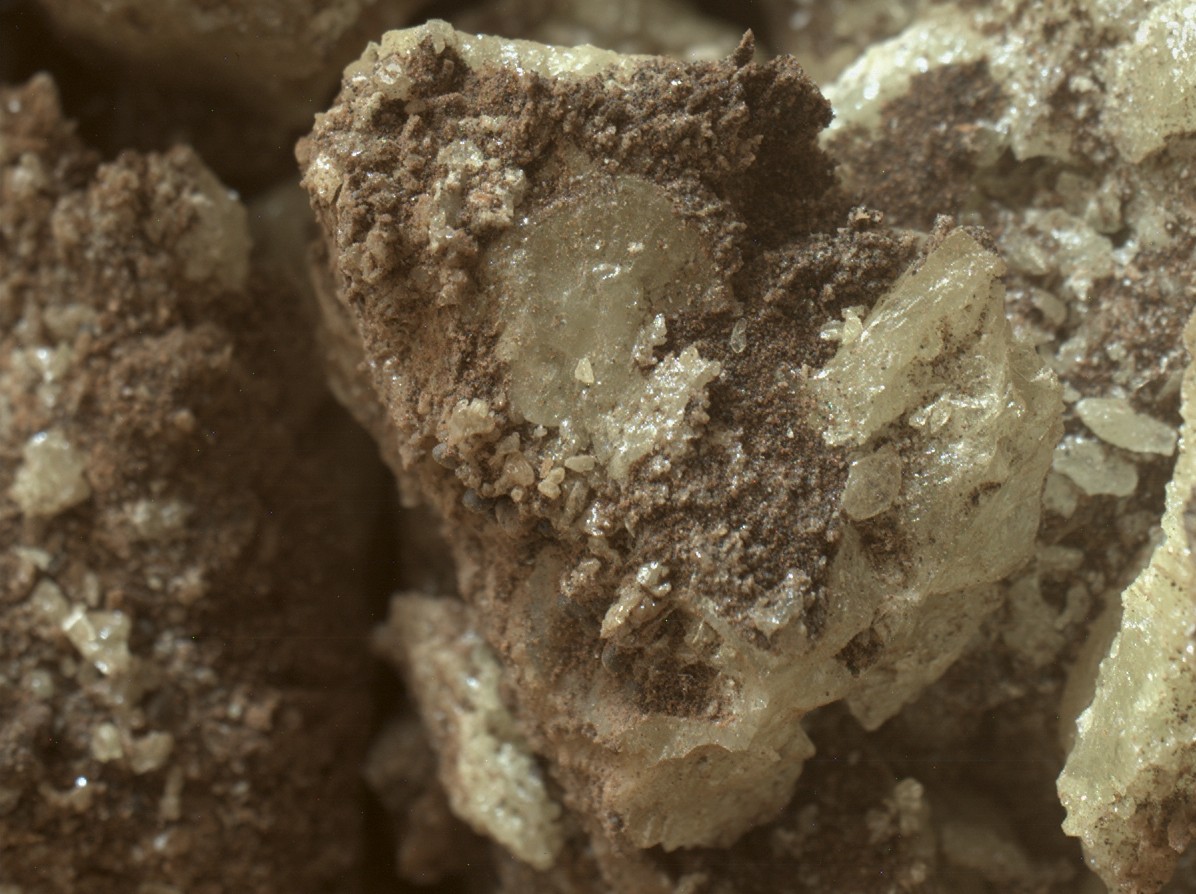
Curiosity sees Martian sulfur up close after accidental rock break reveals yellow crystals NASA’s Curiosity rover has captured a rare close-up of bright yellow sulfur…
Curiosity sees Martian sulfur up close after accidental rock break reveals yellow crystals
NASA’s Curiosity rover has captured a rare close-up of bright yellow sulfur crystals on Mars—an unexpected find that researchers say adds a new piece to the planet’s complex chemical and environmental history. The fragments were exposed only after Curiosity inadvertently drove over a rock on May 30, 2024, cracking it open and revealing crystalline material inside. Several days later, the rover positioned a camera on the end of its robotic arm close to the broken surface, documenting what mission scientists describe as the first sulfur crystals observed on the Red Planet.
The discovery emerged not from a planned drill campaign but from the day-to-day realities of rover exploration: wheels that crush brittle rocks, exposing fresh interiors that have been protected from radiation and wind-driven abrasion. Such freshly revealed surfaces can preserve delicate mineral clues that are otherwise hard to detect from orbit or on weathered outcrops.
Curiosity, part of NASA’s Mars Science Laboratory mission, was the largest and most capable rover ever sent to Mars at the time it launched in 2011. Roughly the size of a small SUV—with a body about 10 feet long, 9 feet wide, and 7 feet tall—Curiosity carries a suite of 10 science instruments, including 17 cameras, a rock-zapping laser for remote chemical checks, and a drill that collects powdered samples for onboard laboratories. Its core objective has remained consistent since landing in Gale Crater: determining whether ancient Mars ever had environmental conditions suitable for microbial life.
The new sulfur imagery fits into that long-running investigation because sulfur is a key player in planetary chemistry. On Earth, sulfur minerals can form through volcanic processes, hydrothermal activity, or the evaporation of sulfate-rich waters. On Mars, sulfur-bearing minerals—especially sulfates—have been detected in many regions and have long been used as indicators of past water activity and changing climate conditions. But seeing apparent sulfur crystals at close range is different from identifying sulfur signatures from orbit or interpreting weathered deposits at a distance. The fresh exposure allows researchers to evaluate texture, crystal form, and context, which can help distinguish how the material formed.
Curiosity’s strength is not only in imaging but in putting multiple lines of evidence together. Its arm-mounted instruments can examine targets at hand-lens scale, while other tools assess chemistry and mineralogy and compare observations across layers of sedimentary rock. That approach has already paid off: early in the mission, the rover found chemical and mineral indicators that parts of Gale Crater once offered habitable environments—settings where liquid water existed and key elements for life were available.
In recent years, Curiosity’s findings have continued to complicate and enrich the picture of ancient Mars. Studies based on rover samples have reported an unusually rich inventory of organic molecules preserved in ancient mudstones. In one peer-reviewed analysis, researchers argued that non-biological explanations they tested could not fully account for the abundance and character of the organics detected, underscoring both the scientific promise and the interpretive challenge of Martian geochemistry. While organics do not equal life, their persistence in the rock record strengthens the rationale for investigating how minerals, water, and chemistry interacted over time—precisely the kind of context sulfur minerals can help provide.
The rover’s current trek has also taken it into a landscape marked by intricate geological patterns. For months it has been exploring an area featuring “boxwork” formations—web-like ridges that, on Earth, can be associated with fluids moving through rock and depositing minerals along fractures. The combination of boxwork terrain and a sudden sulfur-crystal exposure offers researchers an opportunity to test hypotheses about fluid circulation, evaporation, or chemical alteration in Mars’ past.
Curiosity’s accumulating sample history gives additional weight to any new mineral find. The rover has drilled dozens of times—42 powdered rock samples taken from carefully chosen targets—building a stratigraphic and chemical narrative of Gale Crater’s ancient environments. Each new observation, whether planned or accidental, becomes another data point in that evolving story.
For Mars scientists, the sulfur crystals are a reminder that discovery is often opportunistic. A single wheel strike can uncover a hidden mineral pocket and prompt new questions: Was the sulfur deposited by groundwater? Did it form in drying lakes or through volcanic gases interacting with rock? And what does it imply about the conditions that prevailed when Mars transitioned from a wetter world to the cold, arid planet explored today?
As Curiosity continues reading Gale Crater’s rocks like pages in a deep-time archive, the newly revealed sulfur offers a vivid, up-close clue—one that may help refine how researchers reconstruct the chemistry and climate of ancient Mars, and how they prioritize the next targets in the ongoing search for habitable past environments.