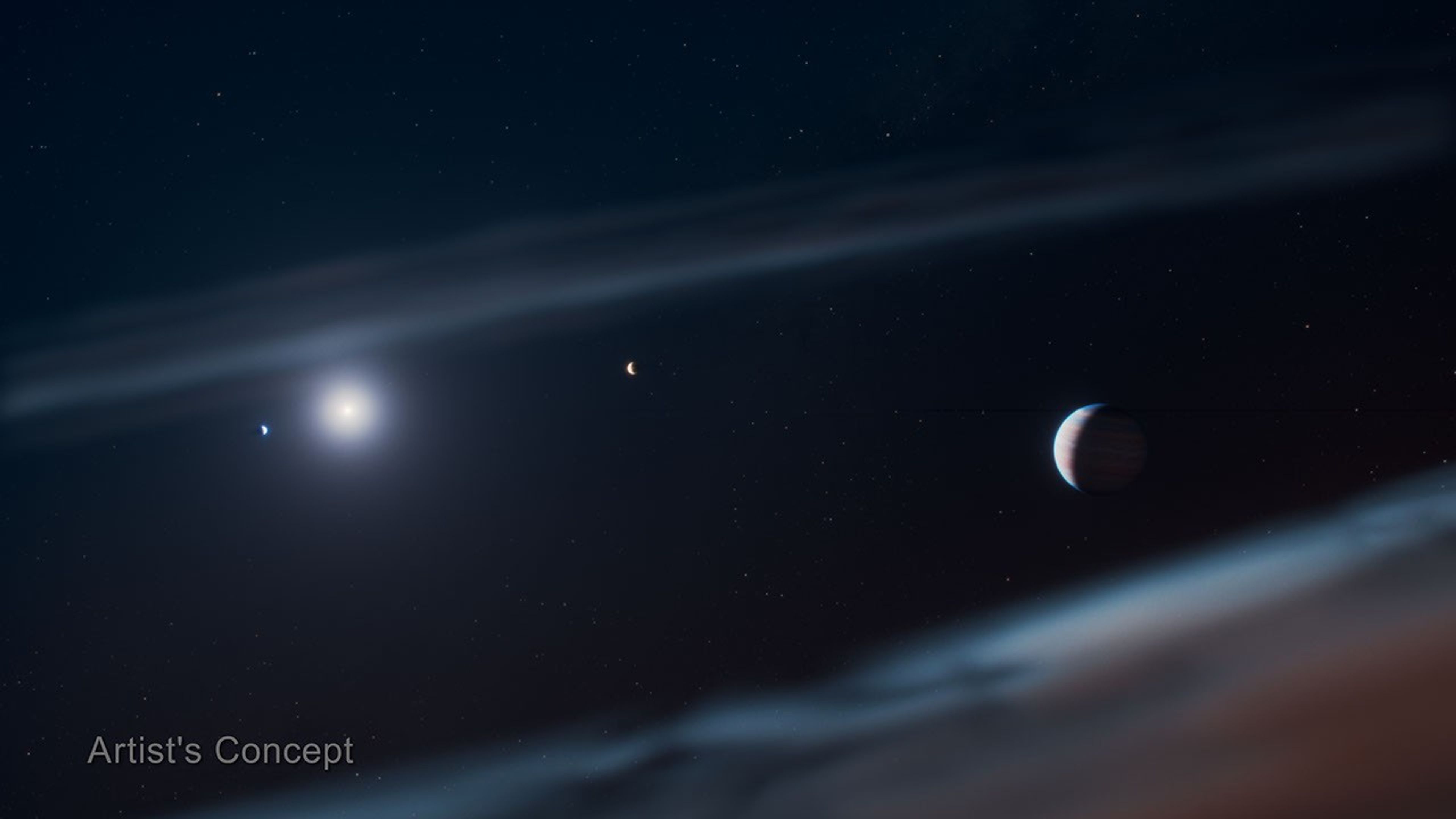
Astronomers working with NASA’s James Webb Space Telescope have uncovered a previously unseen giant exoplanet in one of the Milky Way’s most scrutinized planetary neighborhoods: the Beta Pictoris system.
Astronomers working with NASA’s James Webb Space Telescope have uncovered a previously unseen giant exoplanet in one of the Milky Way’s most scrutinized planetary neighborhoods: the Beta Pictoris system. The newly confirmed world, Beta Pictoris d, was concealed in plain sight around a star that was already famous for hosting two directly imaged gas giants, Beta Pictoris b and Beta Pictoris c. With the addition of this third planet, Beta Pictoris becomes only the second known system to feature at least three planets detected through direct imaging.
What makes the find especially notable is how Webb revealed it. Rather than spotting the planet as a distinct bright point against the glare of its star, the team identified it through the chemical signature of its atmosphere—an approach that could broaden how astronomers search for planets around other stars. The results are reported in a study published Wednesday in The Astrophysical Journal Letters, led by Aidan Gibbs, a postdoctoral researcher at the University of California, San Diego. Gibbs said the detection “adds another piece” to a system that has long served as a natural testbed for studying how planetary systems emerge and change over time.
Beta Pictoris lies about 63 light-years from Earth and is roughly 23 million years old—young enough that the system still bears the dusty debris left over from planet formation. That debris disk has made Beta Pictoris a prime target for studying how growing planets interact with surrounding material.
Based on the team’s analysis, Beta Pictoris d is likely at least twice the mass of Jupiter, making it the least massive of the system’s three known giant planets. Models suggest it orbits at around 30 astronomical units from its star—similar to the region Neptune occupies in our own solar system. Among the three planets, it appears to travel on the widest path, yet still remains inside the inner boundary of the system’s debris disk.
The discovery emerged unexpectedly during Webb observations aimed at a different target. The researchers were using Webb’s Near-Infrared Spectrograph (NIRSpec) to probe the atmosphere of Beta Pictoris b, employing an observing mode called the Integral Field Unit, which captures an image and a spectrum for every pixel. In the data, the team noticed a signal that didn’t fit expectations: where they anticipated a relatively smooth spectrum produced by starlight reflecting off dust, they instead found a structured pattern.
That pattern turned out to be a series of carbon monoxide absorption lines—distinctive features commonly associated with the atmospheres of giant planets. Because spectroscopy can also reveal how an object is moving, the researchers extracted the planet’s radial velocity as well. Its measured speed, position, and orientation relative to the disk all pointed to an object orbiting Beta Pictoris, rather than a distant background star or a brown dwarf that might also contain carbon monoxide.
Jean-Baptiste Ruffio, a UC San Diego research scientist and principal investigator on the Webb observing program where the signal first appeared, noted that apparent “blobs” in images can be misleading, sometimes arising from instrumental effects or structures in the debris disk. Having the spectrum simultaneously, he said, made it possible to test the candidate quickly.
Additional Webb observations strengthened the case. Follow-up work with Webb’s Mid-Infrared Instrument (MIRI), obtained through Director’s Discretionary Time, detected water vapor and methane—further confirming the object as a planet while expanding the first look at its atmospheric chemistry. Unlike more traditional imaging-first searches, this spectroscopic strategy enabled researchers not only to detect the planet immediately, but to begin characterizing its atmosphere from the start.