Economists Ben Moll and Alex Imas argue that double-digit AI-driven GDP growth is extremely unlikely in advanced economies, citing bottlenecks, demand limits and adjustment frictions.
Economists Ben Moll and Alex Imas are pushing back on a growing chorus of AI optimists who argue that advanced economies could soon see annual real GDP growth rates in the double digits. While they say AI capabilities are already accelerating rapidly—and could continue to do so—the pair contends that translating that technical progress into sustained 10%-plus growth over the next decade or so would require a chain of demanding economic conditions, any one of which could break in practice.
The recent wave of upbeat projections has been striking. Anthropic CEO Dario Amodei has suggested AI might lift growth to roughly 10–15% per year. Leopold Aschenbrenner’s essay “Situational Awareness” goes further, envisioning 30% annual growth or more in the coming decade. In another widely circulated claim, Anthropic researcher Sholto Douglas urged people to “price in” economic doublings during the 2030s—a view endorsed by Elon Musk—implying something like 100% growth per year. Such views are not isolated: compendiums of AI-related growth forecasts show that double-digit expectations are common among some AI insiders.
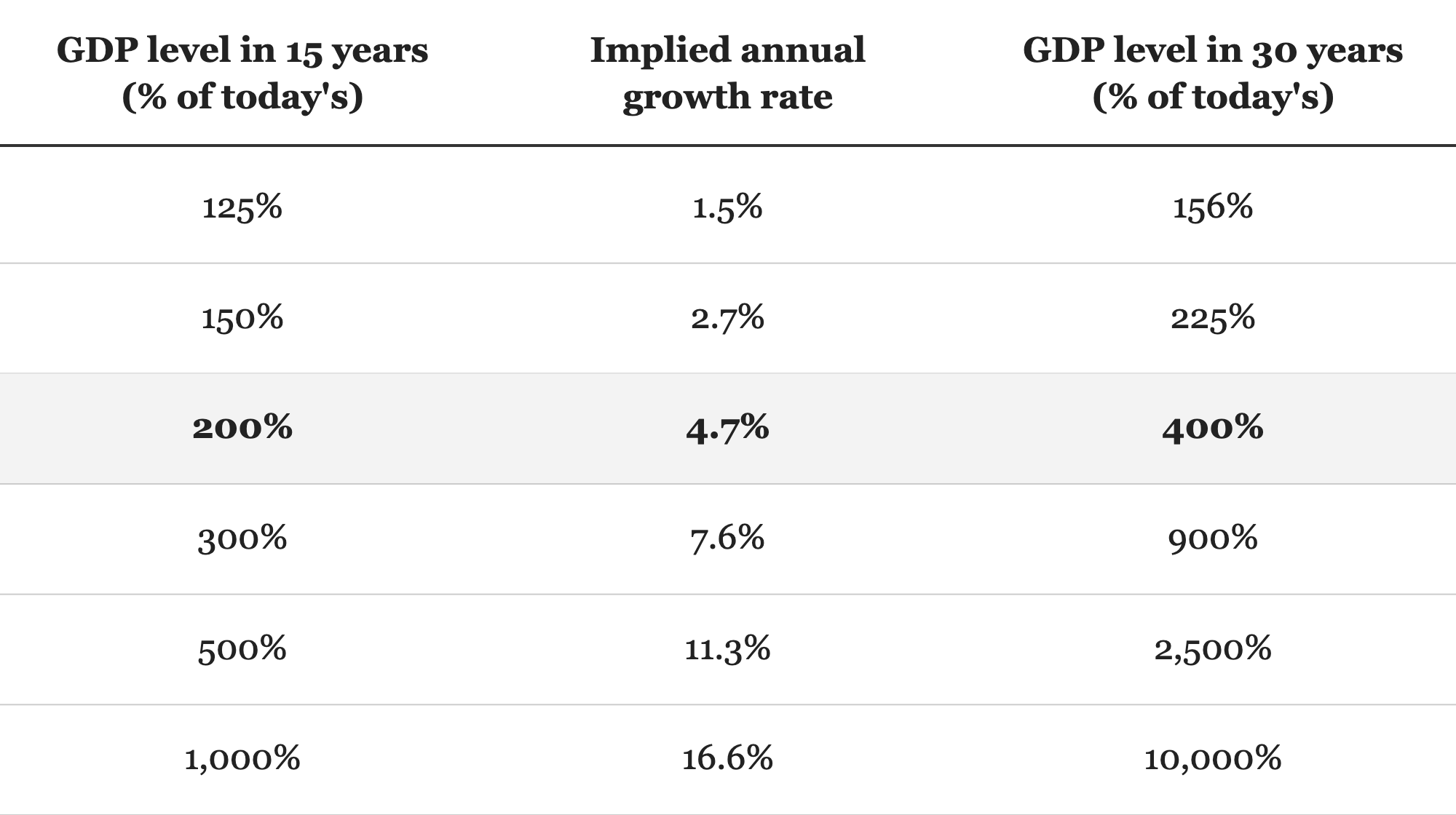
Moll and Imas describe themselves as highly bullish on AI, but they argue that GDP growth is constrained by economic bottlenecks and adjustment frictions that don’t vanish just because software improves quickly. Their central claim is about timing: over the next 10–15 years, they consider double-digit annual growth in advanced economies “extremely unlikely.” A more plausible baseline, they say, is a sustained lift to about 4–5% real growth—still an extraordinary outcome that would imply a major jump in the level of output over a decade or two.
To reach 10% growth, they argue, machines would have to perform a large share of the economy’s work by around 2035. That alone is not sufficient. Consumers would also need to keep spending on goods and services even as tasks become automated, rather than seeing demand fall because the “human” component has been removed. Businesses and investors would have to absorb and deploy the flood of new output rather than encountering demand shortfalls or bottlenecks in scaling. And AI systems would need to be deployed without meaningfully destroying value or triggering slowdowns from regulation, politics, or organizational resistance.
They also highlight the limits imposed by the structure of work. Only about one-third of the economy, they argue, is paid knowledge work that is most directly exposed to automation by today’s AI. Beyond that is a large “relational sector”—services where human presence is itself part of what customers value—creating a floor under demand for labor. More broadly, the non-automatable share of the economy is likely larger than the “knowledge work” slice alone.
A further constraint comes from a classic idea in computing and economics: Amdahl’s Law. When only part of a system can be sped up, the overall improvement is capped by the remaining slow components. Applied to an economy with sectors that are essential but hard to improve, this implies even spectacular productivity gains in automatable areas may not translate into equally spectacular economy-wide growth.
Moll and Imas also emphasize real-world frictions—slow diffusion of new tools, physical and input constraints, the messy reality of many jobs, and political pushback—that can stretch the timeline between technical feasibility and measurable macroeconomic growth. They caution that “singularity” narratives, in effect, assume AI can fully replace researchers and reverse long-run declines in research productivity, and they say there is no evidence yet that either has happened.
They point to Anthropic’s own modeling as a reality check: only the firm’s “extreme” scenario yields double-digit growth, while its “modest” and “substantial” cases remain in single digits.
Why it matters
If AI boosts growth to 4–5% rather than 10%+, the difference reshapes expectations for wages, public finances, interest rates, and inequality—without requiring a near-total automation of work within a decade. Policymakers and investors betting on an imminent macroeconomic “takeoff” may be disappointed even if AI transforms specific industries quickly. The key thing to watch is not just capability progress, but how fast adoption spreads across sectors constrained by regulation, physical inputs, and human-facing demand.