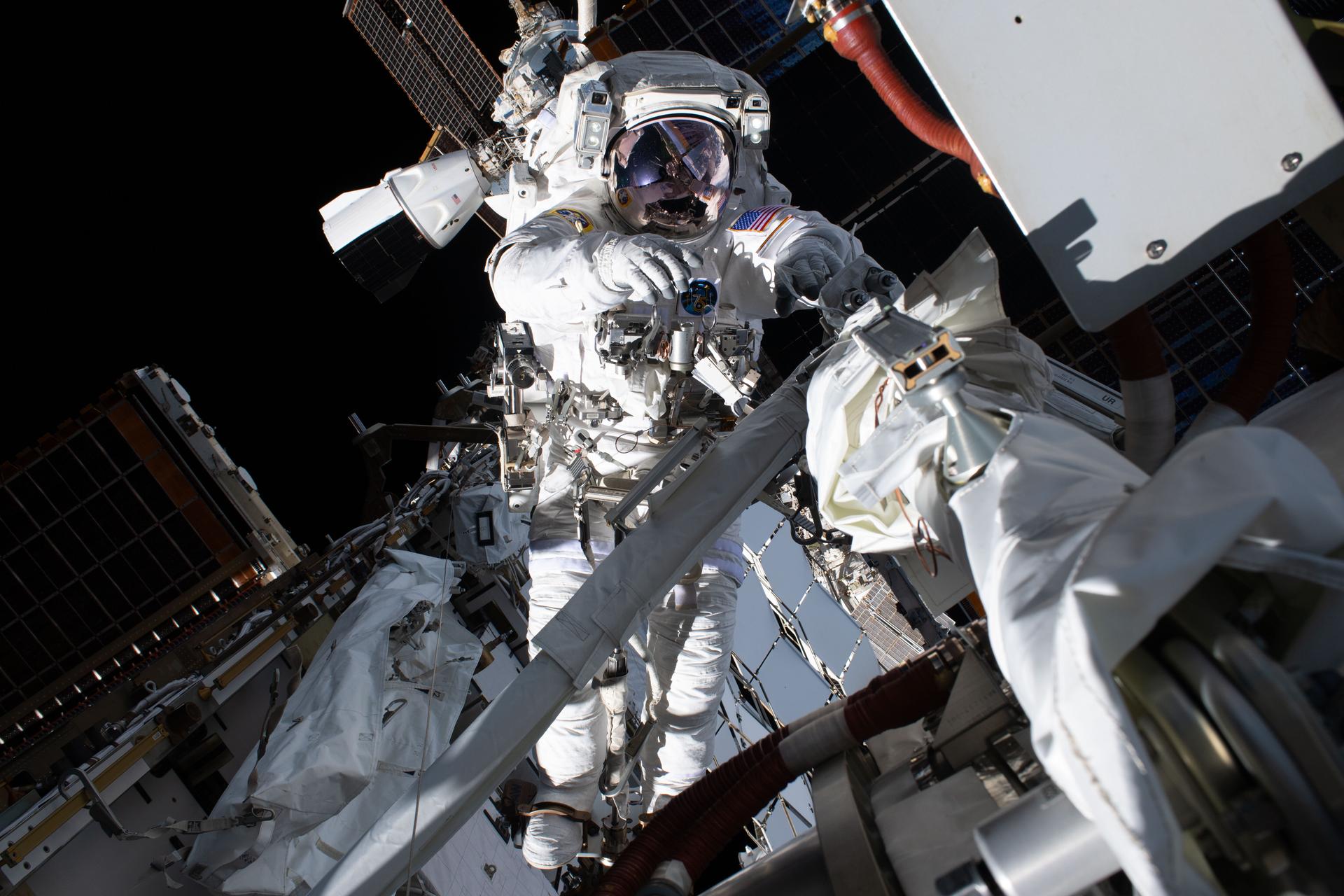
NASA will brief media on two upcoming U.S. spacewalks to install the final roll-out solar arrays on the ISS, completing a major power upgrade expected to boost output by up to 30%.
NASA will outline plans for two forthcoming U.S. spacewalks aimed at finishing a major power upgrade for the International Space Station during a media briefing scheduled for 2 p.m. EDT on Tuesday, Oct. 20. The news conference will originate from NASA’s Johnson Space Center in Houston and will be broadcast online via multiple NASA platforms.
U.S.-based journalists who want to attend in person must coordinate with the Johnson Space Center newsroom by 3 p.m. EDT on Monday, Oct. 19, using jsccommu@mail.nasa.gov. Reporters planning to listen in by phone are also required to request dial-in information by the same deadline. NASA noted that anyone intending to ask questions during the briefing must be connected no later than 15 minutes before the event begins.
The briefing will preview U.S. spacewalks 100 and 101, two extravehicular activities designed to install the last pair of International Space Station Roll-Out Solar Arrays, known as IROSAs. NASA astronaut Anil Menon and Canadian Space Agency astronaut Joshua Kutryk are slated to conduct both spacewalks, exiting through the station’s Quest airlock.
During U.S. spacewalk 100, the crew will install and deploy an IROSA on the station’s 2A electrical power channel. That hardware will be the seventh roll-out solar array added as part of the station’s power-augmentation campaign. NASA says the additional generating capacity is needed to support essential ISS operations, including preparations that enable a safe, controlled deorbit at the end of the station’s life.
U.S. spacewalk 101 is planned to complete the upgrade effort. Menon and Kutryk will install and unfurl the eighth—and final—IROSA on the 3B power channel, finishing the set of enhancements intended to increase the station’s available electrical power.
Once both arrays are in place, the full suite of eight IROSAs is expected to raise available power by as much as 30%. NASA estimates the improvements will boost the ISS’s power generation capability from about 160 kilowatts to roughly 215 kilowatts, providing a larger margin for ongoing research, station maintenance, and other operational demands.
NASA said it will release more detailed coverage information for each of the two spacewalks nearer to the dates of the operations via the agency’s live events webpage and the space station blog. The pair of EVAs will mark the 285th and 286th spacewalks carried out in support of building, maintaining, and upgrading the orbiting laboratory.
Additional information on ISS research, operations, and crews is available through NASA’s International Space Station website.
Why it matters
The final two IROSA installations are designed to close out a multi-year effort to modernize the station’s electrical system, ensuring sufficient power for critical ISS work in its remaining years. More available electricity expands operational flexibility and supports future station milestones, including end-of-mission deorbit planning. Watch next for NASA’s updated schedules and live coverage details as each spacewalk approaches.