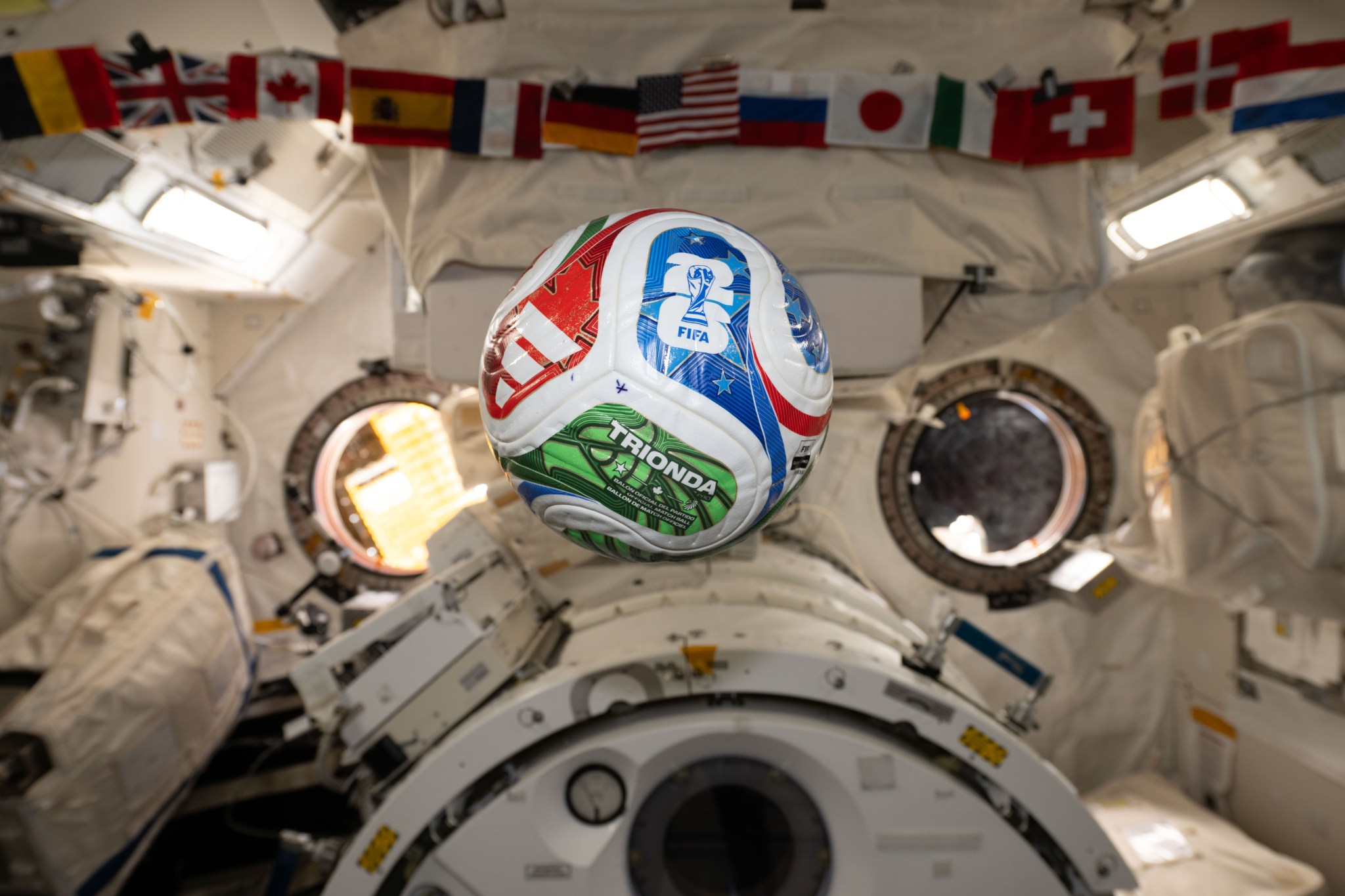
A photograph taken aboard the International Space Station on March 2, 2026, captures an unusual sight: a soccer ball drifting freely in the station’s microgravity environment.
A photograph taken aboard the International Space Station on March 2, 2026, captures an unusual sight: a soccer ball drifting freely in the station’s microgravity environment. The image reflects more than a playful moment in orbit. Station crew members were carrying out structured tests with soccer balls to examine how changes to a ball’s internal mass can alter the way it moves and remains stable when gravity is largely absent.
By observing the ball’s behavior in microgravity—where effects like friction and weight are minimized—researchers can more clearly isolate how mass distribution inside the ball affects its motion. The work is designed to sharpen scientific understanding of stability and dynamics when an object contains embedded components rather than being uniformly weighted.
That question has become increasingly relevant as sports equipment incorporates more technology. Modern match balls can include internal features such as sensors used to gather performance data. While these systems are often small, the research suggests that even modest changes inside a ball may influence how it spins, travels, and responds during play. The crew’s experiments in orbit are helping scientists better understand the potential performance impacts of adding such embedded technologies.
NASA says the investigation is part of a broader pattern in which research conducted for space exploration yields practical benefits on Earth. In this case, insights drawn from studies on the space station—and from technologies originally developed to support exploration—are informing questions that matter to athletes, equipment designers, and ultimately the fans of the world’s most widely played sport.