APODScienceAPODAPOD: 2026 November 19 – The…Today’s APODArchiveSubmissionsIndexSearchCalendarRSSEducationAboutDiscuss APOD Astronomy Picture of the Day Discover the cosmos! Each day a different image or photograph of our fascinating universe is featured, along with a brief explanation written by a professional astronomer. OriginalAnnotated The Horsehead and Flame Nebulas Explanation: Today’s image could have been a painting. But what […]
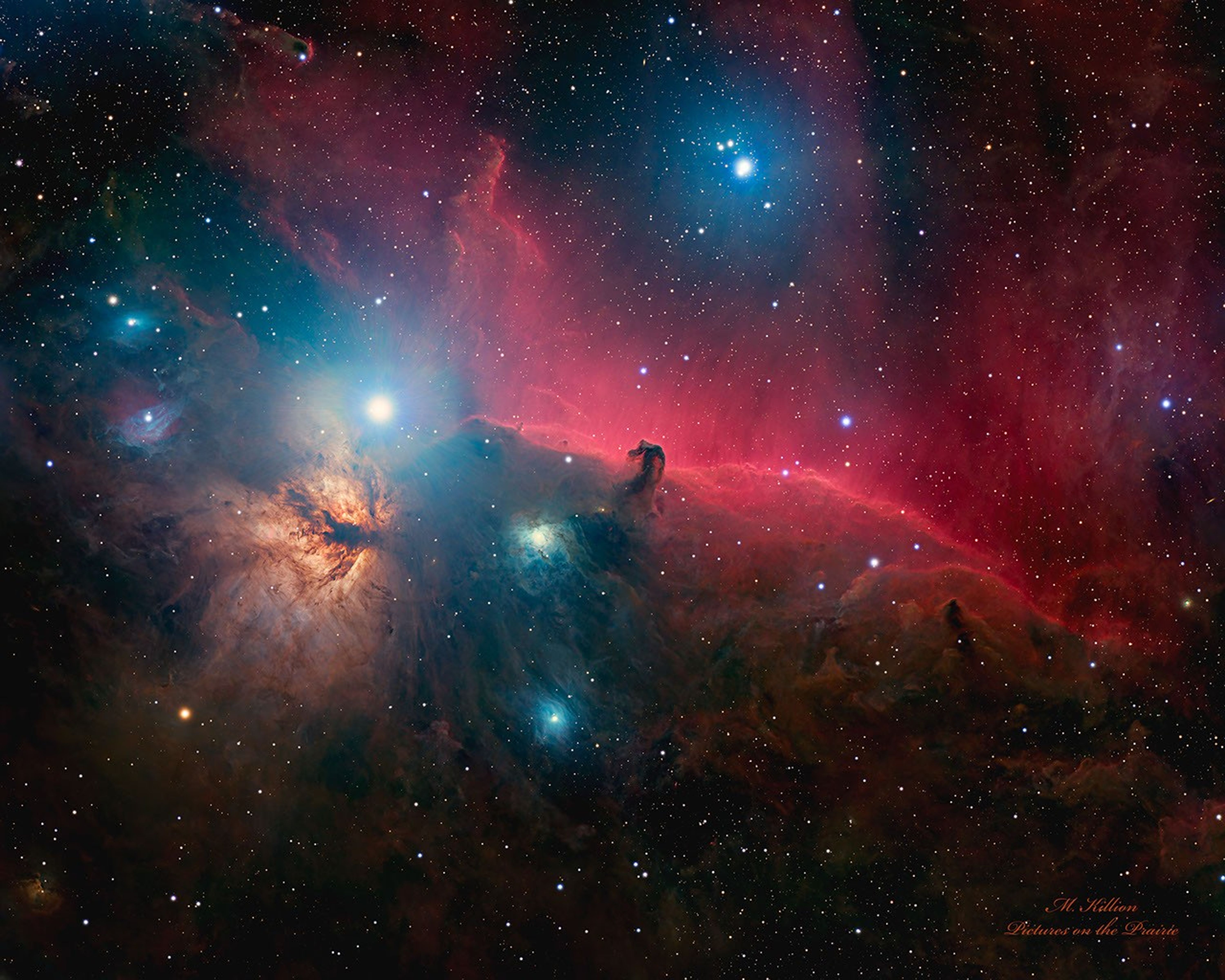
The scene in today’s Astronomy Picture of the Day looks less like a telescope image and more like a carefully composed canvas—an impression strengthened by the vivid blues, reds, and oranges spread across a famous patch of the constellation Orion. Those colors, however, are not artistic guesswork. They trace different physical processes and materials in a complex star-forming region.
Anchoring the view is Alnitak, the bright blue star positioned slightly left of center. Alnitak—also known as Zeta Orionis—is a triple star system and is widely recognized as the easternmost star in Orion’s Belt. Its intense light helps shape and illuminate the surrounding clouds.
Near the middle of the frame is one of astronomy’s most iconic silhouettes: the Horsehead Nebula. The dark shape resembles a horse’s head because it is a dense concentration of dust and gas that blocks light coming from behind. The structure rises about five light-years in height and sits roughly 1,500 light-years from Earth. Rather than glowing strongly on its own, the Horsehead stands out by contrast, appearing in front of a luminous red backdrop.
That red light is produced by hydrogen gas that has been ionized—its electrons stripped away—by energetic starlight. In this region, a key contributor is Sigma Orionis, a bright star near the top of the scene. The ultraviolet radiation from such stars energizes nearby hydrogen, which then emits the characteristic reddish hue seen across many nebulae.
To the left, the Flame Nebula adds a second major landmark. Its orange glow is laced with prominent dark lanes—filaments of colder dust cutting through brighter emission. The Flame sits in the same general neighborhood as the Horsehead, creating a striking contrast between glowing gas and obscuring dust.
Adding still more depth is NGC 2023, a blue reflection nebula located closer to the Horsehead. Unlike emission nebulae that shine due to ionized gas, reflection nebulae are dominated by starlight scattered by dust. NGC 2023 is also a site of active star formation, part of the broader Orion complex where new stars continue to emerge from collapsing clouds.
The “painted” look of the final image also reflects the effort behind it. The data were gathered over nearly six hours at the Utah Desert Remote Observatories. Although the telescopes were located in Utah, the astrophotographer operated the equipment from home in Illinois—more than 2,000 kilometers away—demonstrating how modern remote observing is expanding access to high-quality astronomical imaging.
Why it matters
Images like this are more than celestial portraits: they map where stars are being born and show how bright, massive stars reshape their environments. The growing use of remote observatories is also changing who can collect professional-grade data, enabling astronomers and skilled astrophotographers to work across long distances. Watch for further advances as remote systems and image-processing techniques continue to improve, revealing ever finer structure in nearby star-forming regions.