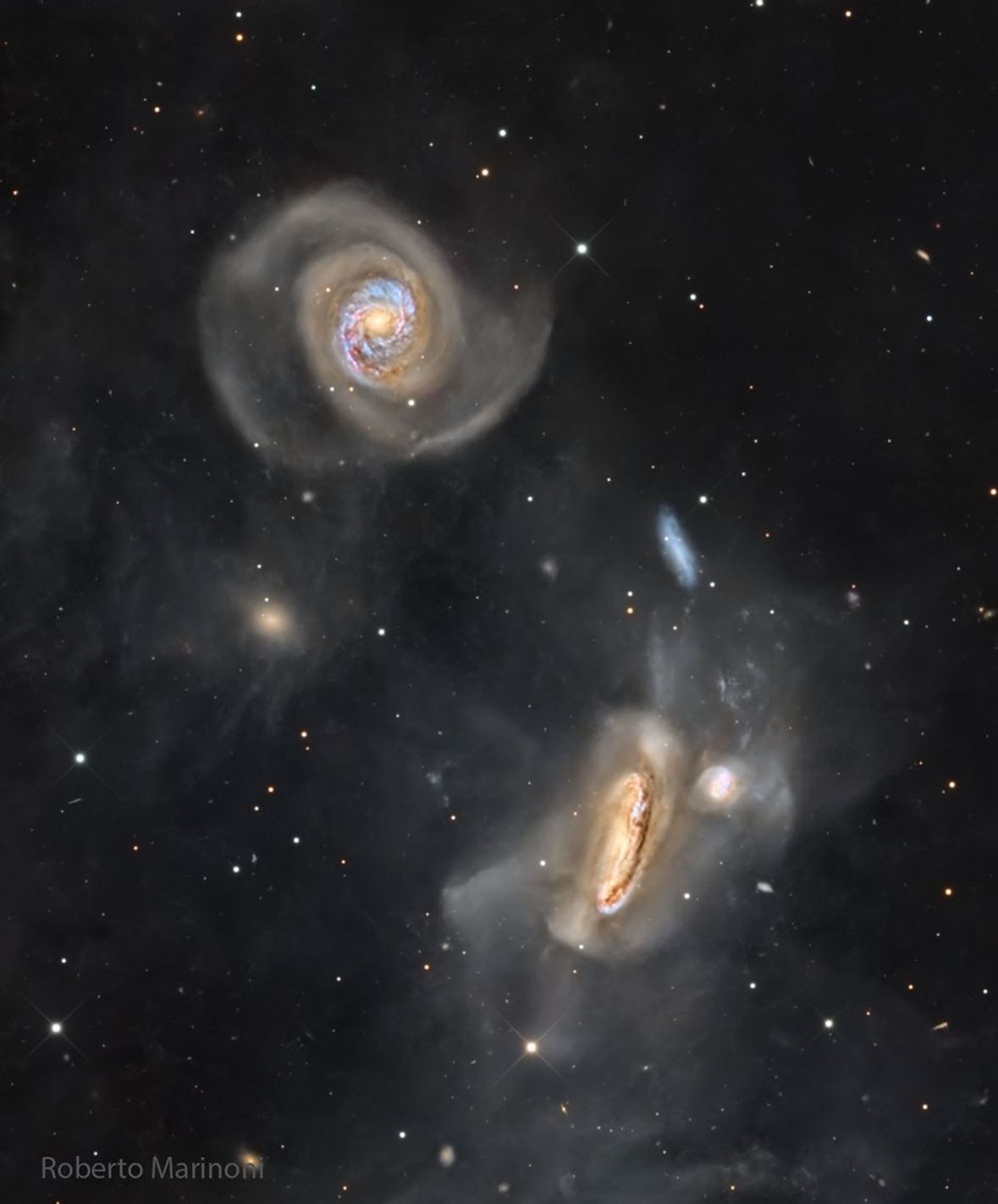
Astronomers are tracking the NGC 7771 Group in Pegasus, where repeated close passes are warping member galaxies with tidal streams. Over time, the system is expected to merge into one larger galaxy.
The calm-looking starfield in Pegasus is masking a slow-motion contest that will end with a single survivor. In the image, several galaxies show the telltale scars of earlier near-misses: faint, looping streams of stars and ring-like structures that have been pulled and reshaped by gravity during previous encounters.
Astronomers refer to this collection as the NGC 7771 Group, a small association of galaxies located nearly 200 million light-years from Earth in the direction of the constellation Pegasus. The dominant member of the group, NGC 7771, sits at the lower right of the frame. It is a barred spiral galaxy—its spiral arms extend outward from a bright central bar—and it spans roughly 75,000 light-years.
Near the upper left lies another major player, NGC 7769, a spiral galaxy that is almost comparable in size to NGC 7771. Around them are smaller companion galaxies, all bound together by mutual gravity. Their orbits bring them repeatedly past one another, and each close passage tugs at their disks, stirring up waves of star formation, stretching out tidal tails, and leaving behind subtle arcs and rings that can persist long after the galaxies separate.
But these separations are temporary. Over billions of years, the group’s continuing gravitational interactions are expected to drain orbital energy and angular momentum, making encounters progressively more disruptive. The prevailing expectation is that NGC 7771, NGC 7769, and their companions will ultimately merge, producing one much larger galaxy. Far from being a rare cosmic accident, astronomers view such mergers as a standard mechanism by which galaxies grow and evolve over cosmic time.
Systems like the NGC 7771 Group offer a nearby laboratory for understanding how these collisions unfold: how stellar disks are distorted, how gas is funneled inward, and how a collection of individual galaxies can be transformed into a single, more massive remnant. Observations of ongoing interactions also help researchers test models of galaxy dynamics and reconstruct the sequence of past encounters from the faint structures left behind.
These distant clashes have a local relevance, too. By studying galaxy groups caught in the act of merging, astronomers refine their expectations for what may happen when the Milky Way and the Andromeda Galaxy begin their own long-forecast gravitational dance.
Why it matters
Galaxy mergers shape the history of the universe by driving how galaxies grow, change form, and recycle gas into new generations of stars. The NGC 7771 Group provides an observable example of the same physics that will influence the future of our own galactic neighborhood. As instruments improve, astronomers will be able to trace even fainter tidal streams in such systems, revealing more of the mergers’ hidden timelines.