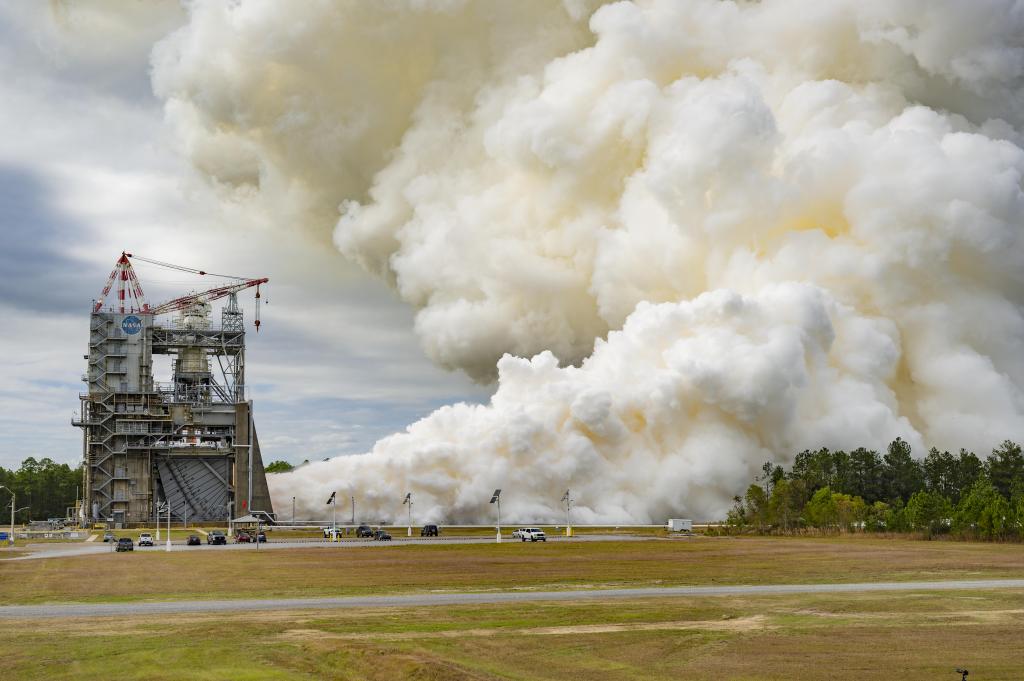
NASA completed a full-duration hot-fire of a developmental RS-25 engine at Stennis, collecting data to refine performance and boost reliability for Artemis SLS flights.
NASA has carried out another full-duration firing of an RS-25 rocket engine as it works to refine propulsion systems for upcoming Artemis missions to the Moon.
On Nov. 18, engineers tested RS-25 engine No. 10001 on the Fred Haise Test Stand at NASA’s Stennis Space Center, located near Bay St. Louis, Mississippi. The team ran the engine for 3 minutes and 20 seconds—200 seconds—matching the planned test time and replicating the kind of sustained performance required during a Space Launch System (SLS) ascent.
Engine No. 10001 is a developmental unit and is not slated to fly. Even so, NASA says the hot-fire campaign is designed to gather high-value measurements that can be used to improve how the RS-25 performs and how reliably it operates in future flights. The data will support NASA and its prime contractor for the engine work, L3Harris Technologies, as they evaluate engine behavior under realistic operating conditions and identify opportunities for enhancements.
The RS-25 is central to the SLS rocket, NASA’s heavy-lift launcher for the Artemis program. Each Artemis mission uses four RS-25 engines, which together can generate as much as 2 million pounds of thrust to propel the vehicle off the pad and into its climb toward space. Before any RS-25 is cleared for flight, it undergoes testing at Stennis to demonstrate readiness—a process NASA describes as part of ensuring engines are proven flightworthy ahead of launch.
The latest test also ties into the agency’s longer-term lunar timeline. NASA has said the Artemis IV Moon landing mission is currently planned for 2028. During that mission, astronauts would lift off from NASA’s Kennedy Space Center in Florida aboard the Orion spacecraft atop an SLS rocket. Artemis IV is positioned as a pivotal step in the broader Artemis strategy: expanding exploration at the Moon’s south polar region, progressing toward a sustained human presence on the lunar surface, and leveraging those capabilities toward the longer-range goal of sending the first crewed mission to Mars.
Operations at Stennis brought together personnel from NASA, L3Harris, and Nova Space Solutions, reflecting the joint government-industry teams that carry out the agency’s ground test program. For NASA, each successful hot fire adds another tranche of real-world engine performance information—an essential ingredient in reducing technical risk as Artemis flights move from preparation to execution.
Why it matters
Ground testing is where NASA can push engines through realistic conditions, capture detailed performance data, and address issues before astronauts ever board a rocket. Improvements derived from developmental tests like this one can translate into higher reliability for SLS launches supporting lunar missions later this decade. Watch for continued RS-25 firings at Stennis as Artemis hardware is qualified and refined ahead of the planned 2028 Artemis IV landing effort.