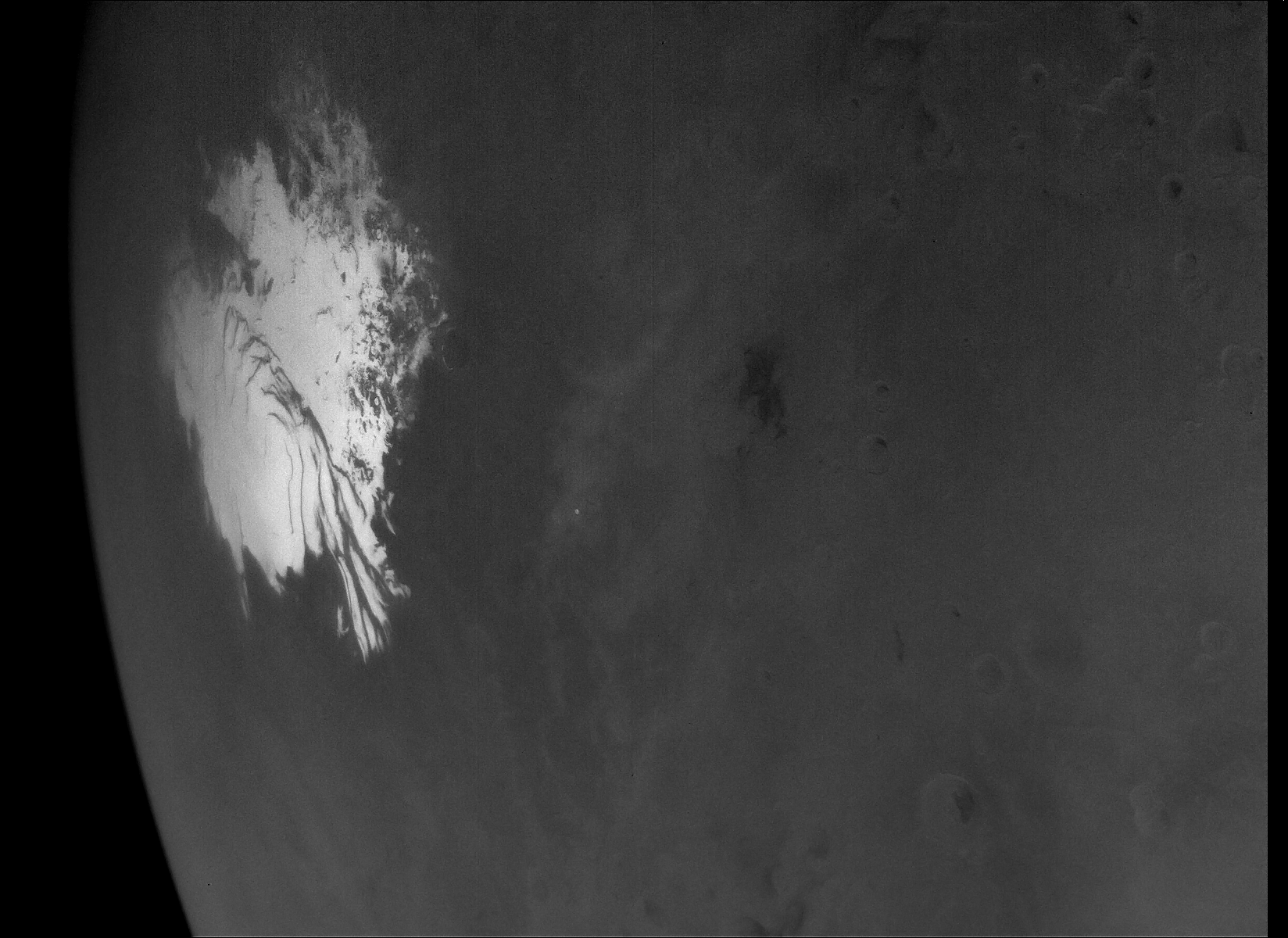
NASA’s Psyche spacecraft has returned its sharpest look yet at Mars’ southern polar region, capturing a detailed view of the planet’s water ice–rich south polar cap…
NASA’s Psyche spacecraft has returned its sharpest look yet at Mars’ southern polar region, capturing a detailed view of the planet’s water ice–rich south polar cap during a close flyby conducted for a gravity assist.
The image, taken with the spacecraft’s Imager A instrument, resolves surface features at a scale of about 0.7 miles per pixel (1.14 kilometers per pixel), making it the highest-resolution view of the south polar cap obtained by the Psyche mission to date. The polar cap itself spans more than 430 miles (700 kilometers) across, filling the frame with a bright, ice-dominated expanse that marks one of Mars’ most distinctive and scientifically important regions.
Psyche collected the observation on May 15, 2026, at roughly 1:53 p.m. PDT, as the spacecraft swept past Mars. The encounter was designed to use the planet’s gravity to reshape the spacecraft’s trajectory—an efficient maneuver that allows missions to gain speed or alter course without expending large amounts of propellant.
With Mars now receding behind it, Psyche is transitioning back to cruise mode and preparing to restart its solar-electric propulsion system. That ion-based engine technology, powered by the spacecraft’s solar arrays, will drive the next phase of the journey: a direct push toward the main asteroid belt, the broad population of rocky bodies that orbits the Sun between Mars and Jupiter.
The mission’s destination is the asteroid Psyche, a world that has long intrigued scientists because it is believed to be unusually metal-rich. Researchers think the object may represent part of the exposed core of an ancient planetesimal—one of the early building blocks that assembled into planets in the Solar System’s formative era. If that hypothesis holds, Psyche could offer a rare natural window into processes that typically remain hidden deep inside differentiated planets, where heavy elements sink and form cores.
NASA’s current flight plan calls for the spacecraft to reach the main belt in August 2029. Upon arrival, Psyche will conduct orbital insertion around its namesake asteroid, beginning an extended period of close-up study aimed at clarifying the body’s composition, history, and the role such objects played in early planetary formation.
More information about NASA’s Psyche mission is available from the agency.