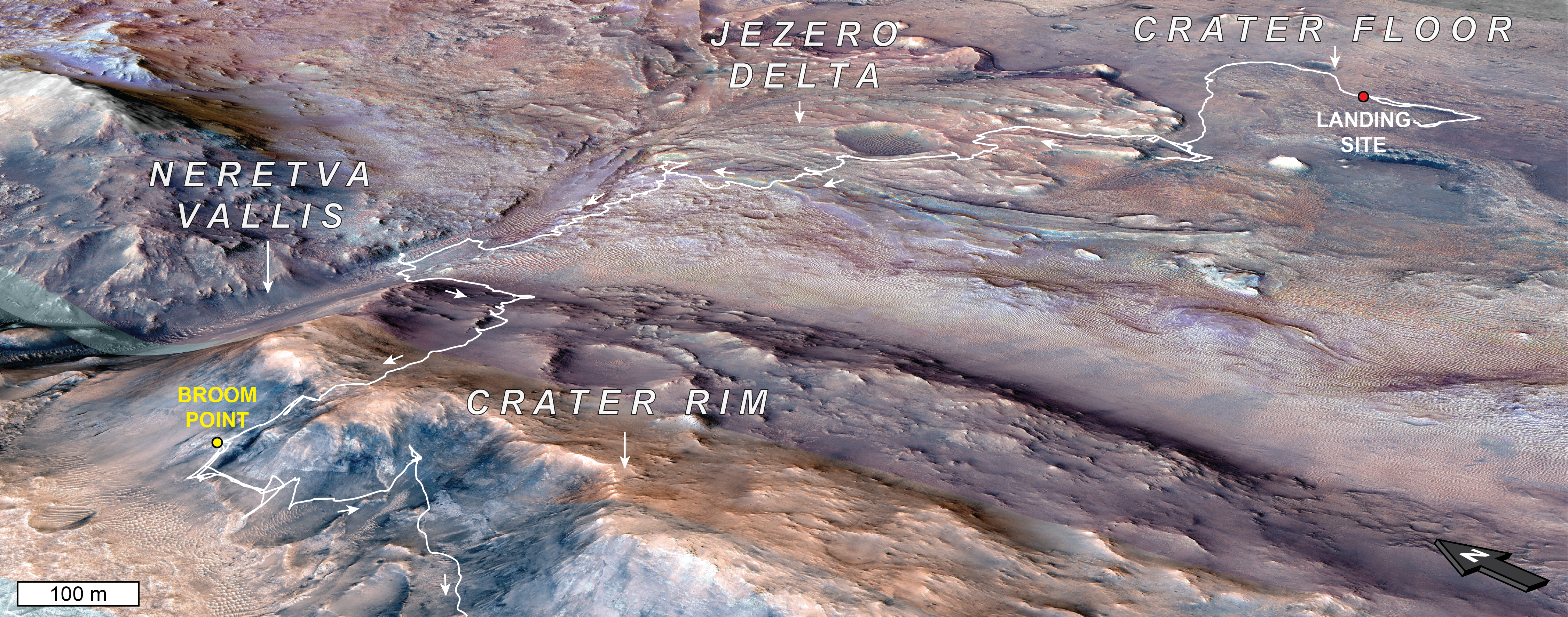
NASA’s Perseverance rover has traced a long, carefully planned route across Jezero Crater to reach a rocky target on the crater’s rim that researchers call the “Broom…
NASA’s Perseverance rover has traced a long, carefully planned route across Jezero Crater to reach a rocky target on the crater’s rim that researchers call the “Broom Point member”—a stacked sequence of layered bedrock that scientists believe could be older than 3.9 billion years.
An orbital map documenting the traverse captures the major phases of the mission since Perseverance touched down inside Jezero on Feb. 18, 2021. The rover’s early work focused on the crater’s western delta, where ancient sediments accumulated when water once flowed into the basin. From there, Perseverance pushed into the inlet river valley known as Neretva Vallis, continuing the campaign to read Jezero’s environmental history in its rocks.
The mission then turned toward higher ground. In December 2024, Perseverance crested the rim of Jezero Crater after completing a “rim-to-crest” ascent of about 2,620 feet (800 meters). That climb brought the rover out of the crater interior and onto the rim region, where older bedrock exposures are expected to reveal chapters of Mars’ past that predate the delta deposits.
The Broom Point region lies on the outer margin of that rim. Perseverance reached and investigated the area in mid-2025, adding another geologically distinct setting to its growing catalog of studied sites. The orbital map also marks, with a yellow dot, the location where the rover paused to take a selfie—an image that doubles as a record of its condition and surroundings at this latest milestone.
Behind the scenes, multiple teams and institutions support the rover and the spacecraft that help contextualize its journey. NASA’s Jet Propulsion Laboratory (JPL), managed for the agency by Caltech in Pasadena, California, built Perseverance and directs mission operations.
The rover’s Mastcam-Z imaging system—used to capture detailed panoramas and scout terrain—has its operations led by Arizona State University. The camera effort is carried out in collaboration with Malin Space Science Systems in San Diego, which contributed to the cameras’ design, fabrication, testing, and operational support. Additional collaboration came from the Niels Bohr Institute at the University of Copenhagen, which worked on the design, fabrication, and testing of Mastcam-Z’s calibration targets used to ensure accurate color and measurement performance.
Perseverance’s path is charted using images from orbit as well. JPL manages NASA’s Mars Reconnaissance Orbiter (MRO) for the agency’s Science Mission Directorate in Washington as part of the Mars Exploration Program. Lockheed Martin Space in Denver built MRO and continues to support its operations. The orbiter’s powerful HiRISE camera is operated by the University of Arizona in Tucson; HiRISE itself was built by Ball Aerospace & Technologies Corp. in Boulder, Colorado.
More information about Perseverance and MRO is available through NASA’s mission pages at science.nasa.gov/mission/mars-2020-perseverance/ and science.nasa.gov/mission/mars-reconnaissance-orbiter.