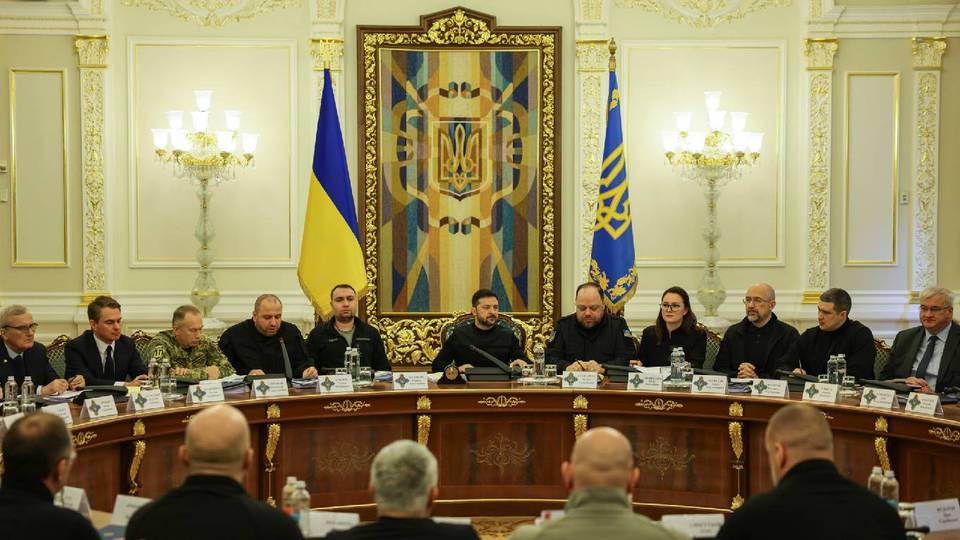
As Zelensky resists a unity government, calls grow to bring opposition into cabinet to strengthen oversight and curb corruption. US turmoil adds urgency.
Ukrainian President Volodymyr Zelensky has, on multiple occasions, dismissed calls to form a national unity government. His argument has been consistent: in wartime, the country needs clear lines of authority and a cabinet able to act quickly, not a coalition that might dilute decision-making or turn policy into a series of political compromises.
Yet the case for broadening the government is growing stronger. Bringing prominent opposition figures into senior posts would not simply be a gesture of political inclusion; it would rebuild internal safeguards that have weakened as Zelensky’s circle has become more dominant. In practice, a wider governing coalition could add oversight capacity at precisely the moment Ukraine’s state institutions are under immense strain—helping to curb corruption risks and restrain erratic or self-serving bureaucratic behavior that the president’s team is increasingly less able to police on its own.
The debate over governance reform is unfolding against an unsettled international backdrop. In Paris, attention has turned to Washington after US voters delivered a sharp political blow to Donald Trump’s camp in the recent midterm elections. It is tempting to interpret that outcome as the beginning of the end of Trump’s disruptive role in world affairs.
That conclusion may be premature. American history suggests that presidents who are politically weakened at home often shift their focus abroad, where constitutional and institutional limits can be looser and where executive authority is comparatively expansive. Foreign policy is one arena in which a US president can still act decisively without the same level of day-to-day constraint imposed by domestic politics.
For Trump—often described by critics as restless, attention-seeking, and driven by personal spectacle—such a dynamic would be an invitation to remain highly active on the international stage. Even as he fixates on his own image and personal projects, the logic goes, he could continue to insert himself into global crises and negotiations, producing unpredictable consequences far beyond US borders.
In that environment, Ukraine’s internal political architecture matters as much as battlefield developments. Kyiv’s ability to sustain public confidence and reassure partners depends not only on military performance but also on transparent governance and credible mechanisms of accountability. A national unity government, by incorporating opposition leaders into the cabinet, could strengthen the perception—and the reality—of checks and balances. It could also reduce the likelihood that administrative missteps, corruption scandals, or uncoordinated bureaucratic actions undermine Ukraine’s war effort and its standing with international supporters.
Zelensky’s reluctance is understandable: coalitions are messy, and wartime politics can be unforgiving. But the pressure on Ukraine’s institutions is intensifying, and external uncertainty—especially in US politics—raises the stakes for getting governance right at home.
Why it matters
Ukraine’s capacity to keep foreign aid flowing and maintain public trust hinges on the credibility of its institutions, not just its military strategy. If US politics becomes more volatile and US foreign policy more personalized, Kyiv may face sharper scrutiny from allies and donors. A broader governing coalition could serve as a stabilizing signal—internally and internationally—at a moment when external shocks are increasingly likely.