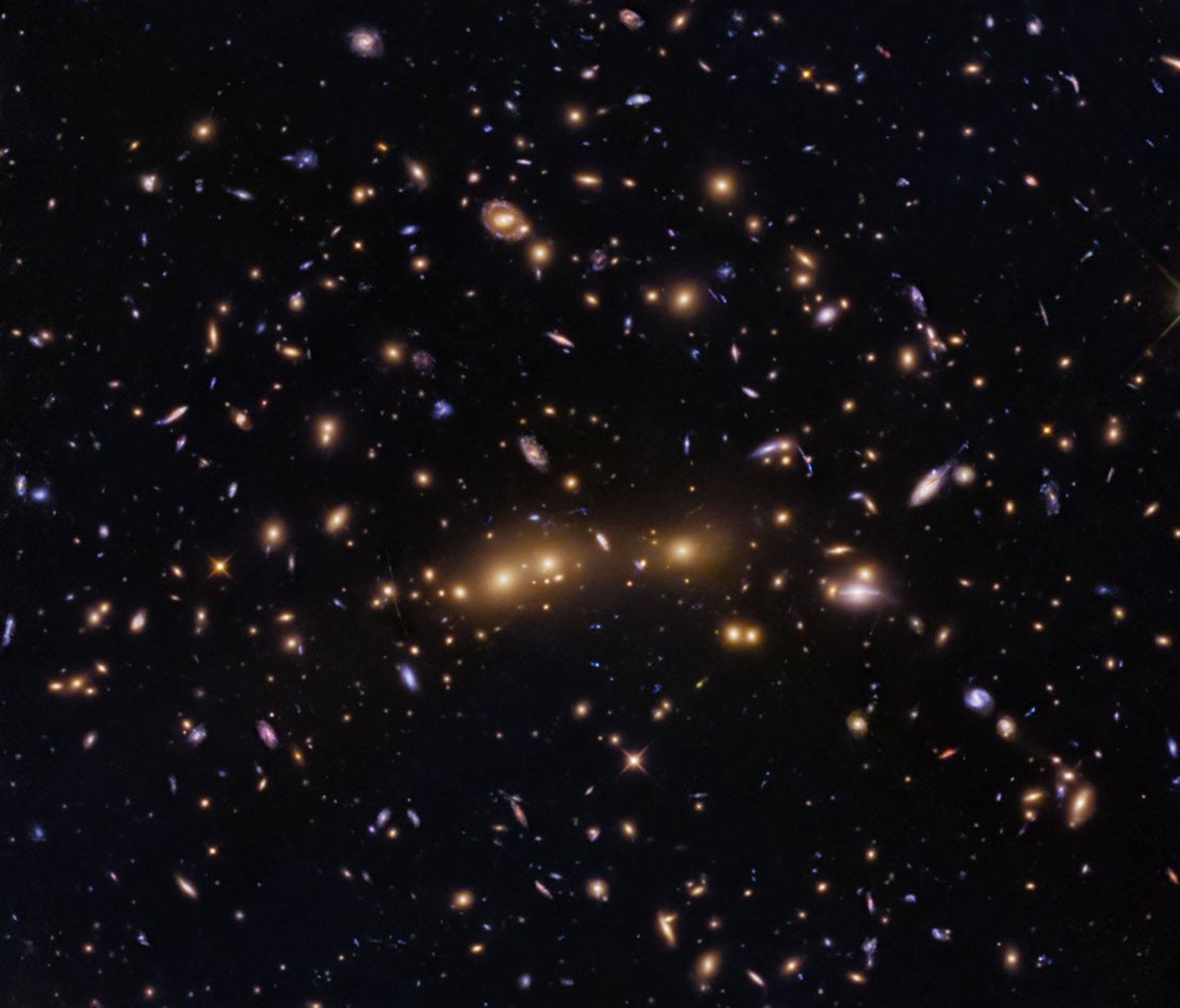
Hubble has captured a detailed view of the galaxy cluster known as CL0016+1609, also cataloged as MACS J0018.5+1626—an object so luminous in X-rays that it has become a…
Hubble has captured a detailed view of the galaxy cluster known as CL0016+1609, also cataloged as MACS J0018.5+1626—an object so luminous in X-rays that it has become a prime target for astronomers studying galaxy clusters across the electromagnetic spectrum. Observations at X-ray and radio wavelengths have made it one of the most closely examined clusters of its kind, and those X-ray data have delivered a crucial insight: CL0016+1609 is not a single, relaxed system, but two galaxy clusters in the process of merging, aligned largely along our line of sight from Earth.
To investigate that collision in greater depth, researchers sought observing time with the Hubble Space Telescope’s Advanced Camera for Surveys. The goal was not simply to produce a sharper image of the galaxies, but to build a more accurate map of how mass is distributed throughout the cluster—especially the elusive dark matter that dominates the cluster’s total mass. Understanding where that dark matter resides helps scientists reconstruct how the merger is unfolding and assess how CL0016+1609 fits into the universe’s larger web-like structure of matter.
Although dark matter does not emit, absorb, or reflect light that Hubble can detect directly, the telescope can still trace its presence. Hubble’s visible and infrared observations can reveal the effects of gravitational lensing, in which the cluster’s mass—including its dark-matter component—bends and magnifies the light from more distant background galaxies. By measuring subtle distortions and stretched images of these faraway galaxies, astronomers can infer the cluster’s underlying mass distribution with far greater precision than would be possible from the luminous matter alone.
The image also incorporates data from Hubble’s Wide Field Camera 3 gathered through a major program designed to broaden this kind of work. That effort, the Reionization Lensing Cluster Survey (RELICS), set out to obtain the first Hubble infrared images of 46 massive galaxy clusters and to use them as cosmic magnifying glasses in the search for extremely distant galaxies. RELICS identified roughly 300 candidate high-redshift galaxies whose light has been gravitationally lensed by the surveyed clusters.
In the CL0016+1609 scene, the lensing signatures are visible as arcs—streaks of light created when a background galaxy is warped by the cluster’s gravity. One faint, nearly vertical arc appears just to the left of the large elliptical galaxies near the image’s center. A second arc is easier to spot: brighter, though shorter, it sits above and to the right of those same central ellipticals. These features are not mere visual curiosities; they are among the key measurements that allow researchers to connect what Hubble sees—galaxies and their distorted shapes—to what it cannot see directly: the distribution of dark matter driving the cluster’s gravitational pull.
Since its launch in 1990, NASA’s Hubble Space Telescope has repeatedly reshaped humanity’s view of the cosmos, and images like this one show how it continues to serve as both a portrait artist and a precision tool for probing the universe’s hidden structure.