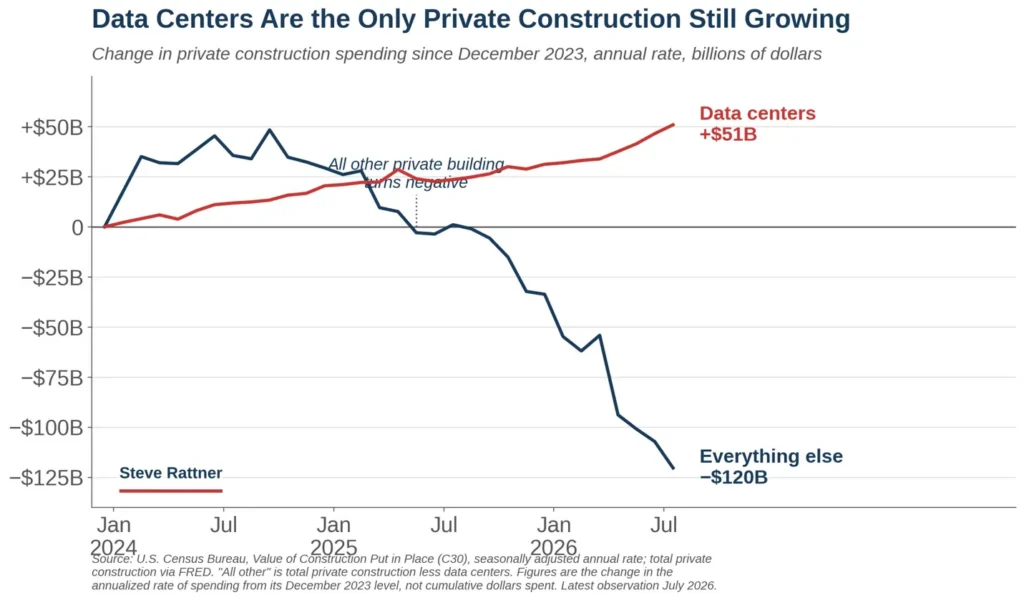
Charts citing a $51bn data-center boom claim it crowds out other investment, but the math and GDP-share framing mislead; in real dollars, non-tech spending still rises.
Charts circulating in the economic debate—amplified by Paul Krugman and others—have fueled a simple storyline: the surge in data center construction is “crowding out” other kinds of business investment. The most commonly cited figure is about $51 billion in annual data center construction spending. The claim is that this boom is squeezing funding for everything else.
There’s an immediate arithmetic issue. In the version of the argument popularized by Steven Rattner’s chart, data centers are shown rising while “everything else” sits around $120 billion—implying that the smaller category is somehow pushing the much larger one aside. Even in the textbook “loanable funds” framework that economists use to describe crowding out, the effect is not typically one-for-one. When investment demand rises, interest rates tend to increase; those higher rates discourage some marginal projects elsewhere, but they also encourage additional saving. The result is that other investment would be expected to decline by less than the new investment surge—not collapse dollar-for-dollar.
It’s also worth noting that “crowding out” is most often discussed in the context of government borrowing, not private investment. Private borrowers must persuade lenders that projects will pay off; when funds flow toward higher-return uses, that’s usually described as reallocation toward more productive activity rather than a policy problem. Government borrowing, by contrast, doesn’t face the same market test, which is why economists tend to emphasize its potential costs.
Krugman has offered an alternative chart that looks more plausible at first glance: it compares “tech” investment with other investment as shares of GDP. But that shift introduces two complications. First, the scale changes dramatically. Rattner’s story centers on data centers rising toward 539 billion over a similar span—suggesting a much broader bucket than data centers or AI infrastructure as commonly discussed. In other words, the argument draws on public frustration about data centers while the data reflect something considerably larger.
Second, ratios can mislead when the denominator—GDP—is growing. If one slice of GDP expands faster than another, the slower-growing slice can shrink as a share even if it is still rising in absolute terms. When the same series are replotted in real dollar terms, the pattern looks less like an outright squeeze. Between 2023 Q2 and 2026 Q2, real tech investment rises by about 46%, while other real investment increases by about 3%. Non-tech investment does soften after peaking in 2024, but it remains above its starting point.
That doesn’t prove crowding out is nonexistent—other investment might have been stronger absent the tech boom. But it does move the debate from claims of an absolute displacement to something more speculative: a counterfactual that cannot be established from these charts alone.
Interest rates are often invoked as the mechanism, yet the timing is awkward for a data-center-driven story. Real rates climbed sharply before the AI investment boom. The average 10-year TIPS yield rose from around −1.00% in late 2021 to about 1.49% in late 2022. Over the periods emphasized in the Rattner and Krugman visuals, the additional increase is only about 0.5 to 0.68 percentage points—a modest move on which to hang a sweeping crowd-out claim. Today’s real rates, around 2–3%, are close to long-run norms and not obviously prohibitive for worthwhile projects.
So why did real rates rise? There are multiple plausible drivers: normalization after unusually low pandemic-era rates, large federal borrowing needs, or even changing expectations about future wealth that reduce saving today. One more clue: real rates have risen across advanced economies, not just in the United States—suggesting broader forces than a single domestic wave of data center construction.
Why it matters
The crowding-out narrative shapes how policymakers and the public judge the AI buildout: as productive investment or as a distortion that starves the rest of the economy. If the evidence mainly shows faster tech growth rather than collapsing non-tech spending, the case for alarm is weaker—and the focus shifts to whether the new capital is genuinely high-value. The next test will be whether elevated tech investment sustains productivity gains without a prolonged slump in other business investment.