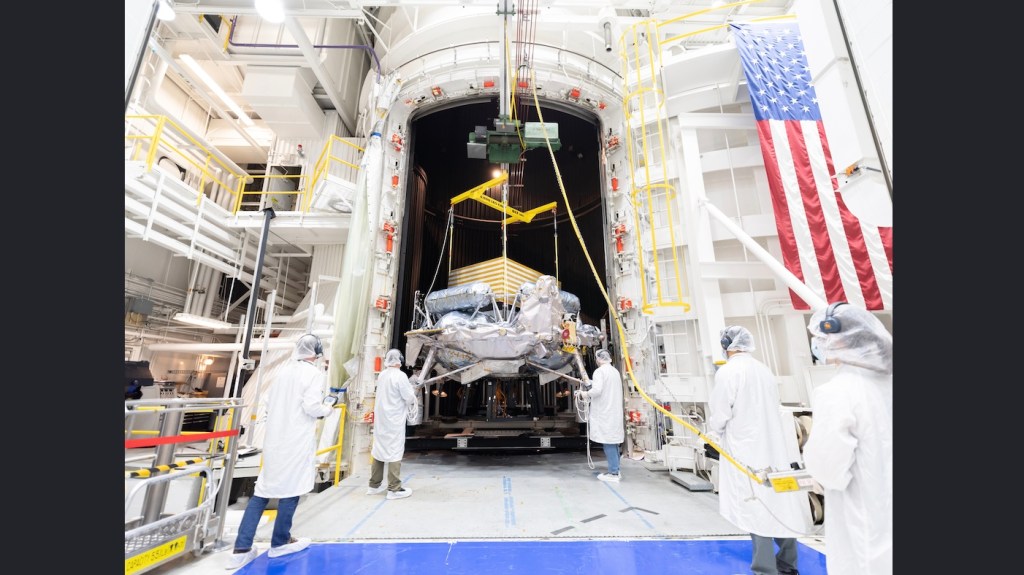
Voyager Technologies’ Griffin‑1 Moon lander has completed key qualification tests at NASA’s JPL, clearing a major hurdle for its CLPS mission delivering cargo and instruments to the lunar south pole.
A commercial Moon lander slated to play a central role in NASA’s push toward a sustained lunar presence has completed a major round of qualification testing at the agency’s Jet Propulsion Laboratory (JPL) in Southern California. The campaign put Voyager Technologies’ Griffin Mission One (Griffin‑1) spacecraft through conditions designed to replicate what it will endure from liftoff through operations on the lunar surface: hard vacuum, extreme hot-and-cold cycles, violent launch vibrations, and punishing acoustic loads.
The results indicate the lander is prepared for the physical stresses of spaceflight, clearing an important hurdle ahead of launch. Griffin‑1 is part of NASA’s Commercial Lunar Payload Services (CLPS) effort, which uses competitively selected commercial providers to deliver science and technology to the Moon in support of the agency’s broader Moon Base Program goals. Voyager expects Griffin‑1 to fly later this year on a SpaceX Falcon Heavy.
Once en route, Griffin‑1 is intended to deliver more than 1,100 pounds (455 kilograms) of cargo to Nobile Crater near the Moon’s south pole—making it an “infrastructure-class” lunar lander. The mission manifest includes 10 science instruments and technology demonstrations contributed by six countries. Among them is Astrolab’s FLIP (FLEX Lunar Innovation Platform) rover, described as the largest commercial payload yet slated for delivery to the lunar surface.
JPL’s Environmental Test Laboratory—whose heritage stretches back to the Ranger missions that returned NASA’s first close-up lunar images in the mid‑1960s—hosted the work. “We’re proud to provide our expertise and facilities to support this new phase of commercial lunar exploration,” said Charles Whetsel, manager of JPL’s Exploration Systems Development Office, noting the lab’s long history of qualifying robotic spacecraft.
Testing began in July, after the 2,789‑pound (1,265‑kilogram) lander was transported by road from Voyager Lunar Systems’ manufacturing site in Pittsburgh to JPL’s campus at the foot of the San Gabriel Mountains. Engineers first assessed Griffin‑1’s mass properties by rotating it on a specialized table to precisely characterize how its weight is distributed. That information is used to predict and control how a spacecraft will behave during maneuvers and is particularly important for navigation and landing stability.
The team then verified that the lander’s electronics can operate without self-inflicted interference. Inside an anechoic chamber—lined with foam wedges that absorb both sound and electromagnetic reflections—Griffin‑1 underwent electromagnetic interference and electromagnetic compatibility testing to ensure onboard systems won’t disrupt one another.
To simulate launch stresses, the spacecraft was bolted to a “shaker table” and vibrated along three axes, while hundreds of sensors tracked its response as the intensity increased. For the acoustic environment of liftoff, powerful horns driven by compressed nitrogen filled a sealed chamber with sound levels reaching 153 decibels.
The capstone was thermal-vacuum testing in JPL’s famed 25‑Foot Space Simulator, a facility listed on the National Register of Historic Places for its contributions to programs including Ranger, Surveyor, Mariner, and Voyager, and later used to support missions such as the Perseverance Mars rover and Europa Clipper. Over roughly two weeks beneath the chamber’s 85‑foot (26‑meter) ceiling, Griffin‑1 cycled between heat as high as 167°F (75°C) and cold down to −148°F (−100°C) in near-vacuum, approximating the extremes of deep space transit and lunar surface operations.
“Seeing the spacecraft complete this demanding environmental testing is a major milestone,” said John Thornton, Voyager’s executive vice president, calling Griffin‑1 a key step toward delivering “infrastructure and capabilities” to the lunar south pole.
Why it matters
NASA is increasingly relying on commercial lunar delivery services to accelerate science, technology demonstrations, and infrastructure buildup near the Moon’s south pole—an area crucial for long-term exploration plans. Passing environmental qualification at JPL reduces technical risk ahead of launch and supports confidence in CLPS missions that carry international payloads. The next watchpoint is the mission’s final integration and launch readiness as Griffin‑1 moves from test success to flight execution.