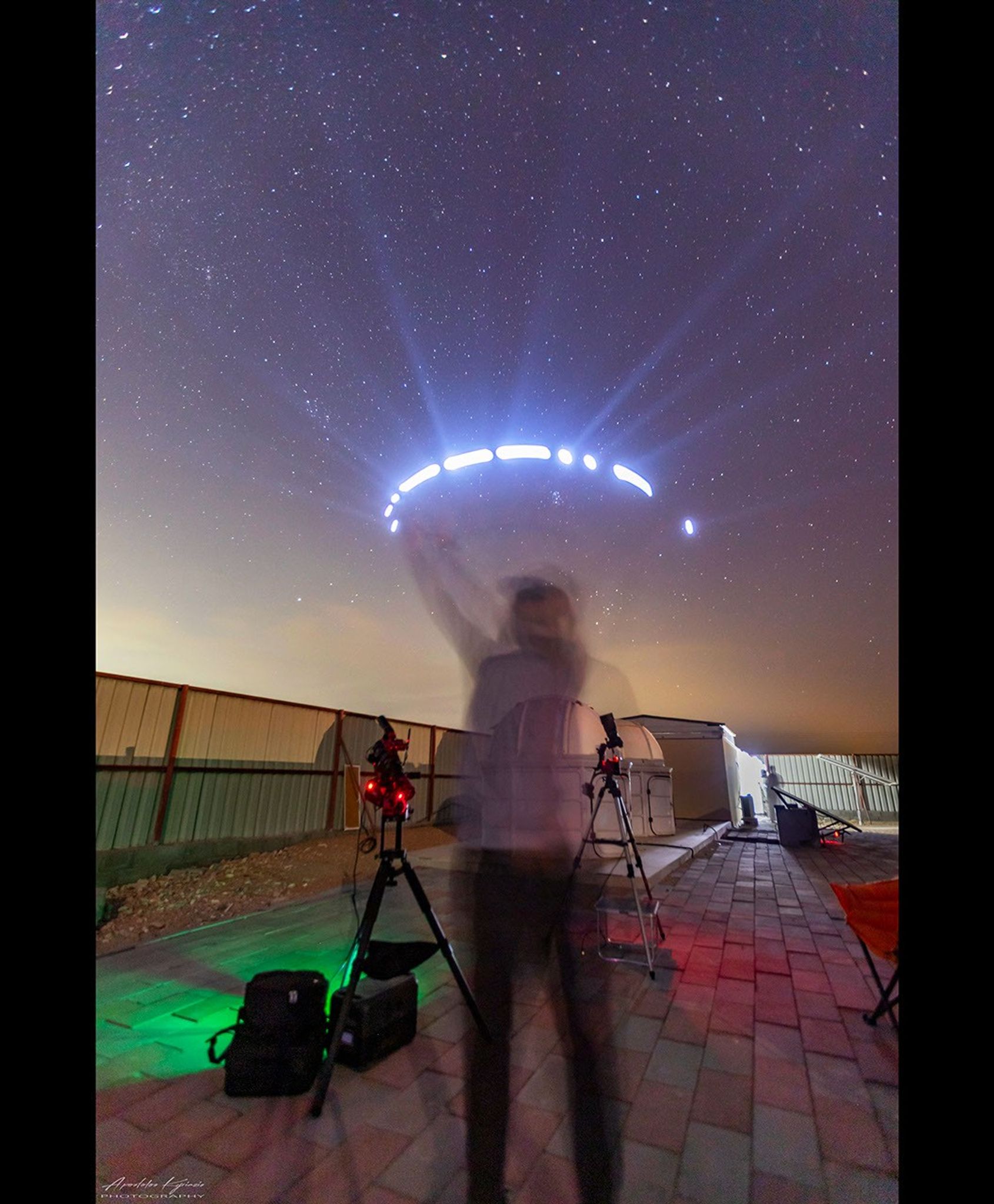
Astronomers blinked a Morse code “V-G-R” salute to Voyager 1 as it reached a one light-day distance from Earth, meaning signals now take about 24 hours to arrive.
On November 17, space enthusiasts on Earth took part in an unusual salute to a spacecraft that has been traveling outward for nearly half a century. From the Emirates Astronomical Observatory, observers aimed a flashlight into the night and switched it on and off to form a Morse code message. In a long-exposure photograph, the blinking beam appears as a sequence of bright marks that spell out “V-G-R” — a nod to Voyager 1, humanity’s farthest-flung spacecraft.
The three letters serve as a call sign for Voyager 1, which is now cruising through interstellar space at an immense distance: about 26 billion kilometers from Earth. The gesture was not just symbolic. It also highlighted a milestone that connects human timekeeping to the physics of light itself: how long a signal must travel to reach the probe.
At the speed of light, the answer is exactly one day. Voyager 1 has reached a distance where a message transmitted from Earth — whether a radio command from NASA’s Deep Space Network or a beam of light in an imaginative demonstration — requires about 24 hours to arrive.
That “one light-day” benchmark was confirmed on November 18 at 10:16:07 UTC. The moment came nearly 50 years after Voyager 1 lifted off in 1977, beginning a mission that would far outlast its original goals. While the spacecraft is famous for its close-up reconnaissance of the outer planets early in its journey, it has since become a working envoy in the space between the stars, returning measurements from a region no other human-built object had previously explored.
The event also invites a bit of perspective through arithmetic. If Voyager 1’s outward progress is compared to the scale of light-travel time, it has effectively taken about 50 years to get one light-day away. A light-year contains 365 light-days. Using the same rough pace, Voyager 1 would not reach a distance of one light-year from Earth for another 18,250 years.
Seen through the camera’s time exposure, the Morse-coded “V-G-R” is a simple streak of light over a terrestrial observatory — a reminder that even as Voyager 1 moves through interstellar space, people on Earth still find ways to connect with it, measure its remoteness, and mark its progress in human terms.
Why it matters
Voyager 1’s one-light-day milestone underscores just how vast interstellar distances are, even for the fastest signals we can send. It affects how scientists operate and communicate with deep-space missions, where timing and patience are built into every command and response. As Voyager 1 continues outward, its ongoing measurements offer rare data about the environment beyond the Sun’s immediate influence — information that will shape future plans for exploring interstellar space.