NASA has named a four-person crew for Artemis III, a mission now positioned as a pivotal rehearsal for the agency’s return-to-the-Moon campaign—even as the first crewed…
NASA has named a four-person crew for Artemis III, a mission now positioned as a pivotal rehearsal for the agency’s return-to-the-Moon campaign—even as the first crewed lunar landing under the program has slipped beyond earlier expectations.
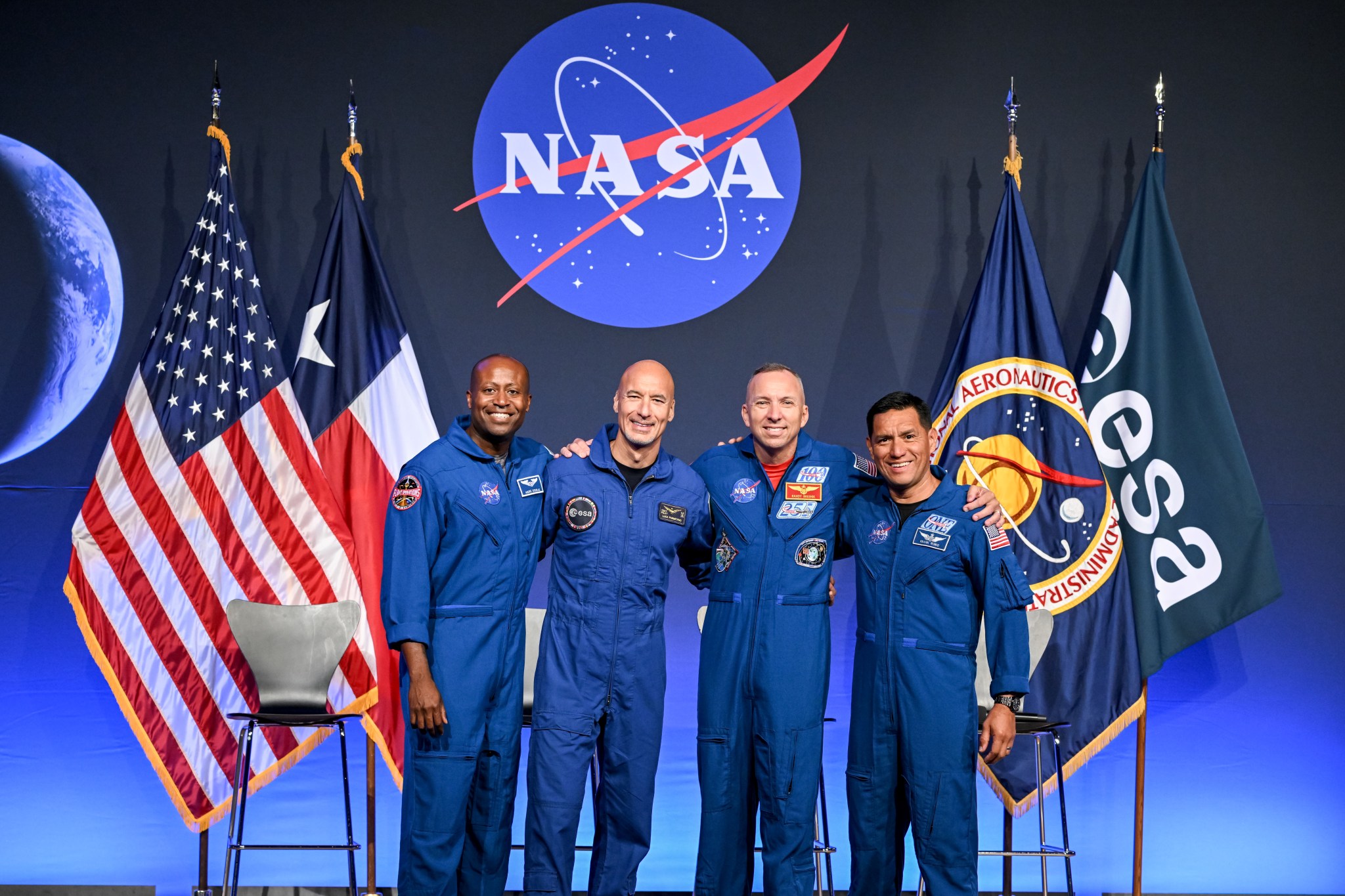
In a group photo taken June 9, 2026, NASA astronaut Andre Douglas stood alongside ESA (European Space Agency) astronaut Luca Parmitano and NASA astronauts Randy Bresnik and Frank Rubio, shortly after the agency announced them as the Artemis III crew. The selection underscores NASA’s intent to blend deep operational experience with international partnership as it moves from demonstration flights toward sustained lunar exploration.
A mission redefined by schedule and strategy
Artemis III was originally framed as the program’s first crewed lunar landing. But in the latest planning laid out in agency briefings and technical updates, NASA is now targeting early 2028 for that first landing attempt—an objective the agency says has remained unchanged since mid-2025. To bridge the gap and reduce risk, NASA has added a new crewed demonstration flight in low Earth orbit, scheduled for 2027, intended to test integrated operations between the Orion spacecraft and one or more commercial lunar landers being developed by U.S. industry.
That shift reflects a broader Artemis strategy: increase mission cadence, standardize the Space Launch System (SLS) rocket configuration, and introduce intermediate demonstrations to prove complex systems together before committing astronauts to a lunar surface sortie. Once the architecture is validated, NASA anticipates launching a lunar surface mission by late 2028 using a standard SLS configuration, with subsequent missions planned roughly annually.
Orion and SLS: the backbone of crewed deep-space flight
At the center of the Artemis transportation system is Orion, the crew vehicle designed to carry astronauts beyond low Earth orbit and return them safely to Earth. Orion is launched by the SLS, NASA’s heavy-lift rocket, which the agency describes as uniquely capable of sending Orion, crew, and cargo toward the Moon in a single launch—offering high departure energy and large payload capacity.
The program’s credibility was strengthened by Artemis I in 2022, when SLS lifted off from Florida and sent Orion on a roughly 1.4-million-mile journey beyond the Moon and back, a mission meant to qualify the combined system for human flights. Artemis II—billed as the first crewed Artemis mission—remains the next major step, aimed at proving Orion’s life-support and human-rated performance in deep space and setting the stage for surface missions.
On the ground, teams at Kennedy Space Center’s Exploration Ground Systems are responsible for processing, launching, and recovering the rockets and spacecraft—an often-overlooked but essential part of building a repeatable cadence of missions.
Commercial landers, new spacesuits, and a lunar logistics pipeline
A major variable in Artemis scheduling is the readiness of the Human Landing System: commercial landers being developed to ferry astronauts from lunar orbit to the surface and back. NASA has selected industry partners, including SpaceX and Blue Origin, and now plans a 2027 low Earth orbit demonstration to test critical elements of those systems and their interfaces with Orion.
Other elements of the lunar “toolkit” are advancing in parallel. NASA’s Extravehicular Activity and Human Surface Mobility work is focused on next-generation spacesuits, tools, and human-rated rovers, all intended to enable astronauts to operate safely and productively on the lunar surface. Meanwhile, the Commercial Lunar Payload Services initiative is flying science and technology payloads to the Moon through competitively purchased delivery services—an approach NASA argues both accelerates lunar research and helps mature technologies needed for crewed operations.
International rules and an orbital outpost
NASA continues to present Artemis as both a science program and a geopolitical partnership framework. In 2020, the United States, coordinating with the State Department and an initial group of partner nations, established the Artemis Accords—principles intended to guide civil exploration and cooperation. The inclusion of an ESA astronaut on the newly announced Artemis III crew aligns with that emphasis on allied participation.
Gateway, a planned small space station in lunar orbit, is also described in program planning as central to long-term Artemis goals—supporting science in lunar orbit, serving as a staging point for surface missions, and acting as a stepping stone toward Mars.
Why NASA says the Moon still matters
NASA’s public rationale for returning is broader than flags-and-footprints: the agency argues the Moon preserves clues about the evolution of Earth, the planets, and the Sun, and that some high-priority questions are best tackled by on-site human explorers working with robotic systems in orbit and on the surface. Artemis is also explicitly framed as preparation for Mars, which remains NASA’s long-term human exploration horizon because it is one of the few places where life may once have existed.
With the Artemis III crew now named, the mission has become a marker of continuity in a program adapting to technical realities. The next two years—focused on integrated testing, industrial lander development, and the step-by-step proving of systems—will determine whether NASA can turn Artemis from a sequence of demonstrations into a sustained human presence around and, ultimately, on the Moon.