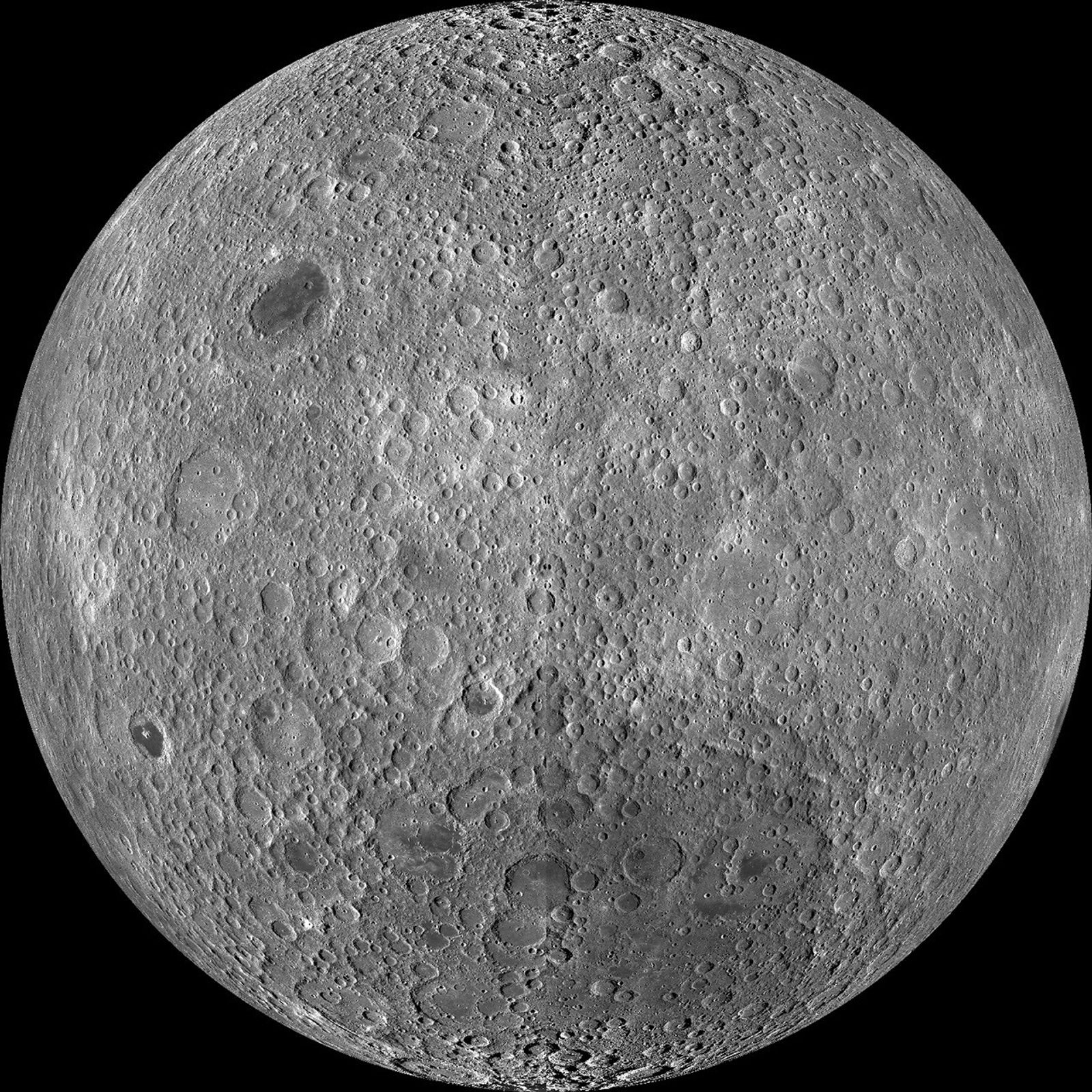
A new Lunar Reconnaissance Orbiter mosaic sharpens views of the Moon’s farside, revealing its rugged, heavily cratered terrain and scant volcanic plains versus the nearside.
Earth’s view of the Moon is famously repetitive. Because the Moon is tidally locked—rotating once in the same time it takes to orbit—people on Earth always see essentially the same face, known as the nearside. But spacecraft circling the Moon have made the opposite hemisphere far less mysterious.
A newly highlighted image offers a detailed look at that hidden half. The picture is a crisp mosaic assembled from the Lunar Reconnaissance Orbiter (LRO), using its wide-angle camera to map the terrain. Centered on the lunar farside, the view is drawn from a much larger global composite built from more than 15,000 individual images captured over an extended observing campaign from November 2009 through February 2011.
At its highest-resolution presentation, the mosaic reveals surface details at a scale of about 100 meters per pixel—fine enough to trace the outlines of countless impact scars and the rugged texture of the highlands. The farside appears rougher and more heavily battered than the hemisphere that faces Earth, a contrast that has long stood out in lunar science.
The difference is especially striking when set against the nearside’s broad, dark plains called lunar maria. Those smoother regions formed when molten rock from the Moon’s interior flooded large basins and cooled into darker volcanic surfaces. On the farside, such maria are far less extensive, leaving a landscape dominated by brighter, older crust and dense impact cratering.
Researchers have pointed to a plausible reason for this split personality: the lunar crust on the farside is thought to be thicker. A thicker crust would make it more difficult for interior melts to reach the surface, limiting the formation of widespread volcanic plains. The result is a hemisphere that preserves more of its ancient, heavily cratered face, while the nearside bears more visible marks of later volcanic resurfacing.
The LRO mosaic underscores how orbital mapping has transformed lunar exploration. What was once literally out of sight has become a well-charted world, allowing scientists to compare the Moon’s two hemispheres in consistent detail and test ideas about how its crust formed and evolved.
Why it matters
Understanding why the Moon’s farside looks so different from its nearside helps scientists reconstruct the Moon’s geological history and internal structure. That knowledge influences where future missions may target for sampling, landing, and resource studies, especially as more countries plan lunar exploration. Continued high-resolution mapping and new farside measurements will be key to confirming how crust thickness and volcanism shaped the Moon we see today.