NASA’s Nancy Grace Roman Space Telescope has reached the Florida spaceport where it will be prepared for launch, marking a major milestone for a mission designed to…
NASA’s Nancy Grace Roman Space Telescope has reached the Florida spaceport where it will be prepared for launch, marking a major milestone for a mission designed to dramatically expand astronomers’ view of the universe.
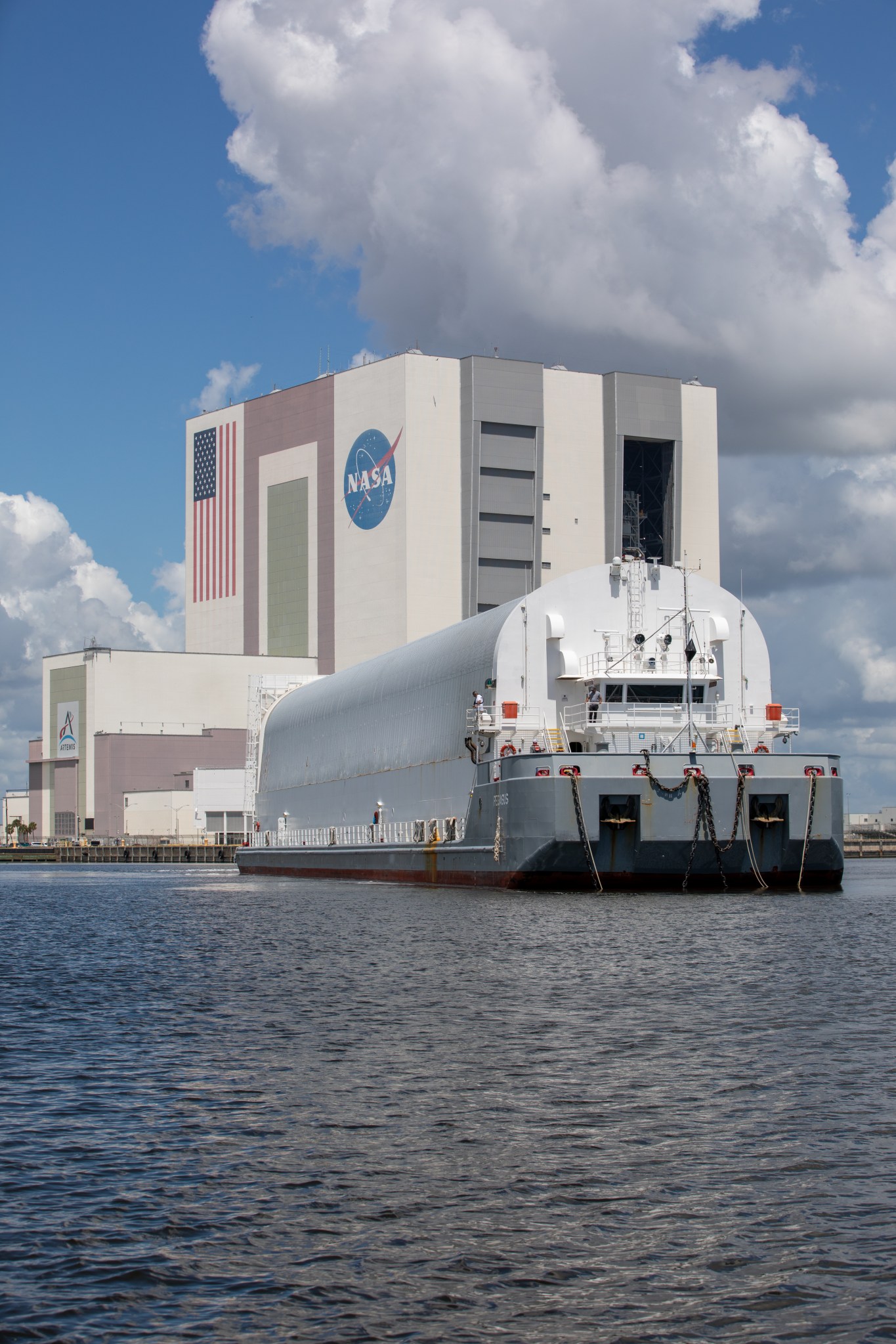
A photograph taken June 21, 2026, shows the observatory arriving at NASA’s Kennedy Space Center aboard the agency’s Pegasus barge. After being unloaded, the spacecraft is to be moved to Kennedy’s Payload Hazardous Servicing Facility, where teams will begin the careful processing and checkouts required before it can be sent to the launch pad. NASA is currently aiming for a liftoff date no earlier than Sunday, Aug. 30, 2026.
The telescope is named for Nancy Grace Roman, NASA’s first chief astronomer and a pioneering advocate for space-based astronomy who is widely credited with laying the groundwork for what became the Hubble Space Telescope—earning her the nickname the “mother of Hubble.” The mission that bears her name is intended to build on that legacy with a different kind of power: an exceptionally wide view of the sky.
Roman’s survey instrument is expected to capture images with a field of view more than 100 times larger than Hubble’s, enabling it to scan large swaths of space quickly while still delivering high-resolution observations. That combination is central to the mission’s science plan, which includes creating expansive maps of the cosmos and tracking how galaxies and cosmic structure have evolved over time.
NASA says Roman will study as many as a billion galaxies over the course of its mission, data that scientists will use to probe some of the most profound problems in modern astrophysics. Among them is dark energy—the still-unexplained phenomenon thought to be driving the accelerating expansion of the universe. By observing vast numbers of galaxies and how their distribution changes across cosmic time, Roman is designed to help researchers test competing ideas about what dark energy is and how it behaves.
The observatory also has a major exoplanet component. Roman is expected to directly image planets beyond our solar system as well as the disks of gas and dust around young stars where planets form. Those observations are aimed at improving scientists’ understanding of how planetary systems take shape and how common different kinds of worlds may be.
In addition to its dark energy and exoplanet programs, Roman will support a broad range of infrared astrophysics, using infrared-sensitive observations to peer through dust and study objects and regions that can be difficult to see at visible wavelengths.
With the telescope now on site at Kennedy, the mission moves into its final prelaunch phase—one that will involve extensive handling, testing, and preparations to ensure Roman is ready for the journey ahead and the ambitious science it is meant to deliver.