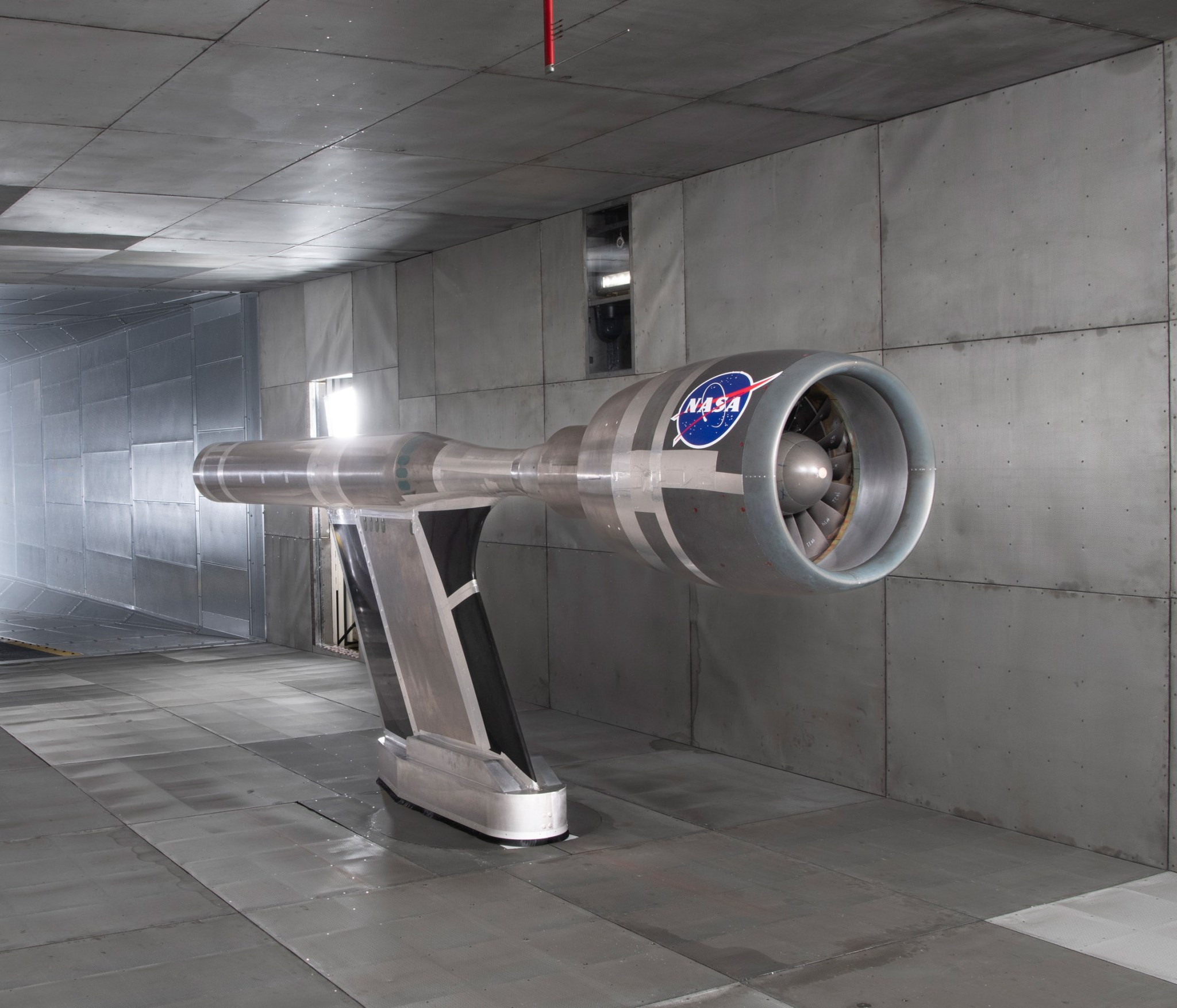
NASA Glenn is using upgraded wind tunnels, anechoic chambers, and instrumented engine rigs to pinpoint how aircraft noise forms and to test quieter propulsion designs.
Scientists and engineers at NASA’s Glenn Research Center are tackling one of aviation’s most stubborn challenges—engine noise—using a suite of specialized test facilities designed to capture both aerodynamics and acoustics under tightly controlled conditions. Their work spans large wind tunnels, purpose-built acoustic chambers, and instrumented jet and turbofan rigs that help researchers understand how noise is generated and how it can be reduced for communities near airports.
A centerpiece of this effort is Glenn’s 9- by 15-Foot Low-Speed Wind Tunnel (9×15 LSWT), built to recreate the airflow conditions aircraft engines experience during takeoff and landing. Those phases of flight are among the most critical for ground-level noise exposure, and the tunnel allows researchers to measure engine-flow behavior and sound production without the confounding variables of an outdoor test. The facility underwent significant upgrades completed in 2019 aimed at improving flow quality while also cutting the tunnel’s own background noise—an essential step when the goal is to detect comparatively subtle acoustic changes from experimental hardware. NASA also added a traversing “microphone rake” carrying five sensors, enabling detailed measurements of sound fields generated by scale propulsor models.
Many of Glenn’s noise-focused experiments take place inside the Aero-Acoustic Propulsion Laboratory (AAPL), an imposing geodesic dome with a 65-foot radius that serves both as a community-noise research asset and as an aeroacoustic test site for engines and components. Inside, the test area can be arranged either as a hemi-anechoic environment or as a fully anechoic chamber—configurations meant to eliminate reflections that would otherwise contaminate measurements. The reason the dome can operate without echoes is practical as well as dramatic: roughly 17,000 fiberglass wedges, each about two feet thick and custom designed, line the interior surfaces; additional absorbing material is placed on the floor and around test rigs to prevent stray reflections. When AAPL opened in 1993, NASA says it was the first known free-standing geodesic dome built with materials engineered both to limit sound transmission through its walls and to absorb sound internally.
AAPL currently houses multiple experimental rigs, including the Nozzle Acoustic Test Rig (NATR), the Small Hot Jet Acoustic Rig (SHJAR), and the DGEN 380 AeroPropulsion Research Turbofan (DART). Among them, SHJAR stands out as a workhorse for probing how nozzle design and jet flow translate into noise. The rig can test single-stream nozzles up to 5 centimeters in diameter at conditions reaching Mach 2.0 and temperatures of 800 K, enabling controlled studies of hot, high-speed jets similar to those found in real propulsion systems.
NASA Glenn researchers use SHJAR not only to evaluate novel, low-cost nozzle concepts, but also to develop advanced diagnostic tools. Techniques employed include Rayleigh scattering, Raman scattering, digital schlieren, and real-time particle image velocimetry, alongside three-dimensional microphone arrays that help locate and map noise sources. Data from these experiments are used to check and improve computational codes intended to predict jet noise—models that, once reliable, can guide engineers toward quieter nozzle designs before hardware is built.
SHJAR has also supported landmark measurements in turbulent-jet science. In 2006, researchers reported the first time-resolved particle image velocimetry measurements capturing space-time correlations of turbulent velocities in hot jets—statistics closely tied to noise generation. The same time-resolved approaches were used to map turbulence convection speeds, another parameter required by jet-noise theory that had previously been unavailable for hot-jet conditions. More recently, NASA achieved time-resolved measurements of turbulent temperature using Raman-based optical methods, capturing high-frequency thermodynamic fluctuations needed to complete turbulence models used in both heat-transfer studies and jet-noise research. Beyond measurement breakthroughs, SHJAR has served as a testbed for “canonical” jet-noise questions, including how mounting a jet on an aircraft can change the sound it produces, such as through jet–surface interactions involving wings, flaps, and tails.
Why it matters
Noise from aircraft engines is a major quality-of-life issue for people living near airports, and it is also a design constraint for manufacturers facing strict certification limits. By improving measurement tools and validating prediction codes in facilities like Glenn’s wind tunnels and anechoic dome, NASA helps accelerate the development of quieter propulsion technologies. The next watchpoint is how these validated models and experimental insights translate into deployable engine and nozzle designs that reduce noise without sacrificing performance.