Economic forecasters still project steady U.S. expansion, with surveys showing low recession odds. NABE expects slightly slower growth, softer hiring and energy-led inflation risks.
Economic forecasters continue to anticipate steady U.S. growth, with little sign in their projections that the economy is nearing contraction.
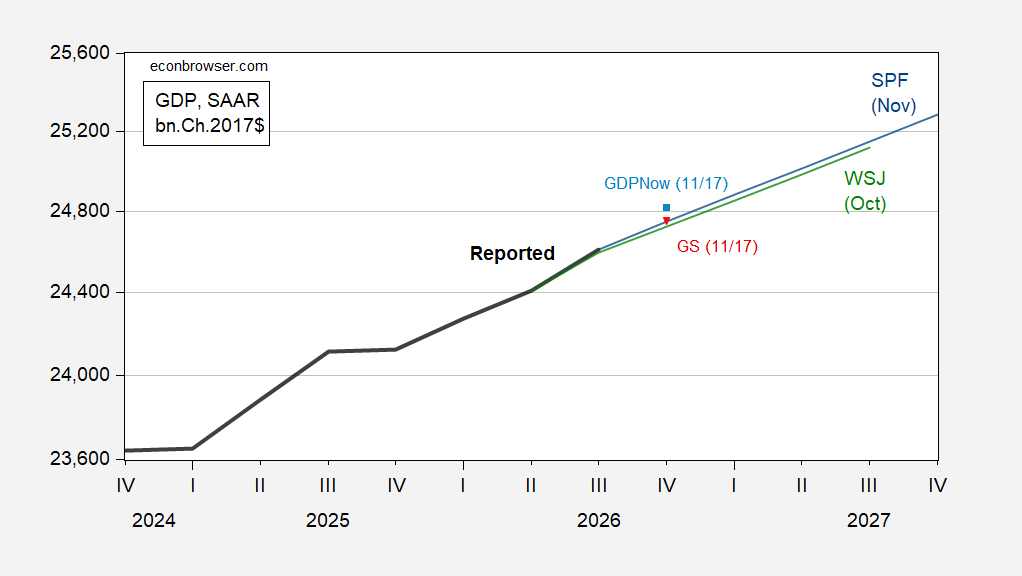
The Philadelphia Fed’s November Survey of Professional Forecasters (SPF) centers on a view of continued expansion and assigns a low likelihood to negative growth. In the survey’s comparison of recent and predicted GDP paths, the SPF median forecast tracks alongside other widely watched gauges, including the Wall Street Journal’s October survey average, the Atlanta Fed’s GDPNow estimate, and a private-sector call from Goldman Sachs. The comparison also incorporates the Bureau of Economic Analysis’ advance release for 2026 Q3. All series are expressed in chained 2017 dollars at a seasonally adjusted annual rate, allowing the different forecasts and nowcasts to be examined on a consistent, inflation-adjusted basis. (For most sources, projected GDP levels are derived by applying forecast growth rates to the latest reported GDP level; the SPF is the exception, as it reports its own level paths.)
A separate reading from the National Association for Business Economics (NABE), released around the same time, points in a similar direction, though with slightly more conservative growth assumptions. NABE’s median estimate for 2026 GDP growth measured from Q4 to Q4 is 2.4%, modestly below the SPF median of 2.6%. While the NABE results were not fully accessible without a subscription, the available summary indicates forecasters have become incrementally more optimistic about the composition of growth even as they temper expectations for hiring.
According to the NABE panel’s synopsis, respondents lifted their forecasts for business investment and overall economic growth in both 2026 and 2027. At the same time, they reduced their projected pace of job creation for those years. Despite the softer employment outlook, the group expects the unemployment rate to remain close to 4.2%, suggesting forecasters see labor-market conditions stabilizing rather than deteriorating sharply.
On inflation, the panel continues to identify energy as the predominant source of upward pressure. In keeping with that view, respondents raised their oil price projections for both 2026 and 2027, a notable signal given energy’s potential to filter into broader prices and household budgets.
The outlook for productivity—the key variable that can allow an economy to grow faster without generating as much inflation—shifted slightly downward. Even so, nearly half of the panelists now name stronger-than-expected productivity gains as the most important upside risk to the forecast. That marks a change in emphasis: stronger productivity has overtaken the possibility of an end to the wars in Ukraine and the Middle East as the leading “positive surprise” scenario cited by forecasters.
Risks, however, are not viewed as one-sided. On the downside, the NABE summary reports that widening geopolitical conflict has regained its position as the top threat to the outlook, and about half of panelists judge overall risks to be skewed toward weaker outcomes. Still, expectations for an imminent downturn remain subdued: recession probabilities have not moved much, and more than half of respondents do not anticipate the next recession beginning before 2029.
Why it matters
These forecasts shape expectations for interest rates, corporate planning, and household confidence, especially when growth and recession risks are finely balanced. The surveys suggest the baseline remains an expansion, but with meaningful vulnerability tied to energy prices and geopolitics. The next key test will be whether productivity strengthens enough to offset inflation pressures and whether external shocks—particularly in oil markets—alter the trajectory forecasters currently see through 2027.