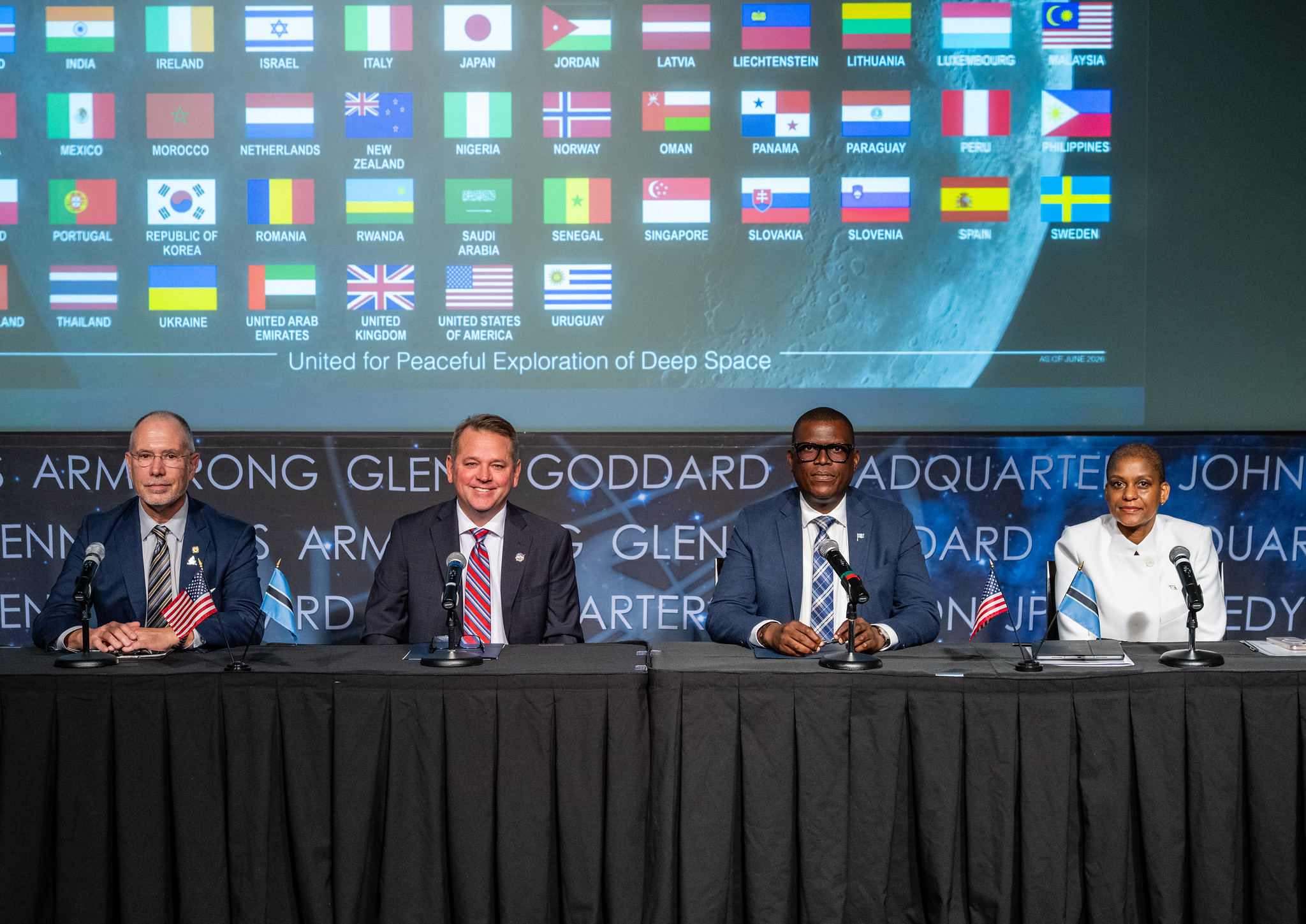
Botswana has become the latest nation to join the Artemis Accords, signing the U.S.-led framework for civil space exploration at a ceremony Thursday at NASA headquarters in Washington.
Botswana has become the latest nation to join the Artemis Accords, signing the U.S.-led framework for civil space exploration at a ceremony Thursday at NASA headquarters in Washington. With the move, Botswana becomes the 68th country to sign the accords and the sixth African nation to do so, expanding an international coalition that says it is committed to peaceful, transparent and responsible activity beyond Earth.
NASA Deputy Administrator Matt Anderson welcomed the new partnership, calling Botswana’s decision a significant step for international cooperation as the Artemis program accelerates toward its next crewed lunar missions. Anderson noted that NASA recently introduced the crew of Artemis III—an upcoming mission intended to return astronauts to the Moon—and said work is underway to assemble the spacecraft that will carry them.
Botswana’s Minister of Communications and Innovation, David Tshere, signed the agreement on behalf of his government. Also taking part in the event were Gregory Autry, a senior advisor for space at the U.S. Department of State, and Mabedi Ngwenya, acting ambassador of Botswana to the United States.
Tshere said Botswana’s interest in joining reflects a broader national focus on space and a desire to support “safe, transparent, and sustainable” exploration. He framed the decision as an investment in international collaboration and in a shared set of expectations for how governments and partners should behave as activity on the Moon and elsewhere increases.
The accords are a relatively new tool of space diplomacy. They were created in 2020, during the first Trump administration, when the United States—through NASA and the State Department—partnered with seven other founding countries to set out practical guidelines for exploration. The effort was driven in part by rising global interest in lunar operations, including from commercial companies, and by concerns that multiple actors working in the same regions will require clearer coordination.
While the accords are nonbinding, signing countries publicly endorse a suite of principles meant to reduce conflict and improve safety. Those commitments include conducting exploration for peaceful purposes and with openness, helping others in distress, and sharing scientific data so it can benefit all. The framework also emphasizes avoiding harmful interference with other missions and protecting places and objects of historical significance in space by developing and applying best practices.
Botswana’s signature also builds on decades of cooperation with the United States in space-based Earth observation. In the early 1970s, Botswana participated in a satellite initiative that later became known as Landsat, joining many other nations in early efforts to monitor the planet’s environment from orbit. More recently, the country reached a national milestone in March 2025 with the launch of its first Earth observation spacecraft, Botswana Satellite 1, which flew to space on a SpaceX Falcon 9 rocket.
NASA expects the Artemis Accords community to continue growing in the coming months and years, as more countries align around shared norms for exploration of the Moon, Mars and beyond—an area of activity the agency says must remain safe, cooperative and oriented toward broad public benefit.