“Touchdown confirmed.” In the early hours of July 20, 1976—5:12 a.m.
“Touchdown confirmed.” In the early hours of July 20, 1976—5:12 a.m. Pacific time—engineers and scientists inside NASA’s Jet Propulsion Laboratory let out a roar as word arrived that Viking 1 had made it safely to the Martian surface. After plunging through Mars’s tenuous atmosphere, the lander had endured the perilous descent and become the first NASA robotic spacecraft to operate on the ground of another planet with the explicit goal of searching for evidence of life.
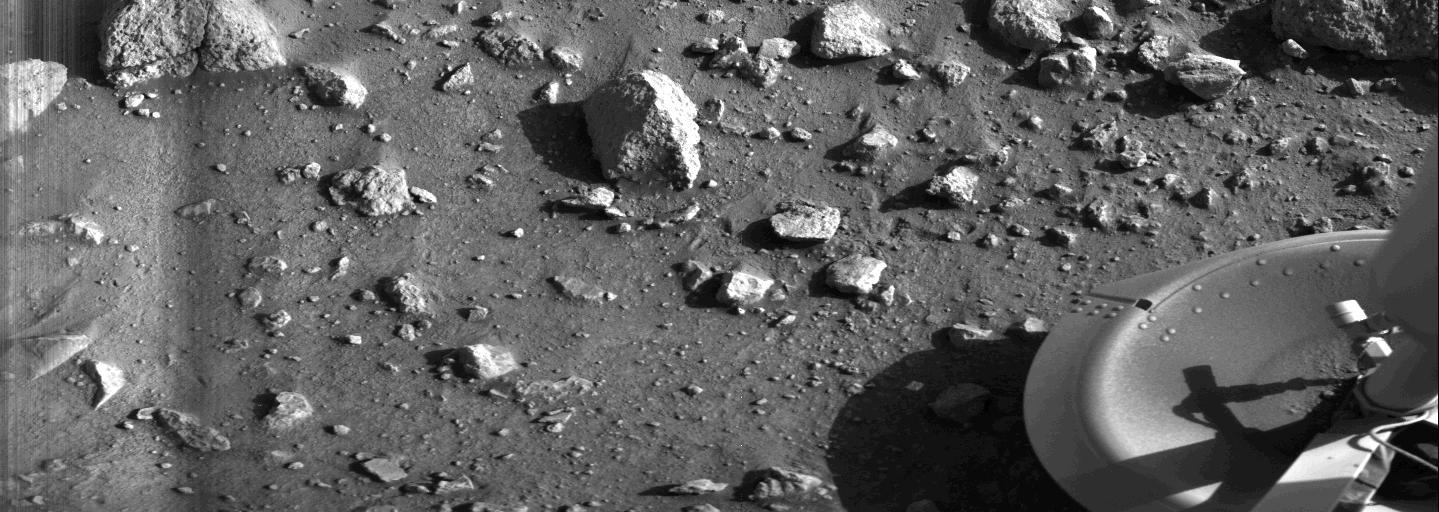
The celebration quickly gave way to suspense. Roughly 40 minutes after landing, Viking 1 began sending back its inaugural photograph from Mars. The image did not arrive as a single snapshot; it assembled gradually, line by line, creeping across monitors from left to right. As the picture emerged, it delivered something no human had ever witnessed directly before: a ground-level view of Mars—its rocks, its sand, and the unmistakable texture of a real landscape under an alien sky.
Dr. Thomas Mutch, who led the lander’s imaging team, later recalled the intensity of those first moments. He watched an empty, dark display, waiting for the first thin band of data that would announce the beginning of the photograph. When that sliver finally appeared, it was, in his words, like “electronic magic.” Contrasts sharpened into recognizable terrain: patches of light and shadow, then the rough scatter of stones and the fine-grained surface material. At the far right edge, one detail made the achievement feel unmistakably concrete—a lander footpad planted on Martian soil, proof that the spacecraft was not merely transmitting signals, but had truly arrived.
That first view marked a turning point in planetary exploration. Viking 1’s landing opened a new era in which Mars was no longer only a distant target viewed through telescopes and orbital cameras, but a world that could be examined directly from the surface.
The mission soon expanded. Six weeks after Viking 1, its twin spacecraft, Viking 2, touched down in a different area of Mars, extending surface operations to another region and broadening the scientific return. Above them, the two Viking orbiters that had transported the landers across interplanetary space continued their own investigations from orbit. They gathered additional data about the planet and also played a crucial operational role, helping relay communications between the landers and Earth.
Fifty years on, the emotional arc of that July morning at JPL—the tense wait for confirmation, the slow reveal of the first image, and the dawning realization that a human-built machine was standing on another planet—remains one of NASA’s defining exploration moments. Viking’s first photograph did more than show rocks and sand; it provided humanity’s first on-the-ground perspective of Mars and launched a legacy of robotic discovery that continues to shape how we explore the Red Planet today.