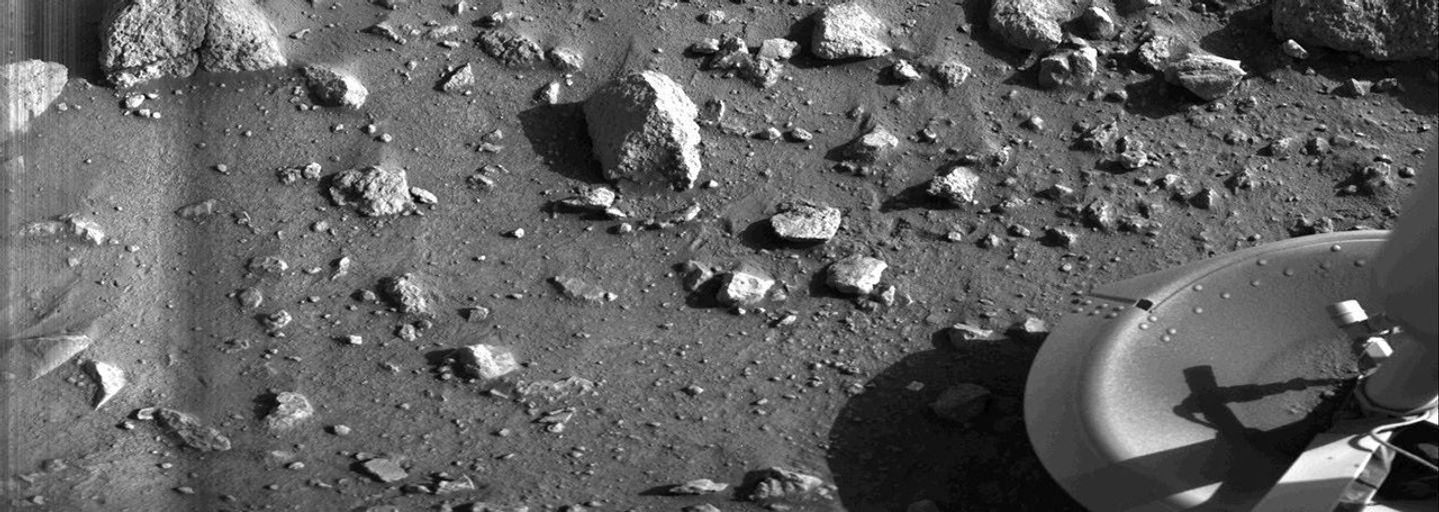
Half a century ago, NASA’s Viking 1 and Viking 2 achieved a milestone that had eluded every previous attempt: they touched down safely on Mars.
Half a century ago, NASA’s Viking 1 and Viking 2 achieved a milestone that had eluded every previous attempt: they touched down safely on Mars. The landings did more than place spacecraft on the Red Planet—they marked the start of modern surface exploration. A major part of that success traces back to a team in Hampton, Virginia, at NASA’s Langley Research Center, which was chosen in 1968 to manage the agency’s first U.S. mission explicitly built to land on Mars and investigate whether life might exist there.
Langley’s leadership helped translate a bold objective into an executable engineering program. Project Manager James S. Martin Jr. pushed for tight mission priorities, rigorous technical scrutiny, and an uncompromising test culture. The approach was straightforward but demanding: every system had to be evaluated repeatedly until the team could justify confidence that it would function in Mars conditions, far from any possibility of repair.
The hardest problem was the one every Mars lander faces: getting from interplanetary speed to a gentle touchdown. The Viking landers would hit the Martian atmosphere traveling faster than 10,000 miles per hour, and the thin air offers little help in slowing a spacecraft. Langley engineers drew on the center’s long experience with entry aerodynamics, thermal protection, and parachute design to develop the hardware that made descent possible. The landers’ aeroshell and heat shield were built to survive searing entry heating, while a supersonic parachute provided critical deceleration before the final phase of landing. These weren’t designs that emerged solely from calculations. They were refined through extensive wind-tunnel experimentation, detailed analysis, and iterative troubleshooting—work that foreshadowed Langley’s continuing role in entry, descent and landing technology.
Viking also pioneered a more systematic way to choose where to land. Rather than relying on limited imagery or broad assumptions, teams combined pictures from Viking’s orbiters with radar observations collected by Earth-based facilities. The result was a process that weighed scientific payoff against practical safety, identifying regions with both compelling targets and acceptable hazards. That balanced, data-driven method has since become a standard ingredient in planning Mars landing sites.
Even the day-to-day rhythm of planetary operations changed. To keep planning and troubleshooting aligned with events on the surface, Viking teams adopted the “sol”—a Martian day that runs slightly longer than 24 hours—so schedules tracked local Mars time. The practice remains common for missions working on the ground.
The Viking architecture itself reflected a major course correction. NASA’s earlier Voyager Mars lander concept was abandoned as too expensive and too risky, in part because it depended on launching two large landers together atop a Saturn V. Viking charted a more achievable route: each lander would travel with its own orbiter, and launches would use Titan IIIE-Centaur rockets. The redesign retained the mission’s scientific ambition while making the program realistic to build and fly.
In hindsight, Viking helped define an enduring strategy for exploring other worlds—use orbiters to scout and characterize, select landing sites using real measurements, and fly landing systems that have been stressed far beyond expected conditions. That playbook informed later Mars missions, including Curiosity and Perseverance. Viking’s two landers ultimately returned thousands of images and a trove of measurements that revealed Mars as an active, complex planet with weather and a rich geologic story still being unraveled.
No astronauts have yet walked on Mars, but Viking proved robotic explorers could arrive, land, and operate on another planet. As the 50th anniversary of those pioneering landings is recognized, Langley’s imprint remains clear—both in Viking’s legacy and in the center’s ongoing work on next-generation descent and landing systems aimed at supporting future missions, including those that may one day carry humans.