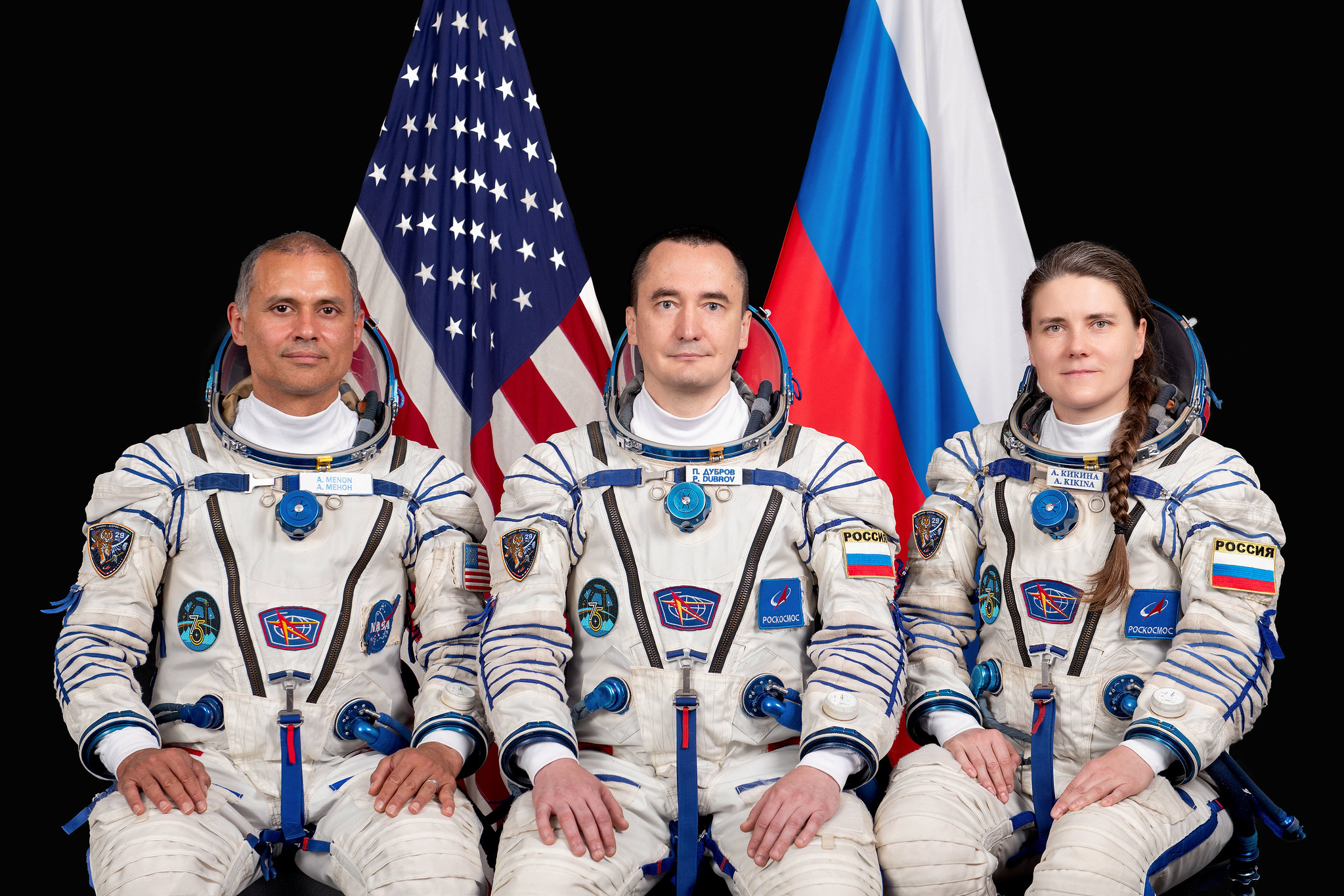
NASA will provide live coverage as astronaut Anil Menon begins his first trip to the International Space Station, launching Tuesday, July 14, aboard the Roscosmos Soyuz…
NASA will provide live coverage as astronaut Anil Menon begins his first trip to the International Space Station, launching Tuesday, July 14, aboard the Roscosmos Soyuz MS-29 spacecraft alongside cosmonauts Pyotr Dubrov and Anna Kikina.
The trio is scheduled to lift off from the Baikonur Cosmodrome in Kazakhstan at 10:47 a.m. EDT (7:47 p.m. local Baikonur time). Viewers can follow the launch and the spacecraft’s arrival activities on NASA+, Amazon Prime, and NASA’s YouTube channel, with additional options available through the agency’s online and social media platforms.
Soyuz MS-29 will take a fast route to orbiting outpost, completing a two-orbit flight lasting about three hours. The spacecraft is expected to dock automatically at 1:56 p.m. EDT at the station’s Prichal module. After docking, crews will proceed with post-arrival checks before opening the hatches connecting Soyuz to the space station.
NASA’s planned broadcast schedule (all times Eastern and subject to adjustment as mission operations unfold) begins at 9:45 a.m. for launch coverage. Rendezvous and docking programming is set to start at 1:10 p.m., followed by hatch opening and the crew’s welcome aboard at 3:30 p.m.
Once inside the station, Menon, Dubrov, and Kikina will join the Expedition 74 team already on orbit: NASA astronauts Jessica Meir, Jack Hathaway, and Chris Williams; European Space Agency astronaut Sophie Adenot; and Roscosmos cosmonauts Sergey Kud-Sverchkov, Sergei Mikaev, and Andrey Fedyaev. The arriving crew members are slated to spend roughly eight months on the orbital complex as part of Expeditions 74 and 75, returning to Earth in April 2027. The mission marks Menon’s debut in space and represents a second flight for both Dubrov and Kikina.
During his time aboard the station, Menon will take part in a suite of research investigations and technology demonstrations intended to support future exploration while delivering potential benefits on Earth. Among the planned work is continued research on improving the production of semiconductor crystals in microgravity—an effort aimed at enabling large-scale manufacturing of components used in high-performance computing, artificial intelligence systems, and advanced medical devices.
Menon is also expected to carry out ultrasound examinations using approaches that combine augmented reality and artificial intelligence, techniques that could reduce reliance on ground-based medical expertise during deep-space missions. In another study, he will serve as a participant as researchers examine how microgravity influences blood flow, information that could help protect astronaut health on longer journeys. He will additionally contribute to experiments evaluating the bioprinting of vascular constructs in weightlessness, work designed to deepen understanding of aging and support the development of new therapies.
NASA notes that the space station has been continuously inhabited for more than a quarter-century, providing a unique laboratory where experiments can be conducted in conditions impossible to replicate on Earth. The ISS plays a central role in the agency’s efforts to address the risks of human spaceflight, broaden commercial activity in low Earth orbit, and build experience for long-duration missions beyond Earth—work that underpins NASA’s Artemis campaign to the Moon and, eventually, missions to Mars.