Economist Mike Konczal has gone looking for the outcome immigration restrictionists routinely promise: that aggressive deportation policies will materially improve the job market for native-born workers.
Economist Mike Konczal has gone looking for the outcome immigration restrictionists routinely promise: that aggressive deportation policies will materially improve the job market for native-born workers. If the basic story were true—remove immigrant workers and native-born people would step into better-paying jobs—there should be visible signals in standard labor-market data. Konczal’s review, however, turns up the opposite pattern: across a battery of plausible tests, the expected “payoff” to natives fails to appear.
Konczal frames his inquiry around a set of indicators that should move in a pro-native direction if deportations were tightening labor markets in the way restrictionists claim. These include measures such as wage growth and employment rates for native-born workers overall, as well as for prime-age workers specifically—groups commonly invoked in political rhetoric about “re-engaging” sidelined Americans. He also considers arguments that specific sectors, notably construction, would see a native-born hiring surge once immigrant labor is removed.
The results, in Konczal’s telling, amount to a clean sweep of disappointments for the restrictionist case. Instead of rising, key employment measures for native-born workers are flat or lower. Rather than a wage boom, wage outcomes do not show the kind of acceleration one would expect if deportations were giving natives new bargaining power. Even the notion that deportations would “tighten” markets enough to create obvious windfalls—particularly in labor-intensive industries—does not show up in the data he checks.
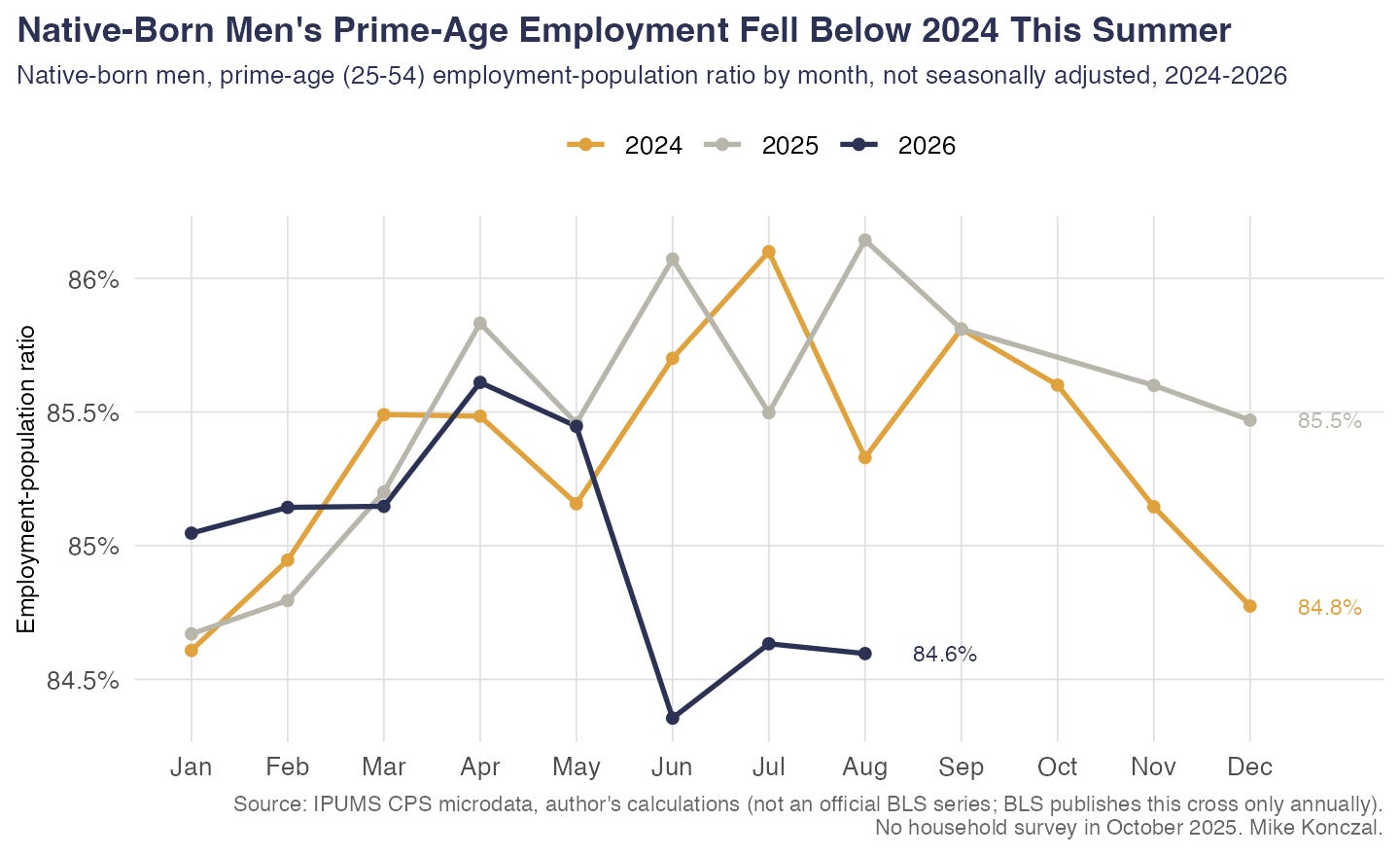
A central claim he disputes is the idea that deportations would draw prime-age native-born men back into work in large numbers. During the 2024 campaign, for example, J.D. Vance argued that deportations could help “re-engage” what he described as seven million prime-age men who had dropped out of the labor force. Konczal examines employment rates for native-born prime-age men and finds no sustained improvement consistent with that narrative. He describes the notion of a male employment boom replacing deported immigrants as “fiction,” noting that the rate has hovered around its 2024 level—higher during part of the winter, but notably weaker in the summer—rather than trending upward.
Konczal also pushes back on a related argument that surfaced in commentary about job gains under the Trump administration: that women’s strong share of net payroll growth could be explained by native-born men filling positions previously held by deported immigrants, producing little net job creation. He says that story does not match the evidence he reviewed.
The broader implication, Konczal argues, aligns with a large empirical literature on immigration and labor markets: immigrants often complement, rather than substitute for, native-born workers. Under the “complementarity” view—associated with research including East et al. (2023) and later work by Cox and East (2026)—removing immigrant workers can reduce overall employment and wages for natives because it shrinks economic activity instead of redistributing it. Konczal notes that this conclusion echoes findings from past episodes studied by economists, from the Mariel Boatlift in Miami to the Obama-era “Secure Communities” program, which he characterizes as demonstrating how enforcement-driven removals can backfire economically.
Konczal emphasizes transparency, pointing readers to a GitHub repository so others can replicate and scrutinize the calculations. But his bottom line is blunt: if mass deportations were supposed to produce a clear labor-market dividend for native-born workers, the expected signs—employment gains, wage gains, sectoral booms—are not there. In his assessment, deportation functions less like a transfer to native workers and more like a deadweight loss that leaves the economy smaller overall.