Astronomers using NASA’s Chandra X-ray Observatory have identified what may be the telltale remains of a supernova explosion in one of the Milky Way’s most crowded and…
Astronomers using NASA’s Chandra X-ray Observatory have identified what may be the telltale remains of a supernova explosion in one of the Milky Way’s most crowded and extreme environments: the galaxy’s central region. The results, reported in a paper in The Astrophysical Journal, point to a possible supernova remnant lurking near the Galactic Center—an area packed with massive stars, dense gas clouds moving at high speeds, and long, magnetized filaments.
Supernova remnants are the expanding debris fields left behind when stars die in explosive blasts. They are also major cosmic delivery systems, dispersing heavy elements such as iron, oxygen, and silicon—materials essential for building planets and, ultimately, life. If the new object is confirmed as a remnant, it would rank among the closest known to the Milky Way’s central supermassive black hole.
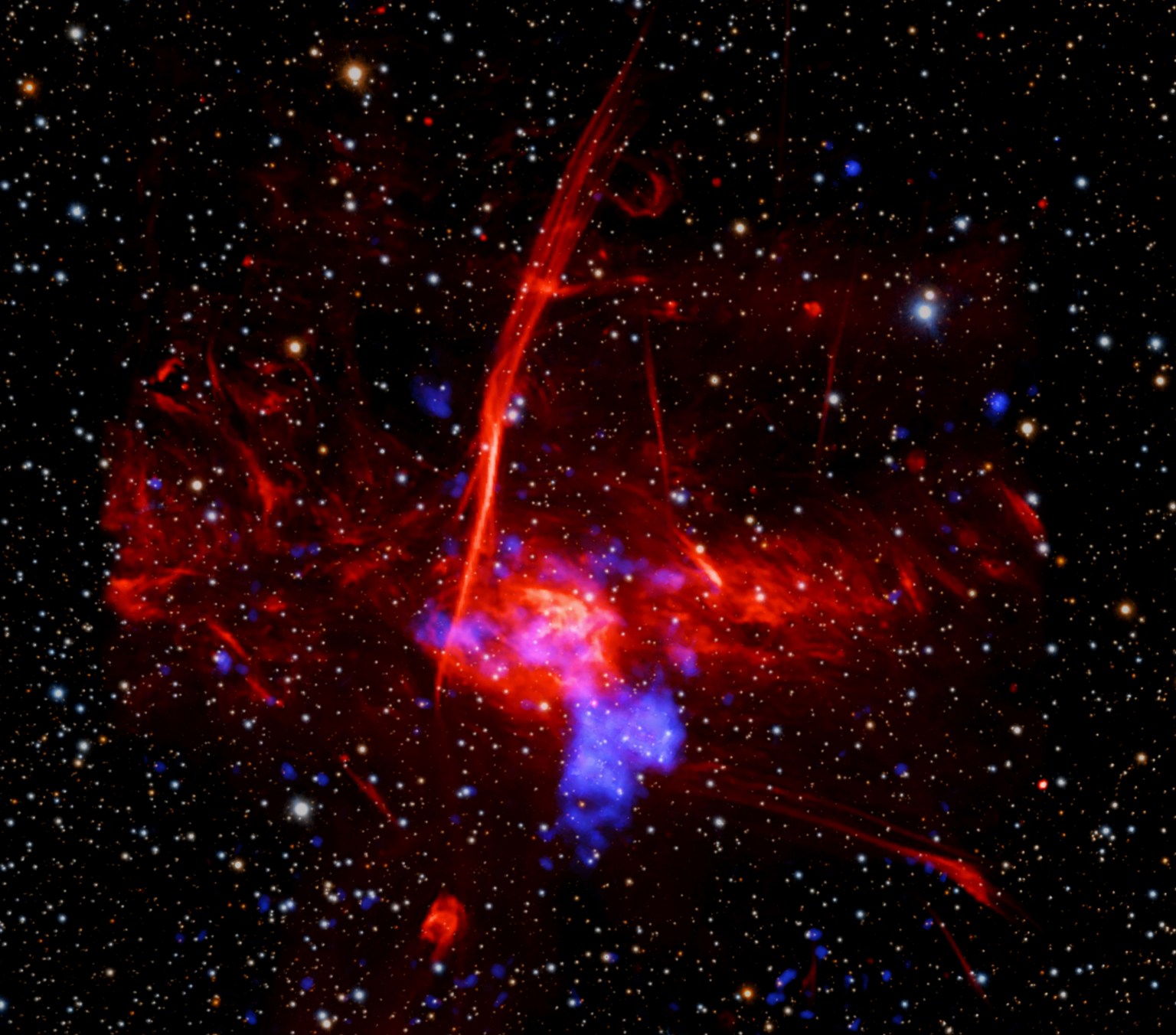
The candidate remnant appears in a new composite view that layers multiple wavelengths and instruments: X-rays from Chandra and the European Space Agency’s XMM-Newton mission shown in blue, radio observations from South Africa’s MeerKAT telescope in red, and visible-light imagery from the Pan-STARRS observatories in Hawaii. In this panorama, the plane of the Milky Way stretches horizontally, while the black hole that anchors the Galactic Center lies off to the left.
The key clue is an X-ray “blob” embedded within a larger region of expanding gas about 26,000 light-years from Earth. Researchers interpret this emission as possibly originating from hot, shocked material produced when a massive star exploded and drove a blast wave into its surroundings. The feature sits inside an H II region—a bubble of hydrogen gas stripped of electrons by intense radiation from a young, massive star. This particular radio-bright complex is known as Sagittarius C.
If the object is truly a supernova remnant, the team estimates it is at least about 1,700 years old and expanding at roughly two million miles per hour. Earlier observations from NASA’s now-retired SOFIA airborne infrared observatory had already hinted at an expanding shell of gas around Sagittarius C, suggesting that an explosion may have occurred there. The fresh X-ray measurements strengthen that case by revealing a compact, unusually bright pocket of high-energy emission consistent with supernova-heated gas.
MeerKAT’s radio data also capture striking, elongated filaments cutting through the region. These structures are thought to trace energetic particles streaming along magnetic field lines that run mostly perpendicular to the galaxy’s disk.
The researchers examined the X-ray spectrum for signs of unusually high abundances of elements expected to be forged and expelled by a supernova. They did not find a clear enhancement, but note that the debris could already be well mixed with surrounding gas, masking a distinct chemical signature.
They also considered a different possibility: that the X-ray blob is powered not by an explosion, but by hot gas generated by a concentration of massive stars. The study argues against this, pointing out that the X-ray brightness of the blob exceeds that of large, well-known massive stellar clusters by more than a factor of ten.
In another composite image, infrared observations from NASA’s James Webb Space Telescope are added to the X-ray and radio view. Webb’s infrared light highlights gas in the H II region, while darker blue X-rays mark the suspected remnant to the right. Separate X-ray emission closer to the image center may come from gas heated to millions of degrees by winds and outflows from massive stars.
The study was led by Zhenlin Zhu and Mark Morris of the University of California, Los Angeles.