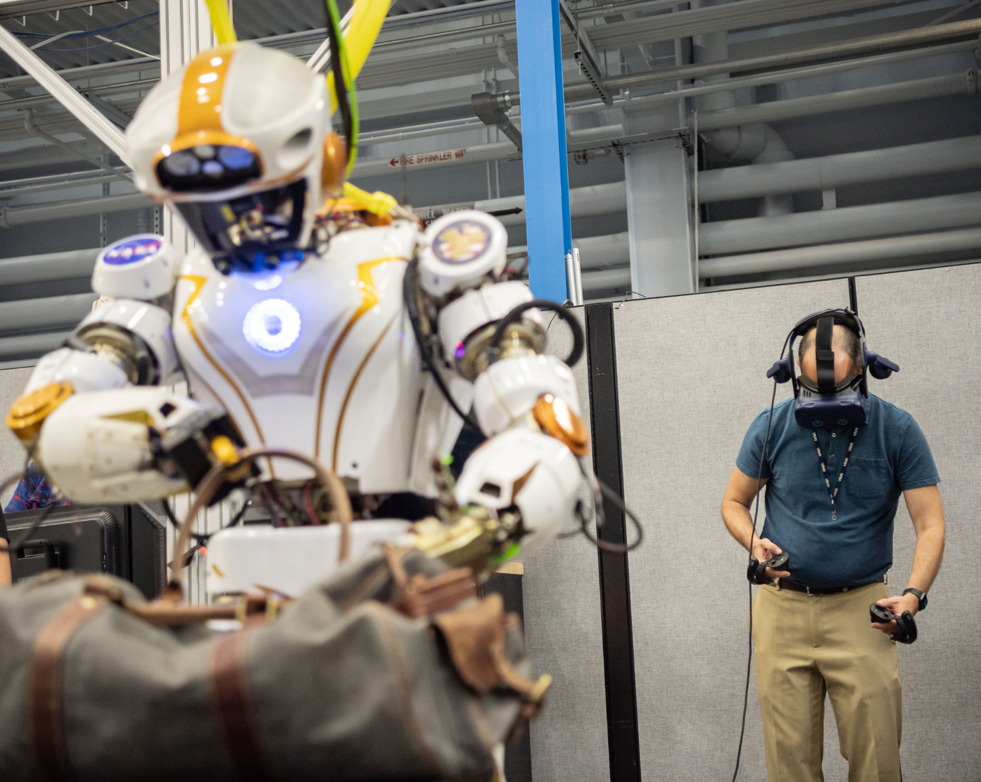
For decades, the notion of astronauts and robots working shoulder to shoulder in space belonged largely to imagination.
For decades, the notion of astronauts and robots working shoulder to shoulder in space belonged largely to imagination. But as NASA prepares for more demanding voyages farther from Earth, that partnership is moving from fantasy toward necessity. Robotic systems that can operate in tight quarters, handle tools, and take on hazardous tasks are increasingly seen as essential for human spaceflight—boosting what crews can accomplish while lowering risk and widening the range of exploration activities.
At the center of that effort is the Dexterous Robotics Team at NASA’s Johnson Space Center in Houston. The group develops both the hardware and software behind robots designed to do the kinds of hand-based tasks humans perform every day—work that becomes far more complicated in extreme environments such as the Moon’s surface or deep-space habitats.
Team lead Shaun Azimi emphasizes that the goal is not to swap people for machines, but to build robotic partners that can be trusted. The aim, he says, is safer and more sustainable exploration: send increasingly capable robots so astronauts can focus on the uniquely human strengths they bring to a mission, while robots absorb more of the risk.
The Dexterous Robotics Team includes 16 members and sits within Johnson’s Robotic System Technology Branch, an organization that also works on mobility technologies such as uncrewed planetary rovers. That overlap is reflected in the staff itself: Azimi and other engineers contribute across both dexterity and mobility projects. Within the dexterous robotics group, roles are broadly split between mechatronics and software, yet many team members span disciplines—bringing backgrounds in mechanics and electronics alongside experience writing code for simulation and analysis.
Much of that expertise was forged on two of NASA’s most recognizable humanoid robots. Robonaut 2 spent seven years aboard the International Space Station supporting robotics technology demonstrations. Valkyrie, meanwhile, became NASA’s first bipedal humanoid robot. Engineers who helped build and operate those platforms now form a core of the current team, carrying forward the lessons learned from those high-profile efforts.
Today, their portfolio supports multiple NASA initiatives, including work that may ultimately connect to the infrastructure required for a Moon Base—often described as humanity’s first long-term lunar outpost. Azimi characterizes the team’s work as a blend of exploratory research and development on one hand, and applied, operations-focused technology on the other.
That mix extends beyond NASA. The team regularly works with private-sector and other outside partners confronting similar problems, such as companies in oil and gas that want robotic systems capable of operating in dangerous, harsh settings and performing higher-risk duties.
One of the team’s major undertakings is the Integrated Mobile Evaluation Testbed for Robotics Operations, known as iMETRO, located at Johnson. The facility is open to NASA programs as well as external collaborators, and its purpose is to help adapt Earth-based robotic technologies to space missions where robots will often be supervised by humans rather than operating fully autonomously. iMETRO targets use cases including logistics, maintenance, and scientific work.
To do that, it combines digital and physical resources: open-source software and simulation tools; mockups of space vehicles and habitats; a fleet of so-called “house robots”; and an outdoor rock yard for field-style testing. That range allows users to evaluate an entire robot or focus narrowly on a single component, whether hardware or software.
Azimi says the testbed reduces uncertainty in joint development by showing partners what NASA actually needs, rather than leaving them to guess. Just as importantly, iMETRO brings together technology builders and the teams designing lunar habitats or rovers, allowing both sides to iterate faster. Providers learn the realities of a habitat, while designers discover what accommodations robots require—and what tasks that are easy for humans can be unexpectedly hard for machines.