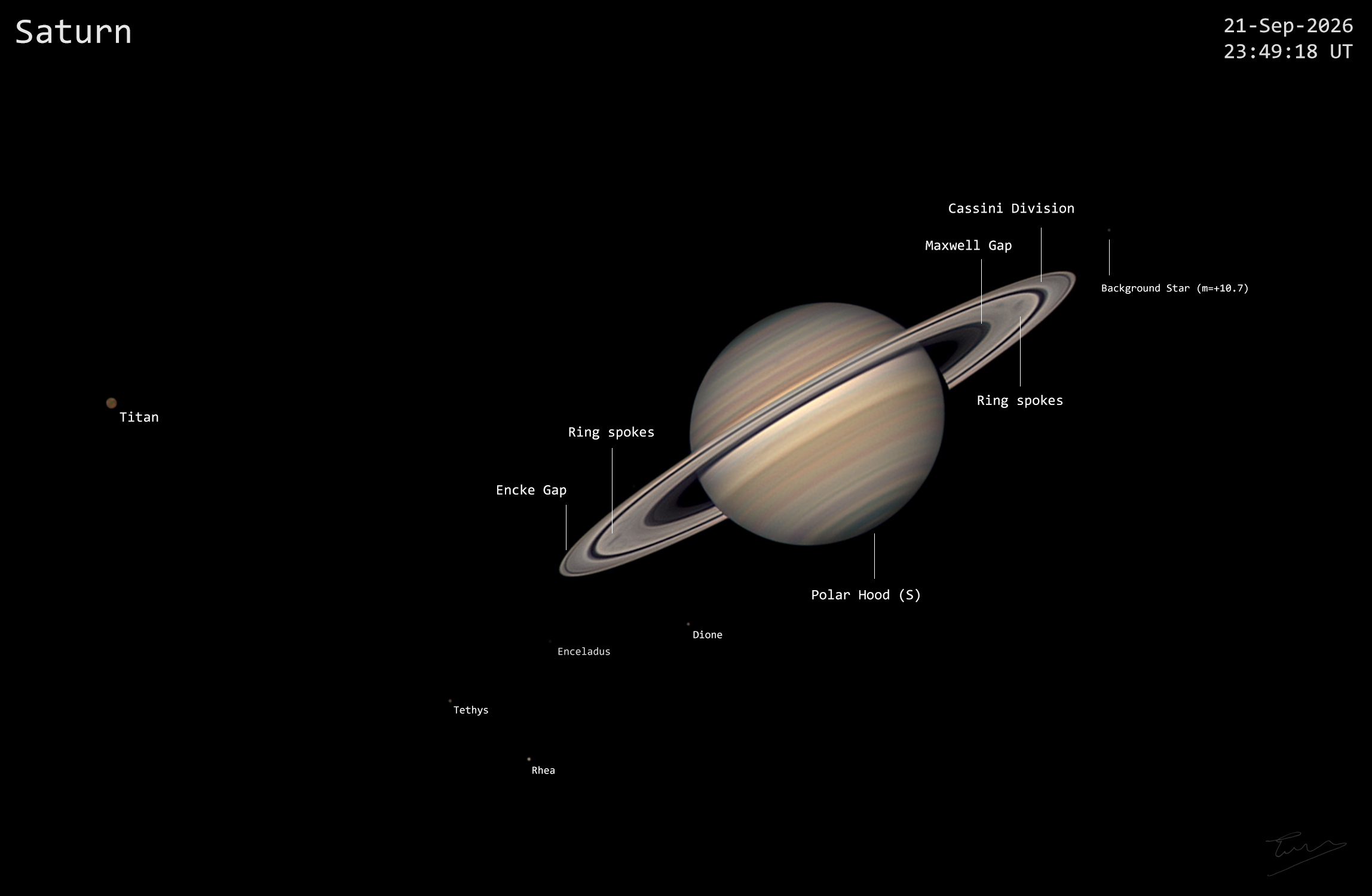
Rarely steady skies over the UK let an astrophotographer capture a crisp, high-resolution portrait of Saturn, revealing fine ring details and several moons.
Astronomy enthusiasts got an unusually crisp look at Saturn and its entourage thanks to a rare night of steadiness in Earth’s atmosphere over the United Kingdom. Astrophotographer Tom Williams produced a sharply defined portrait of the Saturn system—revealing features ranging from the planet’s ring structure to multiple moons—by taking advantage of exceptionally favorable “seeing” conditions.
In observational astronomy, a clear sky is only part of the challenge. Even when clouds are absent, Earth’s atmosphere is constantly in motion. Small, shifting pockets of air with different temperatures and densities act like imperfect lenses, bending incoming light and subtly warping what telescopes record. This turbulence is what astronomers refer to as “seeing,” and when it is poor, fine details blur and shimmer. When it is unusually calm, planetary images can snap into focus.
Williams further minimized the atmosphere’s distorting effects by using a method known as lucky imaging. Rather than relying on a single long exposure—during which the atmosphere has ample time to smear detail—lucky imaging collects thousands of rapid, short exposures with a high-speed camera. Most frames are degraded by turbulence, but a fraction are captured in brief moments when the air is steadier. By selecting the clearest images and stacking them together, the technique boosts sharpness and signal while preserving fleeting high-resolution detail.
The resulting view offers a kind of celestial sampler platter: Saturn itself, its rings, and standout satellites. Observers may be drawn to Titan, Saturn’s largest moon, or to Enceladus, famous for its bright, icy surface. The image also highlights intricate ring phenomena, including visible gaps within the ring system and faint spoke-like structures that can appear across the rings’ face.
Timing also favored the effort. Saturn reached opposition on October 4, the point in its orbit when Earth lies roughly between Saturn and the Sun. Around opposition, Saturn appears closer and brighter in the sky, and sunlight strikes the planet and rings more directly, maximizing illumination. For skywatchers, this period is among the best windows of the year to observe Saturn, whether through backyard telescopes or in detailed astrophotography.
Why it matters
High-resolution ground-based images like this show how much detail can be recovered even through Earth’s turbulent air when conditions and technique align. For amateur astronomers, Saturn’s recent opposition means the planet is especially well placed for observing right now. Watching how ring features and moon positions change over time can also help connect backyard viewing with the dynamic processes scientists study across the Saturn system.