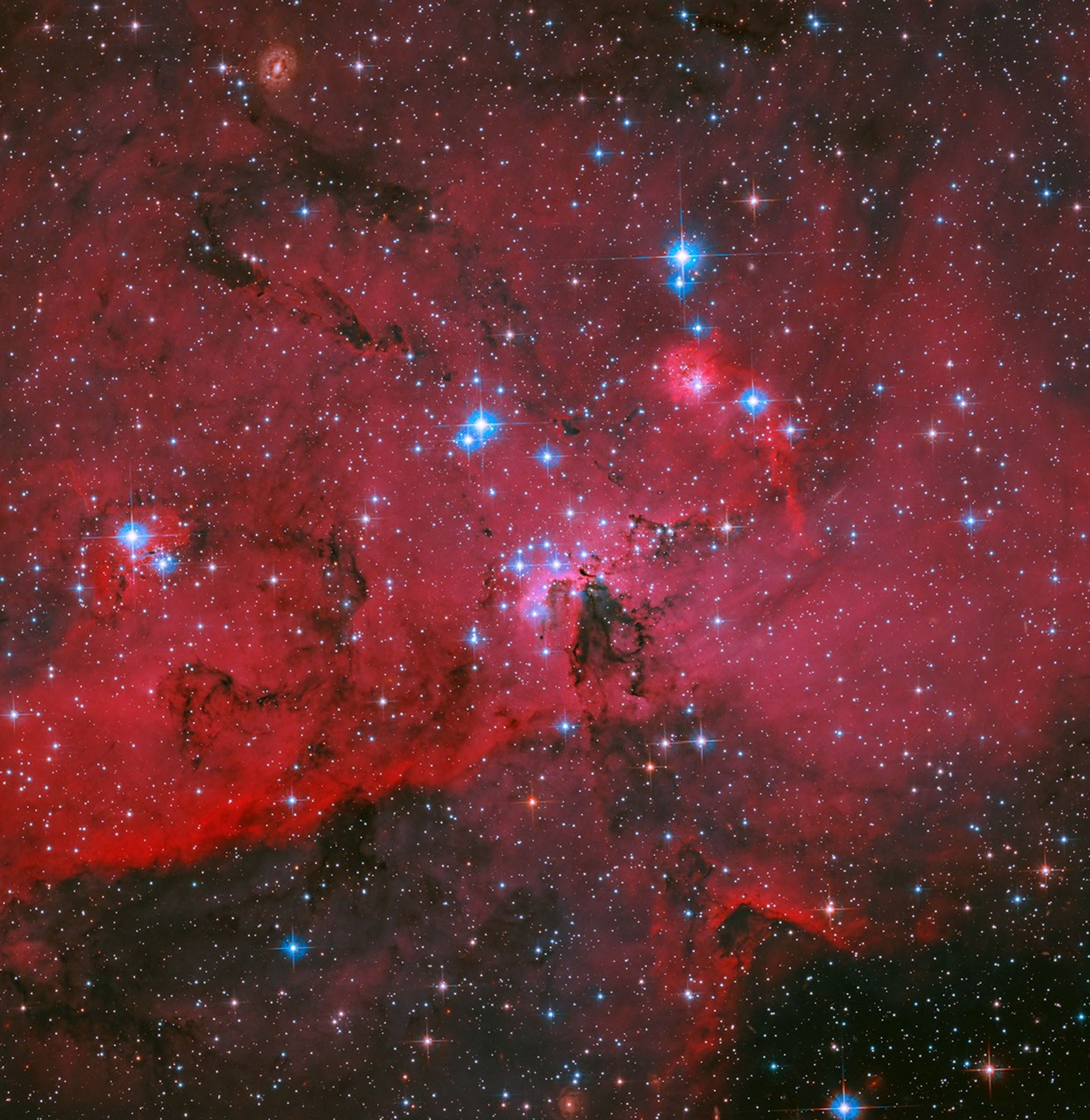
NASA’s Hubble Space Telescope has turned its eye toward a vibrant star-forming region known as LH 95, capturing a scene that resembles bursts of fireworks set against a haze of fading smoke.
NASA’s Hubble Space Telescope has turned its eye toward a vibrant star-forming region known as LH 95, capturing a scene that resembles bursts of fireworks set against a haze of fading smoke. In the image, clusters of bright blue and white stars glitter amid a deep red glow from surrounding gas—an energetic snapshot of a stellar nursery in the Large Magellanic Cloud, a small companion galaxy that orbits the Milky Way.
LH 95 is what astronomers call a stellar association: a loose grouping where stars of different masses form in roughly the same neighborhood. Here, low-mass newborn stars share space with hot, massive blue giants. The largest, most luminous blue stars visible in the picture are at least three times the Sun’s mass, and their influence extends far beyond their own surfaces. By blasting intense ultraviolet radiation and driving powerful stellar winds, these heavyweights heat the surrounding hydrogen and sculpt it into glowing clouds and sharply outlined structures. Dark, threadlike filaments slice across the red background where thicker dust lanes have resisted being worn away by the stars’ radiation.
The color palette in the Hubble view reflects how the telescope separates light using specific filters. Blue hues represent shorter visible wavelengths, while reds correspond to longer visible wavelengths and include some near-infrared light. The nebula’s striking crimson tone is dominated by hydrogen-alpha emission, a signature produced when hydrogen atoms are excited and then emit light at a characteristic wavelength. Because hydrogen-alpha is closely tied to active star birth, it serves as a key tracer for identifying extremely young stars still embedded in their natal gas.
Studies of LH 95 have revealed a population of developing stars that are still drawing in material from disks of gas and dust surrounding them. The region contains an extraordinary tally—about 2,500 stars—that have gained most of their eventual mass but have not yet begun the core hydrogen fusion that marks a star’s arrival on the main sequence. These “pre-main-sequence” stars formed as gas clouds collapsed and are still contracting; in astronomical terms, they are on the brink of switching on as full-fledged stars.
By examining these youthful objects, researchers confirmed a long-expected trend: as stars age, their accretion rates—the pace at which they accumulate matter—decline. At the same time, the observations show that accretion can continue for several million years, lasting longer than is sometimes assumed. That extended growth period offers important clues about how young stars continue building mass and how their surrounding disks evolve over time.
The Hubble results also point to a complex history of star birth in LH 95. Rather than forming in a single burst, the region appears to host multiple generations of stars existing side-by-side. One standout is the most massive star in the field, located above center and slightly to the left. With an estimated mass of about 60 to 70 Suns, it is also roughly a million years younger than many of its neighbors, which seem to be around 4 million years old. Such massive stars live fast and die young, rapidly consuming their fuel and ultimately ending their lives in supernova explosions.
Astronomers prize LH 95 not only for its rich stellar inventory but also because it offers a relatively nearby laboratory for studying star formation in conditions with less obscuring dust than comparable regions within the Milky Way. Hubble, one of NASA’s flagship observatories, has been delivering transformative views like this for more than three decades. Its findings are increasingly complemented by other missions, including the infrared-sensitive James Webb Space Telescope and the upcoming Nancy Grace Roman Space Telescope, slated for launch in late summer.