Nasdaq’s closing bell on April 30 became an unlikely stage for the next chapter of lunar exploration, as the four astronauts of NASA’s Artemis II mission and a Canadian…
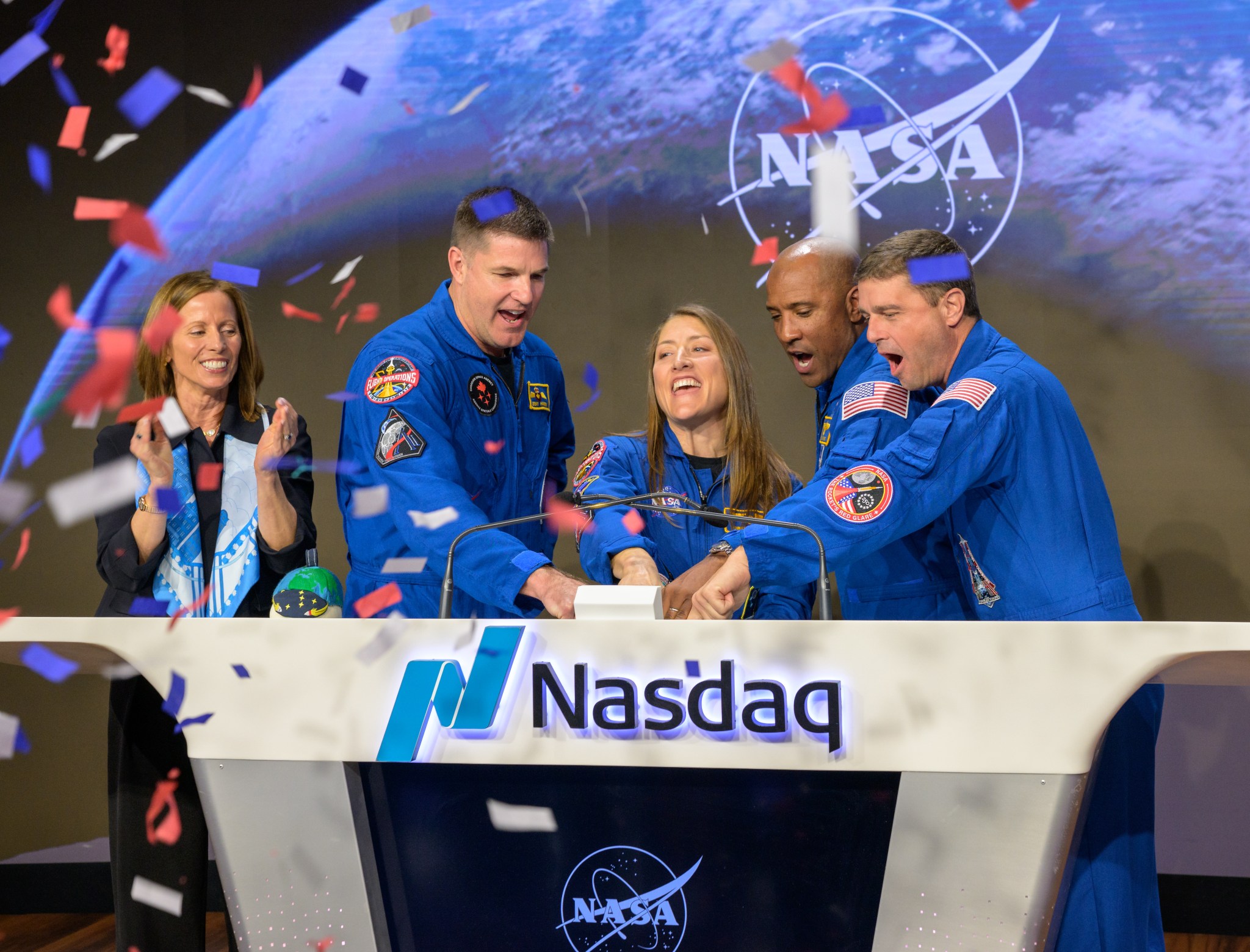
Nasdaq’s closing bell on April 30 became an unlikely stage for the next chapter of lunar exploration, as the four astronauts of NASA’s Artemis II mission and a Canadian crewmate appeared alongside Nasdaq’s top executive to mark the end of the trading day—and to spotlight a program that is increasingly entwined with commercial innovation.
Standing with Nasdaq Chair and Chief Executive Officer Adena T. Friedman, astronauts Reid Wiseman, Victor Glover, Christina Koch and Canadian Space Agency astronaut Jeremy Hansen rang the bell in New York, a ceremonial gesture that nonetheless carried strategic weight. Artemis II, NASA’s first crewed mission of the Artemis era, is intended to send the team around the Moon and back—an operational rehearsal for later landings and a highly visible test of the agency’s new deep-space transportation architecture.
The bell-ringing moment served as a public-facing reminder that Artemis is not only a government exploration campaign but also a catalyst for a broader industrial ecosystem. Over the past several years, research and policy analyses have emphasized that large-scale exploration programs tend to accelerate technology development across communications, navigation, materials, robotics, propulsion and high-reliability software—capabilities that often spill into commercial markets. NASA has repeatedly framed Artemis as a national investment in long-horizon innovation, and the choice of Nasdaq—a venue synonymous with technology and growth capital—fit that narrative.
Artemis II’s crew, introduced by NASA as a mix of flight experience and firsts, reflects the program’s international and societal ambitions. Wiseman is slated to command the mission, with Glover as pilot and Koch and Hansen as mission specialists. Koch would become the first woman to travel to the Moon’s vicinity, while Hansen would be the first Canadian to do so—milestones NASA and its partners have highlighted as part of efforts to broaden representation in human spaceflight.
Behind the symbolism, the hardware and logistics for lunar missions continue to move through a complex pipeline. NASA has recently reported incremental progress in preparation and integration milestones, including the movement of key rocket and spacecraft components through testing and refurbishment cycles at Florida’s Kennedy Space Center. Those steps underscore a central reality of Artemis: the program’s success depends on choreographing manufacturing, ground systems, flight software and safety verification at a scale comparable to the Apollo era, but with today’s stricter certification environment and a much more distributed contractor base.
The Artemis effort is also unfolding against a backdrop of continued international cooperation in low Earth orbit, even as geopolitical tensions persist on Earth. NASA has confirmed that an upcoming Roscosmos Soyuz mission—Soyuz MS‑29—targets a mid-July launch to the International Space Station carrying NASA astronaut Anil Menon alongside Russian cosmonauts Pyotr Dubrov and Anna Kikina for an expected eight-month expedition. For NASA, routine crew rotations on the ISS remain both a scientific platform and a risk-management strategy: maintaining operational experience in spaceflight while building toward the longer transits and higher autonomy demanded by lunar missions.
At the same time, NASA’s science portfolio continues to deliver discoveries that help justify sustained public investment in space infrastructure. A recent peer-reviewed Mars study reported that the Curiosity rover detected a diverse suite of organic molecules in ancient, clay-rich sediments—more than 20 compounds, including a nitrogen-bearing molecule with a structure reminiscent of chemical building blocks used in biology on Earth. Researchers stressed that the findings do not prove past life, because such organics can also form through non-biological chemistry or arrive via meteorites. But they add to evidence that Mars can preserve complex organics over geological timescales, strengthening the case for eventually returning samples to Earth for more definitive analyses.
Elsewhere, NASA astrophysicists have described a compact “X-ray dot” detected by the Chandra X‑ray Observatory that could help explain a puzzling class of objects seen in the early universe. While the details remain under investigation, studies suggest these faint, distant signals may point to previously underappreciated pathways for black hole growth or energetic stellar remnants in young galaxies—another reminder that exploration is not only about destinations, but about the tools that expand what can be measured.
The agency is also widening the diplomatic umbrella around its exploration principles. NASA recently welcomed Morocco as the 64th signatory to the Artemis Accords, the nonbinding framework for cooperation in civil space activities. Policy research has argued that such agreements can reduce coordination friction for multinational missions by aligning expectations on transparency, interoperability and scientific data sharing—an increasingly important factor as more nations and companies plan lunar operations.
With the United States approaching its 250th anniversary, NASA has framed Artemis within a longer national story of innovation and frontier-building. The Nasdaq appearance may have been ceremonial, but the message was practical: returning humans to lunar distance is no longer portrayed as a standalone stunt. It is positioned as a driver of technology, partnerships and scientific return—an agenda in which markets, laboratories and launch pads are all part of the same mission timeline.