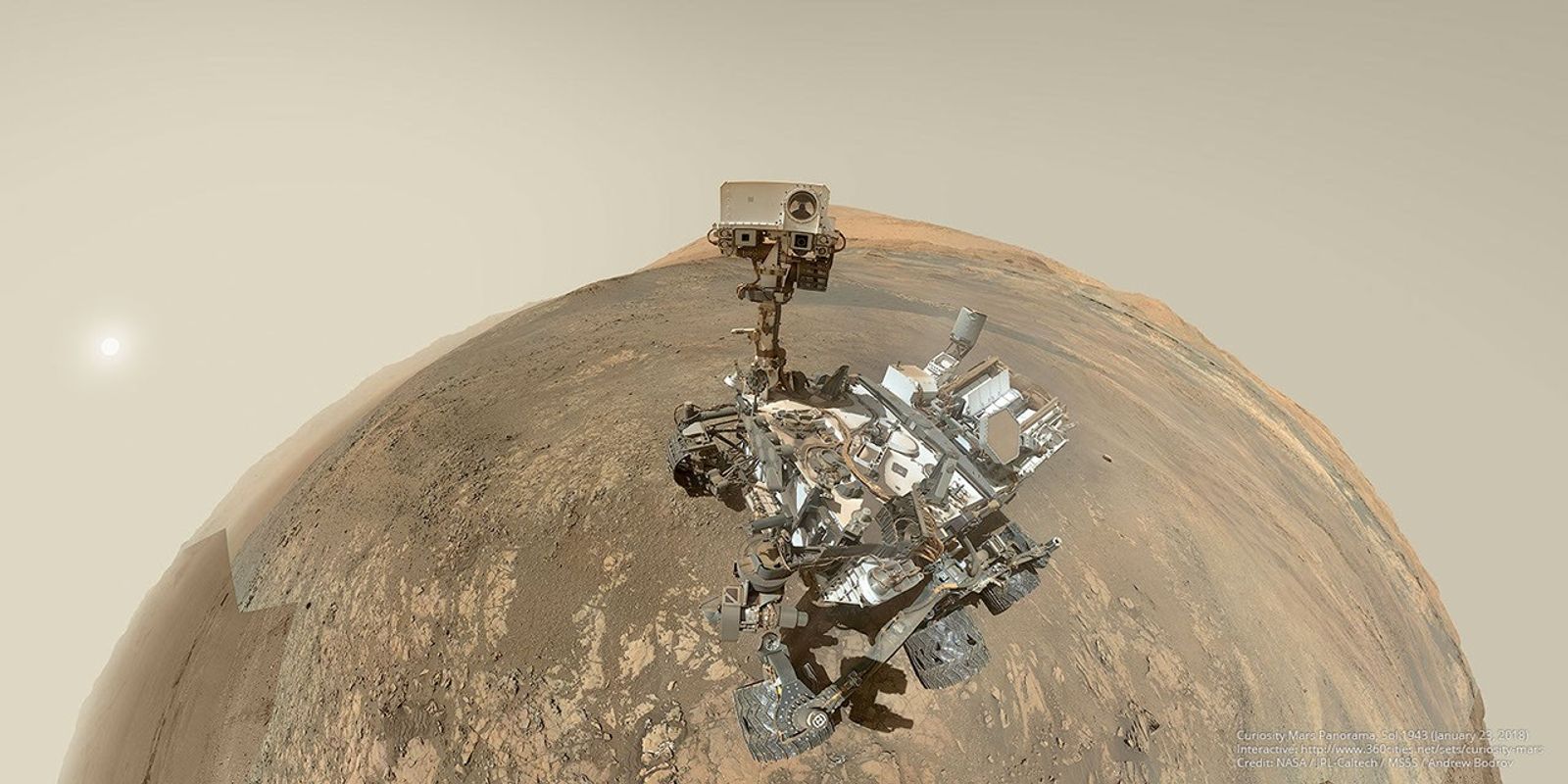
During its long traverse inside Gale Crater, NASA’s Curiosity rover paused on Mars’ Vera Rubin Ridge to take a striking self-portrait that also doubles as an immersive panorama of its surroundings.
During its long traverse inside Gale Crater, NASA’s Curiosity rover paused on Mars’ Vera Rubin Ridge to take a striking self-portrait that also doubles as an immersive panorama of its surroundings.
The image was captured on sol 1943 of the mission—“sol” being the Martian measure of a solar day, which runs roughly 40 minutes longer than a day on Earth. Curiosity’s sol 1943 aligns with January 23, 2018, in Earth timekeeping. From the south rim of Vera Rubin Ridge, the rover assembled a wide, mosaicked view made from 61 separate frames recorded by its Mars Hand Lens Imager (MAHLI), the close-up camera mounted on the rover’s robotic arm.
To produce the familiar “selfie” effect, mission image processors removed frames that included parts of the rover’s arm, leaving Curiosity seemingly poised in the landscape without the hardware that held the camera in place. The final product was also built to support an interactive 360-degree virtual reality version, allowing viewers to look around from the rover’s vantage point on the ridge.
Not all of the scenery comes from the same moment, however. The extended background was supplied by the rover’s Mastcam imagery acquired on sol 1903, helping fill out the panorama beyond the area covered by MAHLI’s set of exposures. High above the rover’s body, the mast that carries Mastcam is topped by the housing for ChemCam, Curiosity’s laser-equipped instrument used to zap rocks and analyze their composition. In this view, that ChemCam enclosure happens to sit directly in the line of sight to Mount Sharp’s distant summit, obscuring the peak, which rises about 5 kilometers above the crater floor.
The selfie marks one scene in an expedition defined by slow, persistent climbing. Years after the 2018 portrait was taken, Curiosity reached a major milestone in elevation: on August 26, 2026 (Earth date), the rover recorded a total gain of 1 kilometer since departing the floor of Gale Crater and beginning its ascent up the lower slopes of Mount Sharp. The climb has been central to the mission’s strategy, as rising through layered terrain offers a natural record of environmental change over Martian time—one that Curiosity has been reading, meter by meter, since landing.
Along the way, the rover’s pictures have become both scientific documentation and a running travelogue, placing a human-friendly perspective on robotic fieldwork. From the ridge where this selfie was taken, Curiosity stands as a small figure against a vast landscape—an engineered explorer continuing its methodical push toward the mountain that dominates Gale Crater’s horizon.