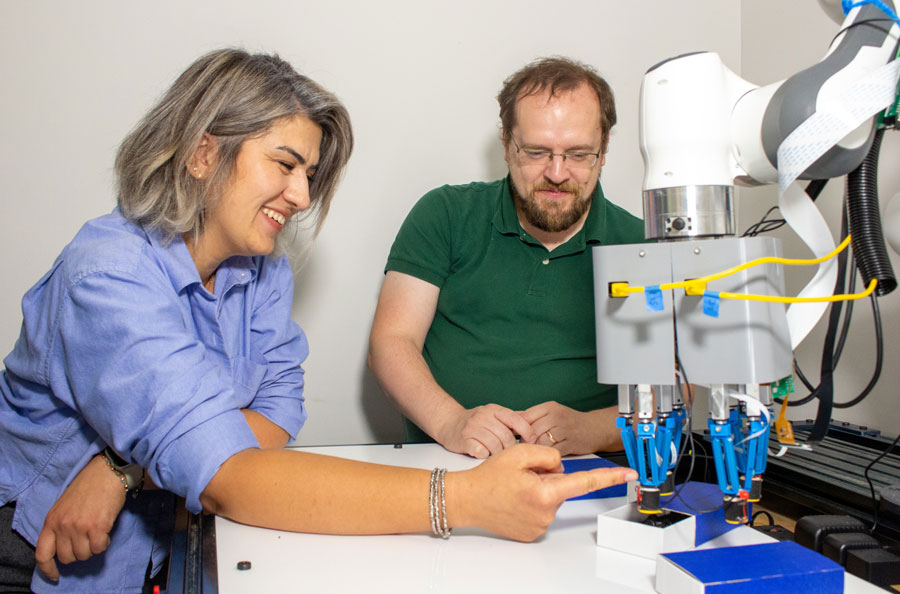
Carnegie Mellon engineers have built a low-cost robotic fingertip that combines force and vibration sensing with a nail-like tip to improve delicate, precise grasping of fragile items.
Engineers at Carnegie Mellon University’s Robotics Institute have developed a new robotic fingertip that brings robots closer to the gentle, precise touch humans take for granted. By blending multiple types of tactile sensing into a low-cost design—complete with a nail-like feature—the team says robots could become better at handling small, fragile items, such as picking up an exact number of pills without crushing or dropping them.
“Dexterity is a frontier area of robotics, and we’re making rapid progress,” said Oliver Kroemer, an associate professor in CMU’s Robotics Institute. Yet, he added, delicate manipulation remains a stubborn hurdle, motivating the group to focus on fine, fingertip-level control.
The work builds on CMU’s earlier DeltaHands project, supported by the National Science Foundation. DeltaHands was conceived as an inexpensive, highly adaptable robotic hand for tasks that are notoriously difficult for machines—like turning book pages or grasping irregular objects. Depending on the job, the device can be configured with one to six finger-like modules, and its heavy use of 3D-printed parts makes it easier to customize than many conventional robot hands.
The new advance is a set of human-inspired fingertips designed to attach to DeltaHands and expand what it can do. Instead of relying on a single sensor, each fingertip combines force sensing and vibration-based touch to help a robot both perceive what it is contacting and adjust its actions in real time.
A strain gauge embedded in the fingertip measures how much pressure the finger is applying, allowing the system to monitor exactly how hard it is pinching. Alongside that, the researchers placed a contact microphone behind a small plastic “fingernail.” As the fingertip brushes across a surface or taps an edge, the microphone captures high-frequency vibrations—signals that can reveal texture, slipping motion, or subtle contact events that are difficult to see.
The sensing hardware is wrapped in a soft silicone skin that improves grip. Together, the strain gauge and microphone let the robot detect fine textures, notice when an object begins to slide, and identify edges or features it might otherwise snag on. The team reports the components cost under 800 it would take to assemble a comparable setup using off-the-shelf parts.
“We show how multimodal touch can directly support both perception and control during manipulation,” said Zhuowei Xu, a College of Engineering alumnus who worked on the project during his master’s degree in mechanical engineering. By combining force and vibrotactile information, Xu said, the system can change how it interacts with objects based on the goal—from tightening a grasp when slip is detected to finding small features that are hard to spot visually, or even probing properties that vision can’t access and using those cues to choose the next move.
To evaluate the fingertips, the researchers ran experiments that included counting and unstacking paper cups, identifying materials such as coarse fabric and wax paper from their micro-vibration signatures, and gripping brittle foods like tofu cubes and potato chips. The cup tests were particularly useful for studying manipulation when sight is partially blocked; in those trials, the nail component could slide along cup rims while the sensors helped the robot determine how many cups were present. In separate trials, vibration patterns recorded by the microphone enabled the system to learn differences between materials and classify what it was touching.
For Zeynep Temel, an associate professor in the Robotics Institute, the goal isn’t to build a robot that replaces hobbies or creative work at home. Rather, she envisions assistant robots that can reliably support people—by handing over the correct item at the right moment or taking on tasks that are tedious or physically challenging.
Why it matters
Robots still struggle with everyday “small touch” tasks that humans barely notice, limiting their usefulness as home assistants and helpers. Low-cost, multimodal fingertips could make robotic hands safer and more reliable around fragile objects and cluttered environments where vision is imperfect. Next to watch: how well the approach scales to real household items such as medications, and whether these sensors can be robust enough for long-term use outside the lab.