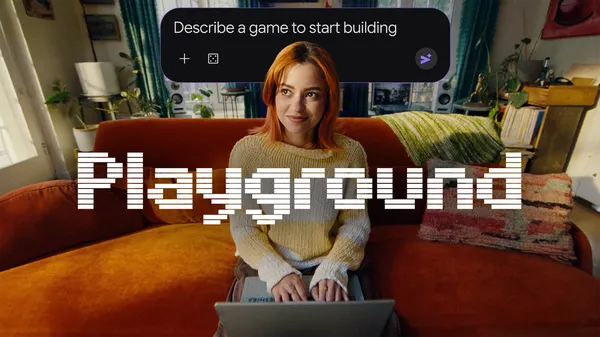
Google has launched Playground, a browser-based platform for creating, playing and sharing games using text prompts without coding, with discovery and multiplayer features.
Turning an idea into a playable game has typically required technical skills, specialized software, and a willingness to wrestle with complex engines. Google is trying to change that dynamic with the launch of Playground, an experimental, browser-based platform that lets people create, play, and share custom games using text prompts—without writing code.
Playground is built around a conversational interface: instead of scripting behaviors or assembling assets by hand, creators describe what they want. Users can start from an empty project, modify starter prompts, or rely on guided assistance to shape an initial concept. From there, the system is designed for rapid iteration. Want to adjust physics, change the rules, redesign characters, or swap out an environment? The platform encourages creators to refine games simply by asking for updates in plain language, with the goal of keeping users in control from early prototype to a more polished result.
Creation is only half of the pitch. Playground also functions as a place to discover and play other people’s games through a growing community catalog. Because it runs in a web browser, games can be played on both phones and laptops, lowering the friction for casual play sessions and quick sharing.
When a project is ready, creators can choose how public it becomes. Games can be kept private, shared via a link with friends and family, or published to the Playground Explore gallery for the wider community. For social competition, some genres support multiplayer gameplay and in-game leaderboards, giving players ways to challenge others and track performance.
Playground ties into a Play Games profile, which allows users to claim a custom handle, like games, follow creators, and compete for leaderboard rankings. Discovery within the gallery is influenced by player ratings and play activity, which the platform uses to highlight games it deems new, inventive, and entertaining.
Google says safety measures are built into the publishing flow. Every game submitted to the public gallery goes through safety checks aligned with the platform’s Community Guidelines, and the system includes user reporting tools intended to help keep the experience welcoming.
The company is also positioning Playground as a potential on-ramp to more advanced development. An upcoming integration with Unity Spark—a Unity effort now in testing, with a closed beta planned—aims to offer professional-grade options such as more sophisticated mechanics, high-fidelity 3D, and the flexibility of the Unity runtime. The long-term vision is an ecosystem where someone can begin with a simple text prompt and later expand the same concept into more immersive experiences using Unity’s toolset, while still distributing playable results through Playground.
Playground is available starting today at playground.google for U.S. users age 18 and older, with tiered creation access rolling out based on a user’s Google One membership. Google is also pointing interested users to demo games on the site, and directing those curious about the Unity roadmap to information at unity.com/spark.
Why it matters
Playground could broaden who gets to experiment with game design by removing the coding barrier that has traditionally limited participation. If the platform’s community tools and safety checks hold up at scale, it may become a meaningful new channel for lightweight, browser-playable games—and a stepping stone into professional development via Unity Spark. Watch next for how creation limits tied to Google One affect adoption, and how quickly Unity Spark moves from testing into broader availability.