Pope Leo XIV’s comments on AI art have reignited debate as tech thinkers argue future embodied systems could create from firsthand experience, not remixing data.
Pope Leo XIV set off a fresh round of debate about artificial intelligence and creativity with a recent post arguing that there is a fundamental difference—deeper than style or taste—between human-made art and imagery produced by machines. His point rests on how current generative systems operate: they assemble new pictures by performing statistical calculations across vast collections of existing human work. As a plain description of today’s mainstream models, that assessment is largely accurate. Contemporary image generators learn visual patterns by training on millions of artworks and photographs created by people, then recombine those learned patterns to produce novel outputs.
But the writer and startup founder Paul Graham, who also paints, suggests the technology is nearing a shift that complicates the Pope’s argument. In Graham’s view, the decisive detail isn’t whether a machine can produce something aesthetically convincing, but where its understanding of the world comes from. Today’s systems largely “see” through datasets. The next wave, he argues, will see through experience.
That change hinges on embodiment: robots and AI systems connected directly to the physical environment through cameras, microphones, touch sensors, and other instruments. Unlike models trained solely on scraped images and captions, an embodied system can gather its own raw observations, build representations from those observations, and update its behavior based on what it personally measures. In such a scenario, the machine is not merely remixing a catalogue of other people’s pictures; it is creating from its own sensory record of the world.
Graham extends the same logic to language. Large language models were originally built by training on text written by humans—books, websites, and other documents. Yet he predicts that machine-generated language could become a growing share of what future systems read, effectively making AI writing part of the environment that shapes subsequent AI. If the cultural “training data” pipeline begins to include more machine-produced material, the boundary between human origin and machine origin becomes harder to treat as a clean dividing line.
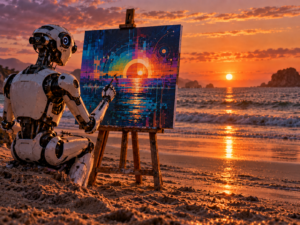
To illustrate what’s at stake, consider a simple vignette: a robot standing on a beach at dusk. It watches the sky dim, tracks the shifting colors, and then paints the sunset it observed—drawing on its own sensors rather than a database of other sunsets. Many people, including the Pope, might still argue that something essential separates that output from human art. But if the straightforward empirical distinction—copying from others versus perceiving for oneself—starts to disappear, the remaining claim of a categorical “ontological” gulf may rely less on technology and more on belief about what art ultimately is.
Why it matters
As AI systems move from screens into the physical world, questions about authorship, originality, and creative rights will become harder to answer with today’s assumptions. Artists, regulators, and companies building consumer robots all have a stake in whether “learning from experience” changes how society judges machine-made work. Watch for legal and cultural fights over what counts as independent creation—and whether embodiment becomes a turning point in public acceptance of AI-generated art.