NASA’s Juno spacecraft has delivered a new kind of look at Jupiter’s volcanic moon Io—not just at its surface, but into the shallow subsurface where heat from active geology can be detected beneath the crust.
NASA’s Juno spacecraft has delivered a new kind of look at Jupiter’s volcanic moon Io—not just at its surface, but into the shallow subsurface where heat from active geology can be detected beneath the crust.
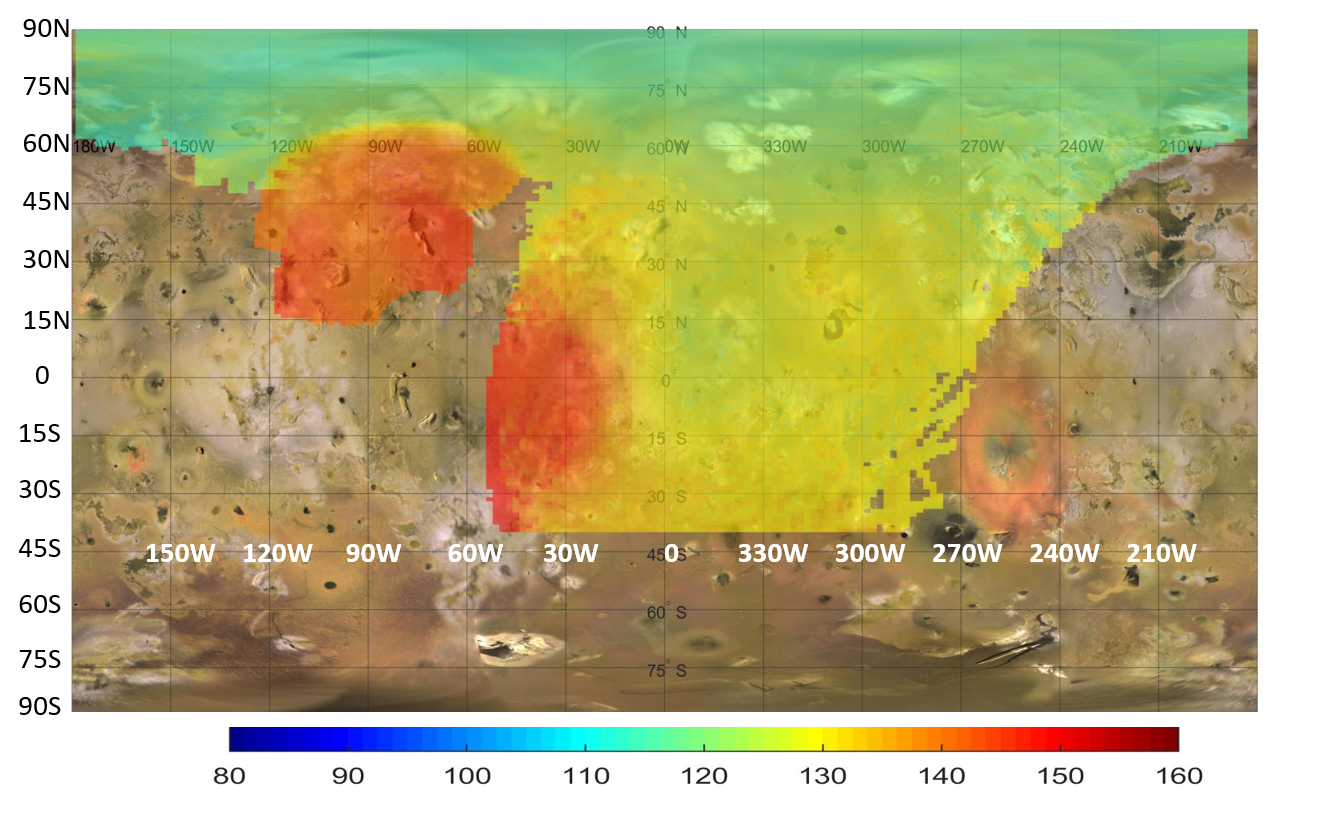
The view comes from data collected by Juno’s Microwave Radiometer (MWR), which senses thermal emission at microwave wavelengths. Unlike infrared instruments that record temperatures at the surface, Juno’s lowest-frequency microwave channels—0.6 and 1.25 gigahertz—can probe below the exterior, reaching roughly 6 to 20 feet (2 to 6 meters) into Io’s crust. The resulting map highlights how subsurface warmth varies across the moon, with the strongest localized heat output shown in red.
One standout hot region appears in the map’s upper-left quadrant, between about 60 and 120 degrees west longitude. There, the subsurface is inferred to be about 18 to 36 degrees Fahrenheit (10 to 20 degrees Celsius, or 10 to 20 Kelvin) warmer than nearby terrain at comparable latitudes. This pronounced anomaly aligns with the Zal Montes Patera complex, a geologically active area where Juno’s Stellar Reference Unit previously recorded evidence of an active lava flow—an independent observation that supports the microwave indication of strong internal heating.
MWR also identifies another major warm zone nearer the equator, extending from roughly 0 to 50 degrees west longitude. Taken together, these two distinct microwave “hot spots” point to substantial internal heat being expressed within the upper tens of meters of Io’s crust, reinforcing the moon’s reputation as the most volcanically active body in the solar system.
Away from these intense anomalies, the map transitions to colors that reflect more typical subsurface conditions. Yellow shades mark intermediate temperatures that increase toward the equator, approaching around -190°F (-123°C, or 150 Kelvin). Green tones—most evident at higher northern latitudes—represent the coldest subsurface areas, with temperatures near the pole falling to about -298°F (-183°C, or 90 Kelvin).
The Juno mission is managed by NASA’s Jet Propulsion Laboratory (JPL), a division of Caltech in Pasadena, California, on behalf of principal investigator Scott Bolton of the Southwest Research Institute in San Antonio. Juno operates as part of NASA’s New Frontiers Program, overseen by the Marshall Space Flight Center in Huntsville, Alabama, for NASA’s Science Mission Directorate in Washington. JPL built the Microwave Radiometer, while Lockheed Martin Space in Denver constructed the spacecraft and is responsible for its operations. Further information about the mission is available at nasa.gov/juno.