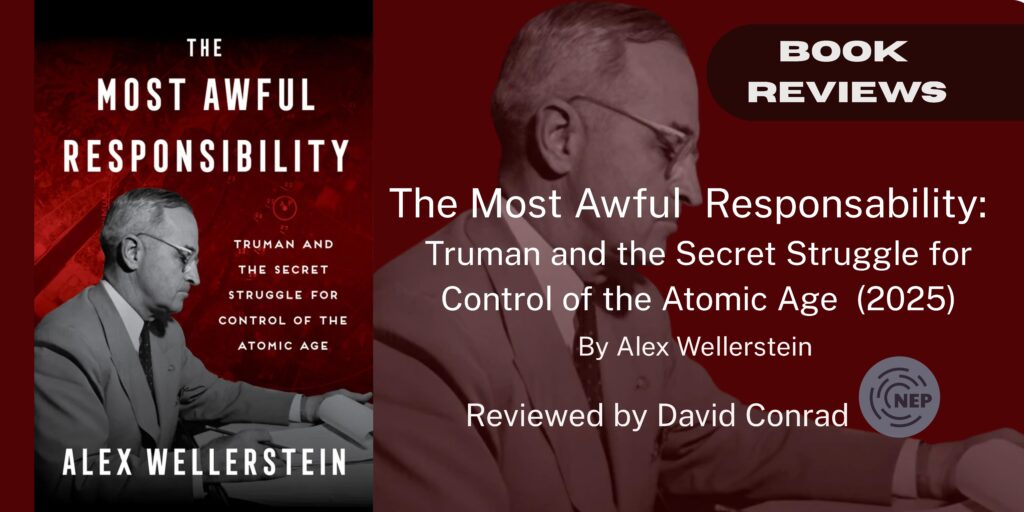
New research revisits Harry Truman’s contested role in the atomic bomb decision and examines how he sought to control nuclear power as historians’ debates remain sharply divided.
Harry S. Truman occupies an awkward place in the long-running historical fight over why the United States used atomic weapons against Japan in 1945. Competing schools of interpretation have turned the new president into either a calculating strategist or a largely detached figure swept along by events—an ambiguity that continues to shape how scholars narrate the dawn of the nuclear age.
In the “orthodox” account, Truman and his advisers made a grim but logically defensible choice. High anticipated U.S. casualties from an invasion, Tokyo’s inability to settle on surrender terms, and the expectations of an American public exhausted by war are often cited as pressures that pushed the administration toward using the bomb. “Revisionist” historians, by contrast, argue that Truman showed limited engagement with the specifics of targeting and timing, failed to pursue a negotiated end to the war that some Japan specialists recommended, and increasingly viewed atomic power through the lens of an approaching confrontation with Josef Stalin, even as the moral implications of nuclear warfare were only beginning to come into focus.
Those debates did not stay confined to academic journals. They flared publicly in 1995, when the Smithsonian Institution abandoned a planned 50th-anniversary exhibition on Hiroshima and Nagasaki after intense criticism from veterans’ groups, politicians, and scholars over how the exhibit framed the bombings. The controversy unfolded at the same moment that online discussion spaces—email lists, early web forums, and later blogs—were expanding historians’ audiences. The result was wider exposure for disputes over evidence and interpretation, often with less restraint. After decades of close archival work produced few points of agreement, frustration hardened into something like entrenched camps.
That polarized landscape is the backdrop for The Most Awful Responsibility: Truman and the Secret Struggle for Control of the Atomic Age (HarperCollins, 2025) by Alex Wellerstein, a prominent contemporary voice on nuclear history. Wellerstein is already well known outside the academy for “Nukemap,” the interactive online tool he launched in 2012 that allows users to model blast damage and fallout patterns for different nuclear detonations. The site—still maintained at https://nuclearsecrecy.com/nukemap/—helped translate abstract megatons into neighborhood-level consequences, and became a widely shared way for the public to visualize what nuclear use could mean for their own cities.
In the new book, Wellerstein turns that same knack for making technical and bureaucratic realities legible toward a different question: once the weapon existed and had been used, how did Truman try to control it? Truman’s own anxieties about who might acquire atomic power were evident early. In a July 1945 journal entry, he reflected that it was “certainly a good thing for the world” that Adolf Hitler’s regime—or Stalin’s—had not been the first to obtain the bomb. Yet the Soviet Union would detonate its own device in August 1949, just as Truman was entering his second term, ending the U.S. monopoly and reshaping global strategy.
Wellerstein’s account focuses on a period many narratives treat as a brief transition: the four years between Hiroshima and Nagasaki in August 1945 and the first Soviet test in August 1949. He reconstructs those years through close, highly contextual readings of Truman’s statements and decisions, emphasizing the often-hidden struggle over who would have access to nuclear weapons and under what authority. Understanding that contest, the book argues, requires grappling with long-classified policies and institutional rivalries—terrain Wellerstein previously explored in his 2021 study of U.S. nuclear secrecy, Restricted Data: The History of Nuclear Secrecy in the United States (University of Chicago Press).
The final portion of the book follows Truman as the nuclear balance shifts. Wellerstein traces how the administration moved to reassert superiority through development of “the Super,” the early term for the hydrogen bomb. He also revisits the fraught arguments over potential nuclear use in the Korean War—debates that erupted precisely as the arms race became an enduring feature of international politics.
Why it matters
Truman’s post-1945 decisions helped define who controls nuclear weapons, how secrecy operates, and how quickly technological escalation can become policy. As today’s nuclear risks extend from great-power rivalry to proliferation fears, understanding the earliest struggles over authority and restraint offers clues about what makes guardrails durable—or fragile. Watch especially for how this history informs current debates about executive power, military access, and the politics of nuclear modernization.