A new power-system concept aims to dramatically upgrade the way deep-space missions turn radioactive heat into electricity.
A new power-system concept aims to dramatically upgrade the way deep-space missions turn radioactive heat into electricity. The proposed device, called a plasmon-enhanced radioisotope thermophotovoltaic (PRTPV) generator, is designed to outperform today’s radioisotope thermoelectric generators (RTGs) on two metrics that matter most for spacecraft: how much electrical power it can deliver for its mass, and how efficiently it converts heat into usable electricity.
According to the proposal, the PRTPV system targets a specific power of about 17 watts per kilogram and a thermal-to-electric efficiency above 40%. If achieved, that would represent roughly a sevenfold efficiency gain and close to an order-of-magnitude improvement in specific power compared with current state-of-the-art RTGs. Such a leap could reshape mission designs that are currently constrained by heavy power supplies and modest electrical output, particularly far from the Sun or in environments where solar panels are ineffective.
Thermophotovoltaic (TPV) systems work by letting a hot source emit thermal radiation that is then converted into electricity by a photovoltaic (PV) cell. In practice, however, conventional TPV approaches have been held back by low power density—the amount of radiative energy that can be delivered to the PV cell per unit area—making it difficult to build compact generators with high output.
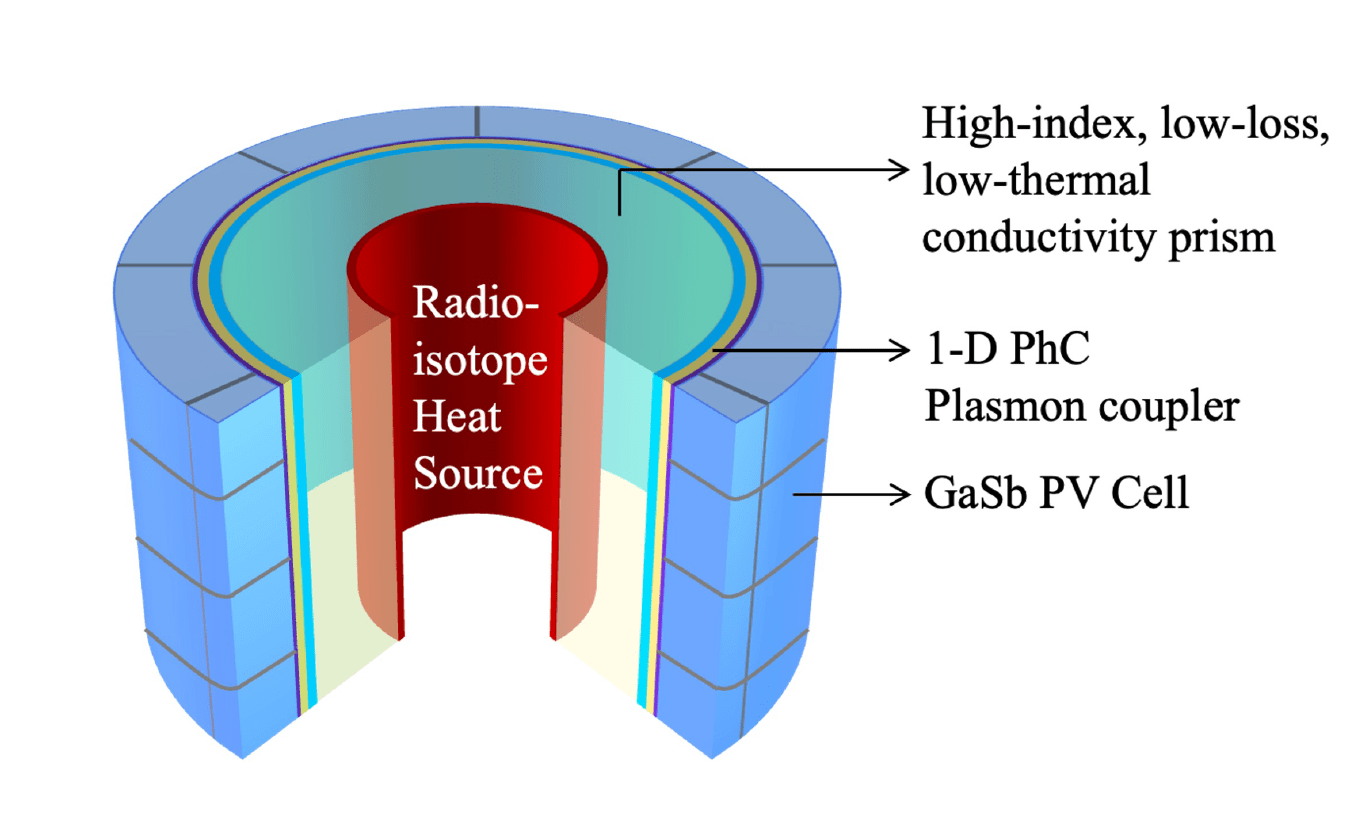
The PRTPV concept tackles that bottleneck with two linked innovations. First, it replaces the traditional vacuum gap between the radioisotope heat source and the PV cell with a carefully chosen solid material. The proposal specifies a class of materials with high refractive index, low infrared loss, low thermal conductivity, and high melting point; aluminum oxide (Al₂O₃) is offered as an example. In this design, the material’s refractive index becomes an advantage: thermal radiation power density is expected to increase in proportion to the square of the refractive index, boosting the radiative coupling between the hot emitter and the PV converter while maintaining thermal robustness.
The second innovation focuses not on increasing the total radiation, but on improving its usefulness to the PV cell. The proposal incorporates a multilayer photonic-crystal “plasmon coupler” that shapes the spectrum of the thermal emission. By exciting surface plasmons at the interface between the coupler and the PV cell, the system can tune radiated energy to align more closely with the PV cell’s bandgap—the energy threshold at which photons can be efficiently converted into electrical current. Better spectral matching reduces wasted heat and pushes conversion efficiency higher.
Together, these strategies are intended to create a compact, high-output radioisotope power source that is also scalable, addressing the long-standing limitations that have kept TPV systems from competing with RTGs in real-world spacecraft applications.
The potential mission impact is broad. The proposal highlights long-duration operations in permanently shadowed regions of the Moon—where sunlight is scarce—as well as interstellar missions for which solar power is essentially off the table. By promising higher efficiency and far more electrical power per kilogram, the PRTPV concept aligns with NASA’s long-term objectives for advanced energy technologies that can expand the reach and capability of future exploration.