When NASA’s Artemis II crew completed its voyage around the Moon and Orion hit the Pacific off San Diego, the mission was not truly over.
When NASA’s Artemis II crew completed its voyage around the Moon and Orion hit the Pacific off San Diego, the mission was not truly over. The next challenge—bringing astronauts and spacecraft safely out of open water—fell to a tightly choreographed team of U.S. Navy divers and NASA specialists led on the water by Tim Goddard.
Goddard serves as NASA’s open water lead for Orion recoveries, a role that makes him responsible for far more than directing divers at the splashdown site. He oversees the planning that underpins the entire open-ocean segment: developing and certifying recovery approaches, acquiring and maintaining specialized equipment, and training both NASA and Navy personnel for the procedures needed to secure Orion and move the crew to safety aboard an amphibious Navy ship.
The work is demanding because it requires multiple assets operating at once in a dynamic environment. Goddard describes a recovery scene that can include six small boats, four helicopters, and the Navy ship working simultaneously, with more than 50 people deployed across the water and support craft. Divers may be submerged near the capsule, others operate at the surface, and boats maneuver in close proximity—all while aviation, communications, medical support, vessel traffic, and ship operations are coordinated as part of the broader recovery effort.
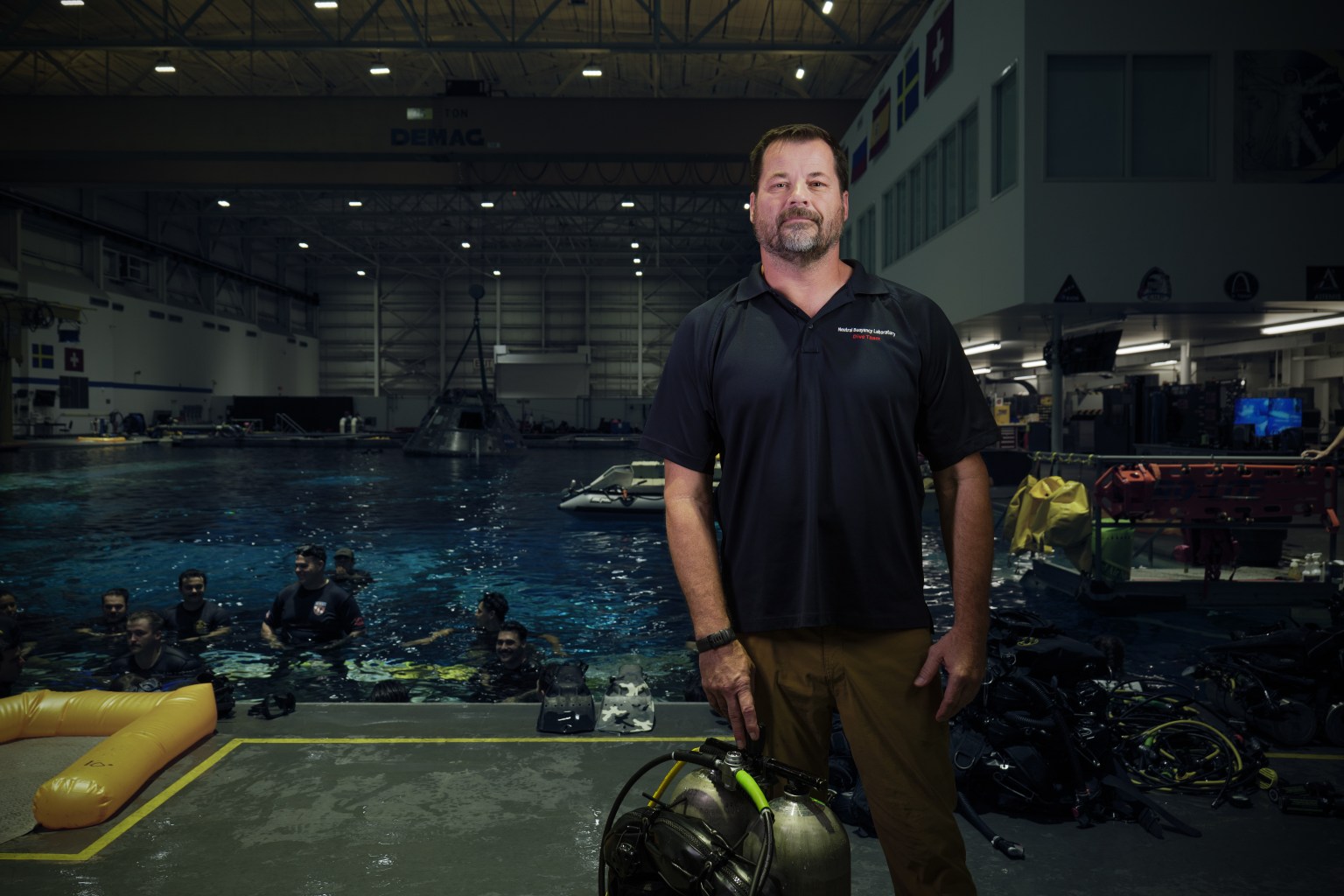
To make that “complex set of operations” function on splashdown day, the team builds experience through extensive repetition. Training begins at NASA’s Johnson Space Center in Houston, where recovery crews rehearse with Orion-like hardware inside the Neutral Buoyancy Laboratory, one of the world’s largest indoor pools capable of supporting large-scale underwater and surface operations. From there, the team transitions to Southern California, starting in San Diego Bay and gradually moving into open-ocean conditions that more closely match what they will face during an actual return.
The goal, Goddard explains, is to ensure that every segment of the recovery has been performed many times before it counts. By the time a mission flies, crews have accumulated hours of practice across each phase, cycling through the sequence repeatedly so that the real event feels familiar rather than novel.
Artemis II marked Goddard’s third Orion recovery. He helped bring in the capsule after Exploration Flight Test-1 in 2014 and after Artemis I, Orion’s uncrewed lunar test flight in 2022. Those operations centered primarily on securing the spacecraft. With Artemis II, the presence of astronauts altered the priorities. Goddard said the team’s focus shifted decisively: first retrieve the crew and get them safely aboard the ship, then transition to the procedures required to recover and transport Orion.
Goddard has been connected to Orion recovery since joining the initial team in 2007 and has served as open water lead for more than a decade. His path to NASA began after a 27-year career as a Navy diver. He joined the agency in the 1990s, initially working dive operations at the Neutral Buoyancy Laboratory before moving into mechanical engineering.
For Goddard, adding a crew to Orion’s return brought both pride and pressure. He said the responsibility weighed heavily on the recovery team. In earlier missions, relief came when the capsule was secured. With Artemis II, that feeling intensified: once the astronauts were safely recovered and Orion was back in San Diego, he described an overwhelming sense of release.