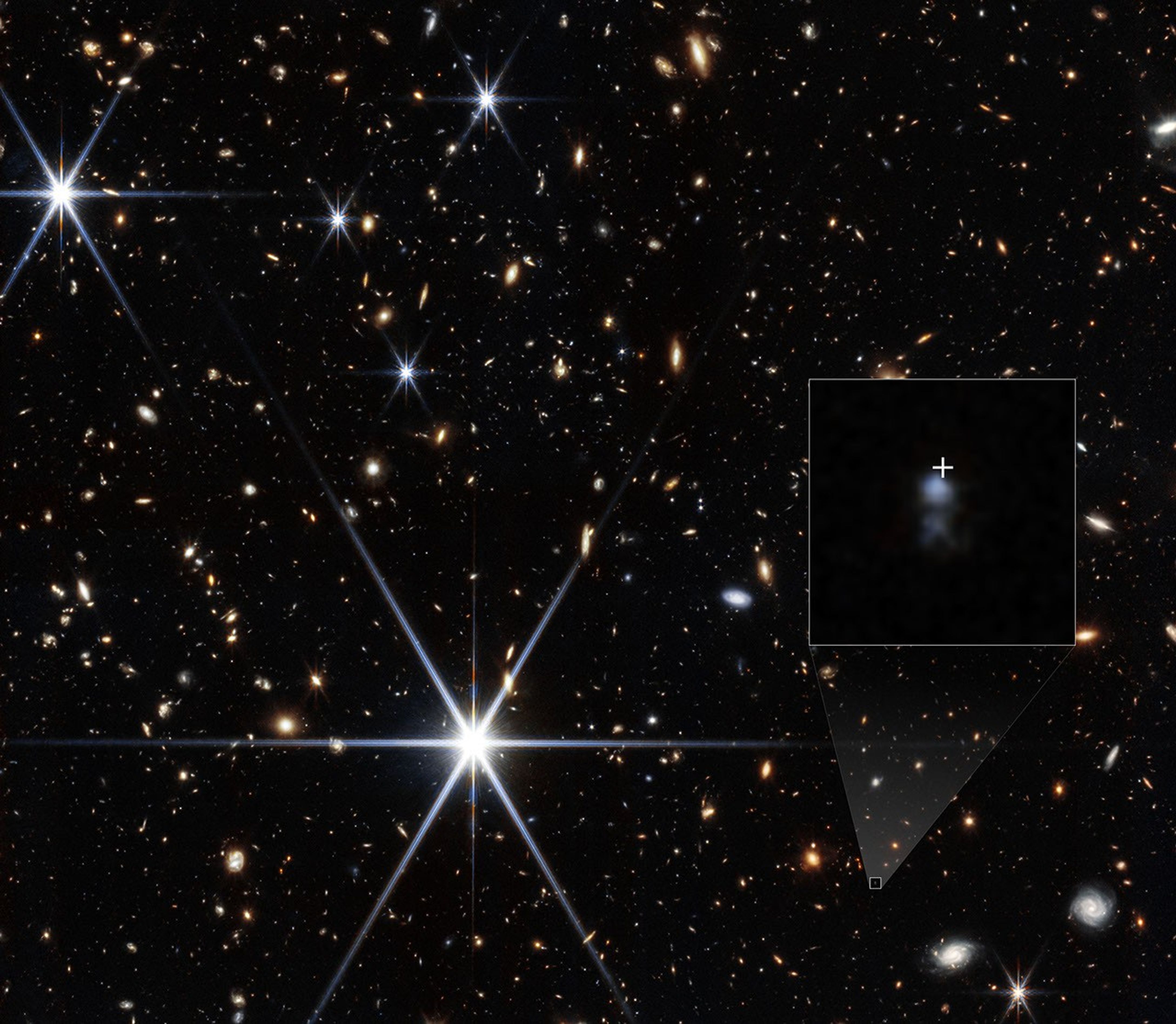
James Webb observations have identified the host galaxy of the most distant confirmed fast radio burst: a small, star-forming dwarf galaxy at redshift 2.148.
Fast radio bursts—intense pulses of radio waves that last only milliseconds—have puzzled astronomers since their discovery in 2007. Most appear once and vanish, leaving little opportunity to determine what produces them. Now researchers using NASA’s James Webb Space Telescope say they have identified the galaxy that hosted the most distant fast radio burst yet confirmed, a result that narrows the range of likely origins for at least this event.
The burst was detected on March 4, 2024 by the MeerTRAP team using the MeerKAT radio telescope in South Africa, and was cataloged as FRB 20240304B. Its radio signal indicated it had traveled an extraordinary distance—potentially farther than any FRB previously observed. But verifying that required locating and characterizing the galaxy from which it came.
That task proved impossible with even the largest ground-based optical telescopes. Although the burst’s position in the sky had been measured precisely, no visible host galaxy could be found at that location. The team therefore turned to Webb, whose infrared sensitivity is designed to pick out faint, distant galaxies whose light has been stretched to longer wavelengths by cosmic expansion.
Webb’s Near-Infrared Camera (NIRCam) revealed a galaxy exactly where astronomers expected the source to be. Follow-up observations with Webb’s Near-Infrared Spectrograph (NIRSpec) then provided a decisive measurement: the galaxy’s redshift is 2.148, placing it when the universe was only about 3 billion years old. Nearly all FRBs with known hosts have been found much later in cosmic history, making this one a notable outlier in both time and distance.
The host itself was also surprising. FRBs that have been traced to galaxies tend to originate in relatively massive, star-forming systems. In contrast, the newly identified host is a dwarf galaxy—about 1,000 times less massive than the researchers anticipated—though it is still actively forming stars. “We thought it would be a big, nicely formed galaxy with lots of stars,” said study lead author Manisha Caleb of the University of Sydney, “and instead it was a little dwarf galaxy.” Co-author Ben Stappers of the University of Manchester said the galaxy “sticks out” compared with the broader sample of known FRB hosts.
The timing is significant as well. The galaxy existed during “cosmic noon,” the epoch when star formation across the universe peaked. Based on the galaxy’s star-formation rate, the researchers infer that most of its stars may have formed over an intense span of roughly 30 million years.
That youthful, fast-building environment matters for competing theories about what generates FRBs. One leading idea links bursts to the merger of two neutron stars. But such systems are thought to take billions of years to spiral together and collide, implying they should be more common in older galaxies with mature stellar populations. Another explanation points to magnetars—highly magnetized neutron stars that form after massive stars explode. If a magnetar produces bursts through processes such as starquakes, FRBs could occur relatively soon after the supernova, consistent with a young, star-forming host like the one Webb observed.
“Our work suggests that it’s very unlikely that this FRB was produced by a merger,” Caleb said. Co-author Themiya Nanayakkara of the University of Sydney emphasized that Webb made the decisive observations possible, extending host-galaxy studies to distances beyond previous limits.
Beyond setting a distance record, the event also offers a probe of the vast, thinly distributed material between galaxies along the burst’s path to Earth—one more way FRBs can illuminate the universe they cross.
Why it matters
Pinpointing the most distant FRB host yet gives astronomers a rare data point from an early era of cosmic history, when galaxies were rapidly forming stars. The dwarf, star-forming host strengthens the case that at least some FRBs come from young magnetars rather than slow-to-form neutron-star mergers. Next, researchers will look for more high-redshift FRBs to see whether this pattern holds—and to use the bursts as tools for studying otherwise hard-to-detect matter between galaxies.