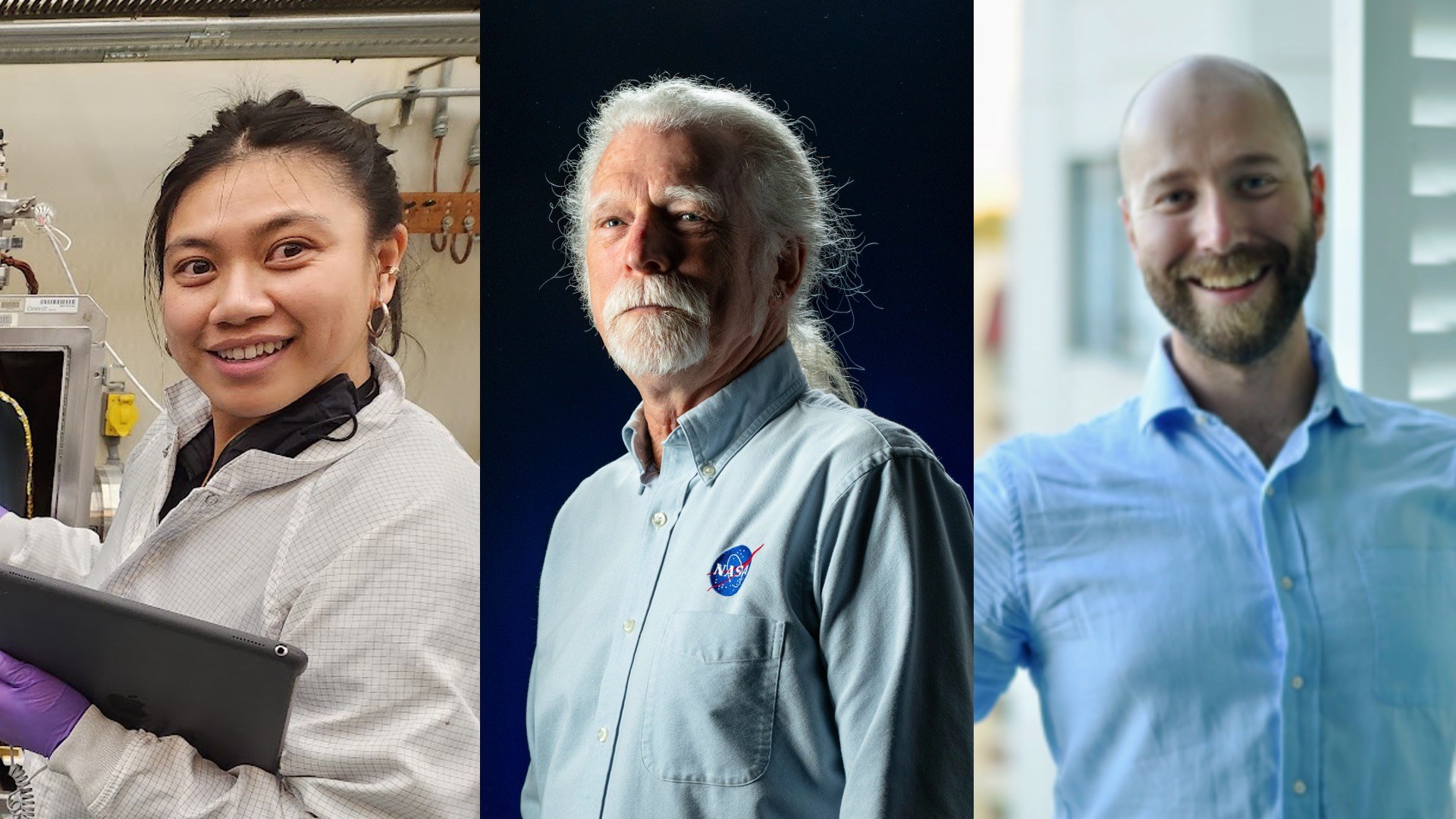
NASA Ames has named Alyssa Villanueva, Steve Howell and Samuel LeBlanc as Science Directorate Stars of the Month for work advancing space biology, astronomy and airborne Earth science.
The Science Directorate at NASA’s Ames Research Center has selected three “Stars of the Month” for November 2026, honoring work that reflects both technical excellence and the collaborative mindset required for NASA’s research and exploration goals. This month’s recognition goes to Alyssa Villanueva, Steve Howell, and Samuel LeBlanc—each cited for contributions that strengthen missions spanning space biology, astronomy, and airborne Earth science.
Alyssa Villanueva, an engineer with Blue Marble in Ames’ Space Biosciences Division, was recognized for her day-to-day impact on the LEIA project—the Lunar Explorer Instrument for space biology Applications. LEIA is part of Ames’ efforts to expand biological research beyond Earth, and Villanueva has become a central technical contributor to the team’s progress. Colleagues highlighted her consistent readiness to support others as well as her deep involvement in testing work. In particular, she was credited with playing an essential role in the preparation and execution of engineering validation testing, a key step in demonstrating that systems perform as intended before moving forward in a mission’s development cycle.
Steve Howell was honored for long-running leadership in scientific teams supporting numerous international space missions and for a career of innovations in astronomical instrumentation. Ames noted that Howell’s work has helped push forward imaging capabilities for both space-based and ground-based observatories, improving how telescopes capture and interpret light from distant objects. His influence has extended across projects that depend on instrument performance and reliable data quality—areas where advances can translate into sharper images, more precise measurements, and stronger science outcomes. Howell’s achievements were also recently recognized by the broader astronomy community: he received the Catherine Wolfe Bruce Gold Medal from the Astronomical Society of the Pacific, one of the field’s most prestigious lifetime honors, awarded for major contributions to astronomy.
Samuel LeBlanc, a research scientist with the Bay Area Environmental Research Institute working in Ames’ Earth Science Division, was selected for technical leadership and inventive problem-solving that have expanded Ames’ flight planning capabilities for NASA airborne science missions. Airborne campaigns rely on carefully designed flight paths, timing, and operational decisions to align aircraft measurements with targets such as storms, wildfires, atmospheric layers, or surface features. LeBlanc’s contributions were credited with positioning Ames as a leading center for airborne science flight planning both within NASA and beyond. The result, Ames said, is an ability to support successful and cost-effective missions while increasing the scientific value of the data collected.
Together, the three honorees represent a cross-section of NASA Ames’ portfolio—developing instruments and tests for space biology, advancing the tools of astronomy, and strengthening the planning infrastructure behind airborne Earth science.
Why it matters
Recognition programs like this spotlight the behind-the-scenes work that makes NASA missions possible, from rigorous validation testing to better scientific instruments and smarter operations planning. Improvements in flight planning and instrumentation can directly affect mission cost, risk, and the quality of scientific data. The next thing to watch is how these contributions translate into upcoming mission milestones, including continued progress on LEIA and future airborne campaigns that depend on advanced planning tools.