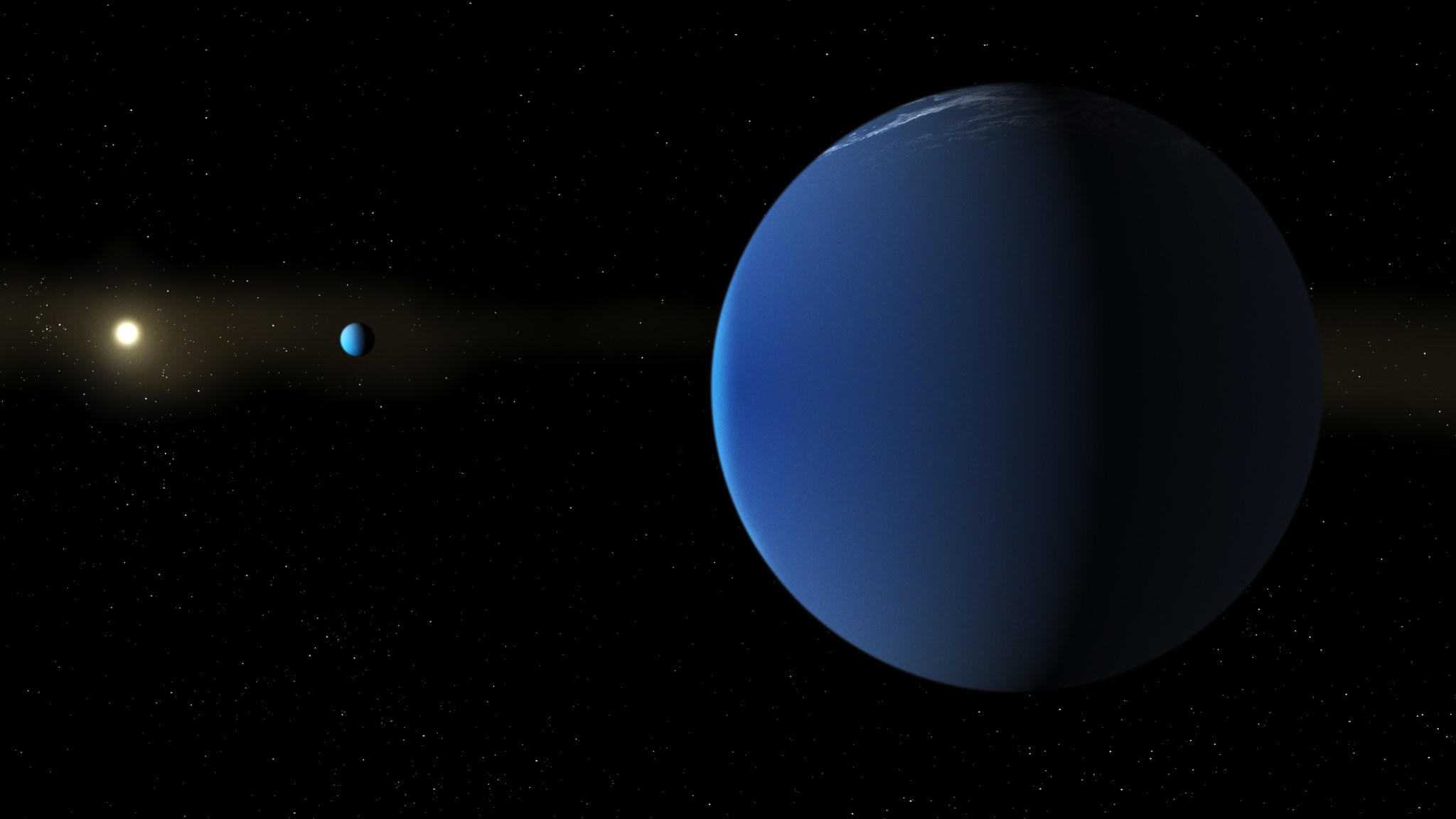
NASA’s Transiting Exoplanet Survey Satellite TESS has identified two remarkably bloated giant planets whose densities are so low they have been likened to cotton candy.
NASA’s Transiting Exoplanet Survey Satellite (TESS) has identified two remarkably bloated giant planets whose densities are so low they have been likened to cotton candy. The newly characterized worlds, TOI-791 b and TOI-791 c, circle a Sun-like star called TOI-791 located about 1,113 light-years from Earth. Based on their measured sizes and masses, researchers say the pair represent the puffiest planets yet found.
TESS initially flagged the system by recording repeated, subtle dimmings in the star’s light—signals produced when a planet crosses, or transits, in front of its host star from our viewpoint. Follow-up analysis showed that TOI-791 hosts two outsized planets with unexpectedly small masses. TOI-791 b is roughly Jupiter’s size but contains only about 3.0% of Jupiter’s mass. TOI-791 c is even larger than Jupiter while weighing in at just 5.9% of Jupiter’s mass.
“These planets are interesting to study is that we didn’t expect to see them at all,” said Jon Jenkins, science lead for the Science Processing Operations Center at NASA’s Ames Research Center in California’s Silicon Valley, which produces the science-ready TESS data used in the work. Their existence, he added, poses a major challenge to prevailing ideas of how gas giants and “super-puff” planets can form.
Adding to the intrigue, both planets take an unusually long time to orbit their star—139 days for TOI-791 b and 232 days for TOI-791 c. Super-puff planets have been found before, but long-period examples are difficult to detect because confirming repeated transits requires extended monitoring. From its position in high Earth orbit, TESS was able to observe this system for a total of 1,122 days spread across seven years, giving scientists enough coverage to pin down the planets’ properties.
The two giants also appear to be gravitationally linked in a way that helps reveal their masses. Researchers found that TOI-791 b and c are locked into an orbital configuration that causes them to tug on each other as they circle the star. Those interactions slightly speed up or slow down the timing of their transits—an effect known as transit timing variations. By measuring these timing shifts, the team could estimate each planet’s mass, confirming both as extremely low-density super-puffs.
“Only a handful of these super-puffy planets are known, and it is even rarer to find two in the same system,” said lead author George Dansfield of the University of Oxford’s Department of Physics. Because their densities are so extreme, he noted, they offer a valuable opportunity to probe how planetary systems are assembled and how they change over time.
Researchers say the discoveries open multiple avenues for future investigation. Steve Howell, a NASA Ames research scientist involved in the study, emphasized that giant-planet formation is thought to shape the broader evolution of planetary systems, making these Jupiter-sized but dramatically underweight worlds especially informative. Planned work includes examining the chemistry of the planets’ atmospheres, assessing whether rotation affects their shapes, and comparing the tilt of the host star with the planets’ orbital planes. Such studies could also help reconstruct how TOI-791 b and c moved through the system during their formation and whether interactions with other planets sculpted their current paths.
The research, led by the University of Oxford with collaborators from Université Côte d’Azur/Observatoire de la Côte d’Azur and the University of Birmingham, is published today in Monthly Notices of the Royal Astronomical Society.