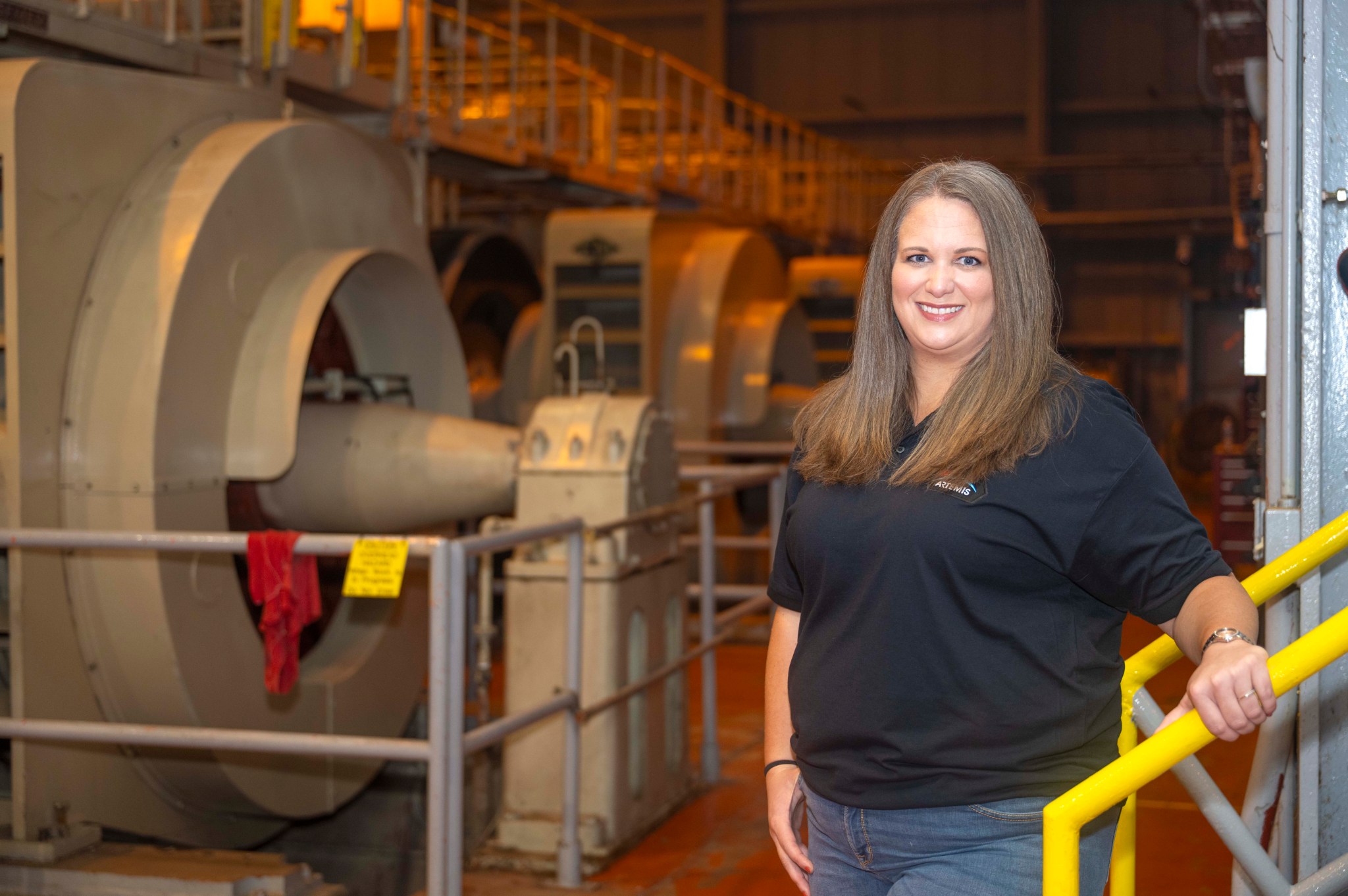
Kristie Foster’s path to becoming a NASA civil servant was built on persistence—sometimes measured in the hours she spent on the road between work and school.
Kristie Foster’s path to becoming a NASA civil servant was built on persistence—sometimes measured in the hours she spent on the road between work and school. Now based at NASA’s Stennis Space Center near Bay St. Louis, Mississippi, Foster plays a behind-the-scenes but essential role in the propulsion testing infrastructure that supports the agency’s push to return astronauts to the Moon and establish a sustained lunar presence.
Foster joined NASA as a civil servant in June after spending years as a contractor at Stennis. Her transition aligns with an agency workforce directive aimed at rebuilding core competencies and retaining critical institutional knowledge. For Foster, the milestone is also personal. Her father, who worked roughly two decades at Stennis, retired from NASA last year—making her hiring feel like a continuation of a family commitment to the center’s work. She described the moment as meaningful not only professionally, but as the fulfillment of a long-held goal.
As a quality engineer at the nation’s largest rocket propulsion test site, Foster oversees quality assurance and engineering efforts with a focus on two key systems: the High Pressure Gas Facility and the High Pressure Industrial Water Facility. The gas facility—often described as central to Stennis operations—produces, stores, and distributes gaseous nitrogen, helium, hydrogen, and air. Those gases are routed through a seven-mile pipeline network that reaches across the site to support engine and stage testing.
The industrial water facility, meanwhile, draws on a 66-million-gallon reservoir to deliver huge volumes of water to test stands. The flow is critical for cooling equipment and helping suppress sound during hot-fire tests, where rocket hardware is ignited while anchored to the ground.
In addition to her quality responsibilities, Foster has taken on a safety role tied to the buildup at the Thad Cochran Test Stand (B-2). The stand is slated to support Blue Origin’s hot-fire testing of the second stage of its New Glenn rocket. Foster’s work includes scrutinizing test preparation documentation, confirming operational plans in the field, and tracking processes from early design through closeout—an end-to-end approach meant to prevent problems before they reach a test stand.
Her philosophy is straightforward: embed safety and quality at the start, and carry it through every phase. In her view, NASA’s culture of actively implementing safety enables teams to move quickly without compromising standards—a necessity at a site where complex systems and high-energy testing leave no room for shortcuts.
Foster brings an adaptable, mission-focused approach to work that contributes to Artemis, NASA’s lunar campaign. After Artemis II flew successfully last April, NASA is looking ahead to Artemis III, which is intended to demonstrate integrated operations between the Orion spacecraft and test versions of commercial human landing systems. Artemis IV is planned to return astronauts to the lunar surface.
For Foster, the momentum feels like a revival of the excitement that once defined the space race. She has watched Artemis I and II succeed and is eager to see the next chapters unfold—especially the moment humans set foot on the Moon again.
Her own NASA story began close to home. Foster completed two years at Pearl River Community College and took summer night courses at Mississippi Gulf Coast Community College. Her first experience at Stennis came through the center’s largest tenant, the U.S. Navy, via an internship with the Naval Oceanographic Office. While finishing a bachelor’s degree in construction management and land development at Mississippi State University, she secured a four-week holiday internship on a Stennis construction project—work that expanded into a demanding senior-year rhythm of three days on site and four days back on campus.
That effort led to a full-time position. Foster supported NASA’s work as a contractor from 2008 until her recent civil service appointment. Today, the Poplarville, Mississippi, resident balances her career with life on a farm, and shares her enthusiasm for space with her 12-year-old son, a self-described space fan. The aerospace conversations she once had with her father have become a new generational thread—one that runs alongside her daily work helping keep NASA’s propulsion testing safe, reliable, and ready for the Artemis era.