One of the earliest photographs beamed back during NASA’s Artemis II journey toward the Moon offered an arresting twist on a familiar view: Earth appears as a fully…
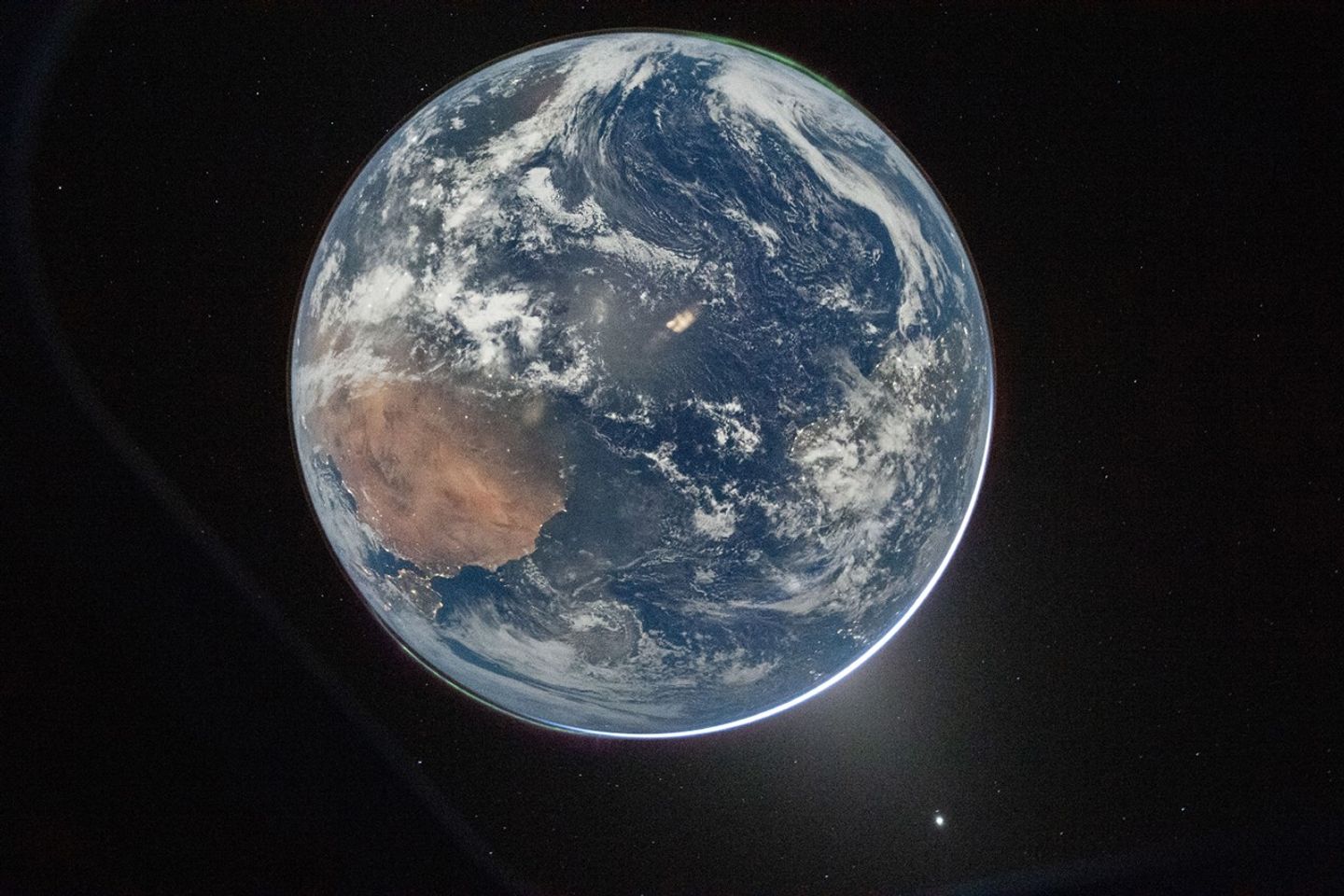
One of the earliest photographs beamed back during NASA’s Artemis II journey toward the Moon offered an arresting twist on a familiar view: Earth appears as a fully rounded world suspended in a busy solar-system scene—yet the planet’s face is not sunlit. From the Orion spacecraft’s position after the mission’s translunar injection burn, the crew was looking at the night side of Earth, illuminated instead by the glow of a full Moon.
That unusual geometry also set up a dramatic eclipse. In the image, Earth blocks the Sun from Orion’s perspective, leaving only a thin rim of sunlight peeking out along the planet’s lower right edge. Around the globe, faint but distinct green curtains of aurora appear near both poles—visible at the lower left for the north and upper right for the south—produced when charged particles from the Sun collide with gases high in Earth’s atmosphere.
The frame contains more than just Earth’s atmospheric glow. A diffuse haze known as zodiacal light spreads near the lower right, created by sunlight scattering off dust distributed through interplanetary space. Observers on the ground can sometimes spot the same phenomenon during certain seasons at dawn or dusk, when it presents as a dim, tapering column rising from the horizon. Data from NASA’s Juno spacecraft, collected during its cruise to Jupiter, point to Mars as a potentially important contributor of the dust grains responsible for that glow.
Another neighbor is also caught in the shot: Venus, shining as the bright point near the bottom right of the image.
Back on Earth’s surface, the nighttime vantage reveals a human signature. Clusters of city lights mark regions of Spain and Portugal and parts of northern Africa (lower left), swaths of sub-Saharan Africa (center left), and sections of Brazil (center right). Capturing those details from deep space required modern digital imaging pushed to its limits. The crew set the camera’s sensitivity to ISO 51,200—far beyond the ISO 100 or 200 settings typical for daylight scenes—using the Moon’s illumination to help bring out subtle features in the dimly lit atmosphere and on the ground.
Night views of Earth from spacecraft have a long history, but this one stands out for combining a full-disk portrait with multiple low-light phenomena in a single, astronaut-made frame. In 1969, Apollo 12 astronauts photographed Earth eclipsing the Sun, an experience later interpreted in paintings by astronaut Alan Bean. Today, astronauts on the International Space Station routinely photograph city lights from low Earth orbit, while NASA’s Black Marble product suite turns satellite measurements into scientific records of nighttime illumination on daily, monthly, and yearly schedules. Those efforts provide sustained monitoring; the Artemis II image is distinctive for offering a one-off, deep-space perspective that gathers many faint signatures at once.
Cindy Evans, a senior exploration scientist in NASA’s Astromaterials Research and Exploration Science Division at Johnson Space Center, was in the mission’s Science Evaluation Room and among the first on Earth to see the photograph. She said the view resonates because it presents Earth “in moonshine” as a member of the solar system—active, shaped by the solar wind, and clearly inhabited.
Miguel Román, deputy director for Atmospheres and Data Systems at NASA’s Goddard Space Flight Center, also emphasized its research value. Román studies artificial light at night as a quantifiable indicator of human activity, and he said the image underscores the span of NASA’s work across both scientific observation and human exploration—while reminding viewers that Earth after dark is both visually striking and physically complex.